
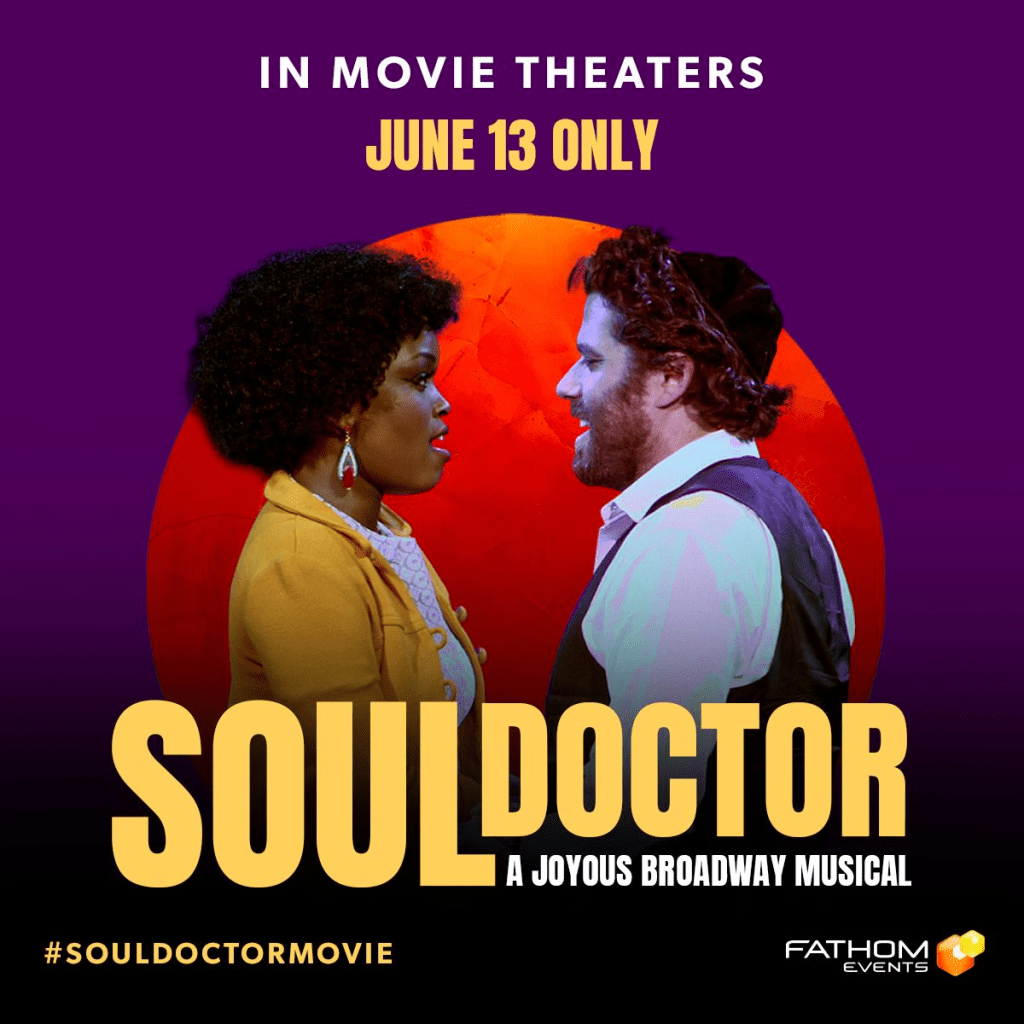
Having the opportunity to come together to celebrate common hopes and aspirations is one of humanity’s greatest joys in life. That simple act of unity, which is rekindling the rich relationship between the Blacks and Jewish communities, is powerfully being shown in the upcoming biographical musical film, ‘Soul Doctor.’
The drama was written and directed by Broadway playwright, Danny Wise. He previously penned the book for, and also helmed, the acclaimed 2013 Broadway musical of the same name, which the movie is based on.
The new screen adaptation of ‘Soul Doctor’ tells the story of the beloved yet controversial father of popular Jewish music, Rabbi Shlomo Carlebach (played Tony Award nominee Josh Young). A modern-day troubadour, Shlomo ignited the spirit of millions around the world with his soul-stirring melodies, transformative storytelling, and boundless love.
After his childhood escape from Nazi Germany, the young Rabbi formed an unlikely friendship with musical icon and pioneer, Nina Simone (portrayed by Nya, star of the Broadway revival of ‘Caroline or Change’). She introduced him to Soul and Gospel music, and a Jewish music and cultural revival was born. Fusing his roots with his new inspiration, Shlomo created a revolutionary musical sound, writing songs which continue to be the main body of Jewish musical standards. The Jewish Gospel/Soul experience he introduced to the synagogue worship remains the most popular of services across all denominations of Jewish practice.
The screen version of ‘Soul Doctor,’ which was shot on location in Jerusalem, opens on the 10th anniversary of its Broadway musical premiere. Simone’s daughter Lisa, who served as an executive producer on the feature, and Fathom Events are partnering to present the special nationwide screenings of the film in more than 1,000 select theaters for one night only, this Tuesday, June 13. (Tickets may be purchased on Fathom Events’ official website and participating theater box offices.
A special introduction to the biopic was shot exclusively for the Fathom audiences by Lisa Simone, along with ‘Call, Clap & Sing Bootcamp,’ during which famed percussion master Bashiri Johnson will teach audience how to Call, Step, Clap, and Sing. ‘Soul Doctor’ concludes with a historical epilogue showing rare footage, bringing to life Simone, Carlebach and other characters, created by filmmaker Nicole Fernandez and Somondoco Films.
Lisa Simone and Wise were joined by Carlebach’s daughter, Dari Carlebach, during a press conference yesterday at New York City’s Bryant Park Hotel to discuss the process of adapting ‘Soul Doctor’ for the screen. The trio also discusses how the kinship between Nina Simone and Rabbi Shlomo Carlebach demonstrates the positive influence people can have on each other when they look past their differences.
Question (Q): The play is based on archival footage and interviews. What was that process like, and did you learn any new facts that you hadn’t heard before?
Danny Wise (DW): The process of doing the research was so exciting as a director because we were looking for his inner conflicts and the turning points in his life. Where ever we turned, especially in the most unexpected places, we heard from people throughout the world who knew Shlomo in his career.
We spent about three years recording and transcribing interviews with people who are students of his. We also did archival research, as well as research through the Red Cross to find records in Europe. Northwestern University also has an extensive archive of the Berkeley Folk (Music) Festival during that time.
So there was a wealth of boxes of undiscovered relationships. They showed how his life intersected with Nina Simone’s life, as well as the power of change during that whole era until today. When we were reading Shlomo’s writing of his own life story, we really discovered the turning point of his transformative relationship with Nina Simone.
Q: Dari, this is your father’s story. What’s it like seeing your dad portrayed on the screen like this?
Dari Carlebach (DC): My father is my greatest teacher because he continuously teaches me that to be true to yourself, you have to follow the calling of your soul, no matter what anyone else believes or thinks or wants of you. His ability to transform the world started in the moment he chose to live outside of the box. To truly live inside your heart and soul, you have to bravely honor that inner voice and break through the confines of what people think we should be.
I think that the true magic of him and Nina is that they both chose to break through and follow the transformation of what it means to touch another person’s life entirely. In that place, we break down the boundaries of love, and that’s what the movie’s really about.
Q: How is the stage production different than the film?
DW: They’re not much different as they’re both a minimalist production. You really don’t feel the divide of $100 million of special effects coming at you; instead, you feel the story that is taking place.
For most of his career, Shlomo really performed from the front of the stage. So we told his story from the theater in the round on Broadway, and it also feels like theater in the round in the film. That way, the audience feels a part of the actual theatrical production. So hopefully the film as close to his performances as possible.
Q: Lisa, how did it feel to watch Nya performing the role of your mother on screen?
Lisa Simone (LS): I thought she was refreshing, and it was really nice. My mom has been dead for about 20 years now; the film marks the 20th anniversary of her death. For me, who’s one of the most biased Nina Simone fans out there…to be able to enjoy everybody’s homage to my mother in a way that’s not biased, and recognize that this is their way of honoring her, is amazing. I continue to enjoy Nya’s portrayal of my mother.
Q: Danny, how many of the original songs written by Dr. Simone and Rabbi Carlebach are in the performance? How difficult was it adding new songs to move the musical along, while keeping in tone with their original works?
DW: Almost all of the music is Shlomo’s melodies and timeless hits. The lyrics were written by our very talented New York musician, David Schechter. He was the original director of the show, as well. We have created new theatrical songs, but they were composed by Shlomo.
There are also several Nina Simone songs. She composed some original songs, and there are also some traditional songs that she created new melodies for herself. But they’re all her songs. Everything Nina Simone did was Nina Simone, so you really feel the musical synergy and how it influenced this Jewish Hasidic gospel, which was so out of nowhere.
So when you’re watching and experiencing ‘Soul Doctor,’ you actually go through a musical journey. You see a cross-section of this journey between these two worlds. When the cosmic forces of these two musical traditions collide, you have this amazing experiences.
Q: With the uptick in anti-Semitic events in recent years, along with attacks on the Black community, what is the significance of releasing the film now?
LS: There’s no better time than the present.Everything happens when it’s supposed to. We’re here for a reason…Our community and world is more ready. It’s being born in a matter that’s shining a light on it on a platform that cannot be ignored.
I think ‘Soul Doctor’ is going to spread (across the country), and it’s overdue. Since the time to release the film is now, the strength, courage and fearlessness of these two individuals, and the impact that they’ve had and continue to have, will remain timeless. That will remain as powerful in future generations as it is now.
DC: My father used to say, “If I had two hearts, I could hit with one heart and love with the other heart. But I only have one heart, so I choose to love.” We’re in an unprecedented time, which reflects another thing he used to say: “There’s nothing more whole than a broken heart.”
Our hearts have been broken over and over again. But we’re now in a place in our history that all we can do now is rise up in song and rebuild those broken hearts with harmony…Our job in this generation is to create the most infinite amount of harmony within ourselves amongst our communities and all of humankind. This story allows us to create harmonies in unexpected ways that uplift us and allows us to see a whole new way of the world.
Q: Dari, how does it feel to see your father’s message conveyed in this movie?
DC: It’s nothing but pride. My father was born in (Germany several years before, and grew up during,) the Holocaust, and was part of a dynasty of rabbis. But he raised with a huge openness for all religions. He used to talk about how in his house, his father used to have bishops, priests and leaders of all possible religions come in and come together.
He was told from when the was three-years-old that he was going to be a rabbi. At one point, he took his yarmulke and his twin brother cried because it meant that he wasn’t going to be a rabbi. He felt bad for this brother so he put it back on and said, “Okay, I’ll be a rabbi.”
Every choice he made reflects his big heart and kindness. I believe his soul came back into the Earth to bring back the joy and passion that was lost during the Holocaust.
When I watch him and see that he had this never-ending heart, I feel we need to follow that and bring the loss and trauma into prayer. That inspires me to want to do the same in my life.
Q: Danny, Fathom Events is known for creating top-notch special events and screenings. The film will play for one day – this Tuesday, June 13, in over 600 theaters across the U.S., courtesy of Fathom Events. How did you know you wanted this film to be presented that way instead of a more traditional national roll-out?
DW: Fathom is a very unique phenomenon; to me, it’s the great cultural federation of America. I’m learning this every day that Fathom is a content creator of high culture and individual culture to very different faith-based and micro communities all throughout our country, as well as 45 other countries. They’re so very involved in creating content for the micro communities. I encourage people to look into Fathom and the outreach that they do.
It’s one of the last organizations in America that has that kind of vision, and can bring people to the movie theater. It looks at the movie theater the way they’re supposed to be used for – they’re community centers, and where we once saw the news reels.
Shlomo and Nina traveled the world to where ever the people were, and they’re still doing that with this film…They set out to connect with the world, and they’re still doing that, too…The message of ‘Soul Doctor’ is so needed on this Juneteenth this year.
 Film Factual