
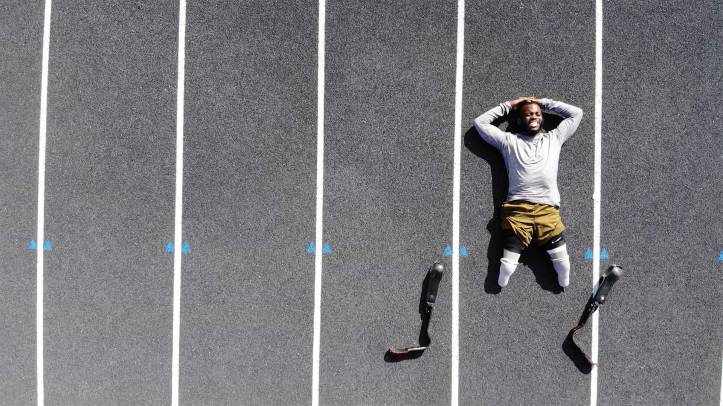
The most adept, capable leaders in any given fields aren’t always the ones who fit into the specific characteristics that the media and public have long crafted for them. Medal-winning Paralympian sprinter, Blake Leeper is one such trailblazer who has determinedly overcome the deliberate biases that disabled athletes have long faced as he set out to compete against the able-bodied throughout his career. The acclaimed athlete’s struggle to overcome the bias used to bar him from cross competitions is chronicled in the new documentary, ‘Abled: The Blake Leeper Story.’
The project marks the feature film directorial debut of editor-producer, Einar Thorsteinsson, who serves as a partner at commercial post-production company, Union Editorial. The filmmaker not only helmed the project, but also edited and collaborated with fellow producers Katherine LeBlond and his son, Anton, to shoot and put the final version of the project together.
‘Abled’ introduces audiences to Leeper, who’s also a world record holder in the 400m. Born with both legs missing below the knee, he embraced sports from a young age, playing baseball and basketball. He ultimately chose to participate in competitive running in his late teens.
The athlete quickly became a major competitor in the 100m, 200m and 400m sprints, earning a silver and bronze medal at the 2012 London Paralympics. After a non-performance drug suspension halted his dream for the 2016 Rio games, Leeper announced his intention to compete at the 2020 Tokyo Olympics against able-bodied runners.
But despite the one-time precedent set by fellow blade runner Oscar Pistorius at the 2012 Olympics, World Athletics, the sport’s governing body, claims Leeper’s blades give him an advantage over non-disabled runners – a misconception that still persists, particularly among the uninformed public. Using candid interviews, incisive reporting and rigorous scientific testing, the movie reveals the deliberate biases faced by disabled athletes who want to compete against the able-bodied, and the dubious science and deceptive publicity used to bar them from cross competitions.
‘Abled’is having its L.A. Premiere this Saturday, July 1 at 12:30pm PT at the TCL Chinese Theatres in Hollywood as part of Dances With Films: L.A. The movie is screening as part of the festival’s Docs section. To help promote the feature’s screening at Dances With Films, Anton and LaBlond generously took the time last week to talk about producing, shooting and editing the project during an exclusive interview over Zoom.
Film Factual: What interested you both in making a documentary about Blake Leeper? How did production on ‘Abled: The Blake Leeper Story’ begin?
Anton Thorsteinsson (AT): It started out pretty naturally. The director is friends with Blake’s trainer, so that’s how he initially met Blake. It was a pretty quick meeting after that.
The director, Einar, was looking for a new project to work on that would stretch his creativity. He found out that his friend was training Blake, who has this incredible story that we feel like needed to be told. So we had a quick meeting.
Blake was just great to work with; he was so accepting, humble and open. He understood the process that we wanted to undertake. I think it took about half-an-hour, and we started the process.
FF: Speaking about the fact that Einar Thorsteinsson serves as the movie’s director, what were your experiences like collaborating with him throughout the production?
AT: Einar is actually my father, and this is actually the first time that we ever worked on anything together. So that was another interesting path that I had never been on. It was really fun to work with my dad.
I think us working together made it special, in a way. Our crew was small and intimate, so I think that helped Blake feel comfortable around us.
Katherine LaBlond (KL): Anton served multiple roles on this crew, so he was with Blake both in production, sometimes shooting with him, and other times trying to race him on the track. Anton also edited the film alongside his dad as an assistant editor. So he’s really been a part of the project from its inception all the way through to its completion.
FF: Katherine, you served as one of the producers on ‘Abled.’ How did you approach your producing duties throughout the documentary’s production?
KL: Einar is a career commercial editor. He’s a partner at a company called Union Editorial, which is where I work and where Anton occasionally works. We support Einar day-to-day as not only a partner at that company, but also as an editor who famously cuts car commercials; he does all the sleekest car commercials you see on TV. For him, that’s his joy, but he also wanted to have some more creative flow in tackling something else.
Feature docs can now be shot by the everyman nowadays, thanks to technology. However, you still run into the big, bad world when you leave the safety of your own office.
So these guys went in everywhere they could and shot however they could on the sidelines. They did handshake deals with whoever they could to get access.
Then I came on just to support the production in the last couple of years as they started to capture enough footage to get a rough cut. Then what I have done with them is try to produce in reverse; I would go back and get some of the necessary paperwork, and make sure we were allowed to use all of our licensing footage and all of the other boring stuff that wasn’t the glamorous part of filmmaking. But the production on this film has really been an interesting one; it was truly a gorilla shoot, and everyone helped pick up the pieces whenever we needed them.
FF: Speaking of the licensing and overall archive footage, how did you decide what clips and images you wanted to include in the film?
AT: We were really lucky to over 30 hours of archive footage, which included home videos, from before Blake was born, throughout his entire childhood, up until him getting his first blades. There was so much good stuff in there that we probably could have just made a movie with home videos.
But we tried to keep the best parts in there, including the parts that showed what Blake’s childhood and family were like. We also showed what the town he grew up in was like.
Besides the archival footage, it was a joy trying to shoot Blake because there was a challenge in trying to capture him on film. He’s a really fast guy, so if you’re just standing on the side of the track, you just get about two seconds of footage.
So we were trying to think of creative ways to capture him running. So a lot of it is me on a skateboard next to him, trying to keep pace with him. A lot of it was also us running next to him with stabilizers. We also used drones.
So it was a lot of fun trying to capture his athletic abilities in a cinematic way. I think that was the most fun part of the project for me.
FF: Once all of the footage was captured, what was the experience like collaborating with Einar to put the final version of the movie together?
KL: The film ended up being about 88 minutes, and there were about 290 hours shot of Blake. Of course, that’s always the case with documentaries; you shoot way more than you need.
But Blake is such a charismatic guy that there were often times when the cameras would already be packed up. Then something crazy would happen, so the team would have to pull the cameras back out again, as they couldn’t miss that moment that was totally unplanned.
AT: I would say that the editing process required the heaviest lifting. Luckily, Einar was able to start looking at all of the footage once he finished shooting. So I would put the footage onto a hard drive and give him everything. Then he would start pulling the footage that he wanted.
That was our process for the approximate four years we were shooting. We would have a couple of days, go back and sort it out in the editing room. The challenge was when we were done, we had to find what was missing. If we could go out and get a version of something that we were missing, we would.
There were many times when I thought the cut was done. Then a year later, I was happy that that wasn’t the version that we stayed with. There were many final versions that I thought were final, but then we ended up changing later on because we really needed to find a way to make the story more cohesive and a little bit more of a structure.
So there were definitely a lot of things that we had to go out and find after we put everything in the timeline. There were holes, so we needed to find something that represented this and that, and then we were able to flow through.
KL: We tried very hard to tell his story fairly, too. Whenever you’re working on a documentary, especially when it’s about one person, it can be very slanted. So we tried our best to get outside perspective, so that we could tell Blake’s story and the other parties’ stories without giving anything away.
We, like many of the films that are debuting this year suffered from pandemic slowdowns. In a lot of ways, it never really stopped us, though, because Blake never really stops.
But in a lot of ways it did because it prevented us from attending a lot of events he was trying to qualify for, which were postponed or cancelled altogether, and we had to wait longer for certain people to get back to us. So the journey got a lot longer. But I think in the end, we’re all very grateful because it gave us more time to reconsider the story and find the best version of it that we could come up with.
FF: Speaking about how certain events were delayed or cancelled because of COVID, how did the delay of the 2020 Tokyo Olympics, which Blake was determined to qualify for with the USA Team inspire the storytelling that’s featured in ‘Abled?’
AT: When we set out to make the film, we started off imagining that Blake’s ultimate goal was to qualify for the Olympics in Tokyo in 2020. He looked on pace to be challenging to do that, without giving too much away.
Then when COVID happened, the Olympics were pushed back, and that started a whole draw-out process of litigation and legal stuff. That was the beginning of us considering that Tokyo might not be the end of the movie, and we might have to reconsider how we wanted to finish the movie.
So the lockdown, events being cancelled and that whole year in general, really changed what we were envisioning the movie was going to be. So that’s why the end works out differently than what we initially imaged and set out to make.
FF: The feature is having its L.A. premiere at Dances With Films (this) Saturday, July 1. What does it mean to both of you that you’ll be sharing the documentary with audiences at the festival?
AT: It means a lot to me. I grew up in L.A., and have lived here my whole life. The Chinese Theatre is an amazing, historic theater. I never would have imagined that our documentary would be playing at the Chinese Theatre. So it’s going to be a great experience for me and my family and friends. I know a lot of the other crew also live in and around L.A., so it should be a pretty big celebration, and I’m looking forward to it.
KL: Yes, we’re really excited. We premiered the film at the Seattle Film Festival back in May, and we had two screenings there. Blake was able to go to one of those two screenings.
Simultaneously to his first documentary coming out, he’s been training with the Paralympics to compete again this year. He qualified to go to the World Championships. So he’s actually going to be in Paris when we premiere the film here at Dances With Films. Luckily, he’ll be able to Zoom in so that he can still participate. He’s really bummed to miss the screening here, but what an exciting life goal to get to achieve – he’s both participating in the World Championships and premiering a movie at the same time! It’s pretty great!
 Film Factual