
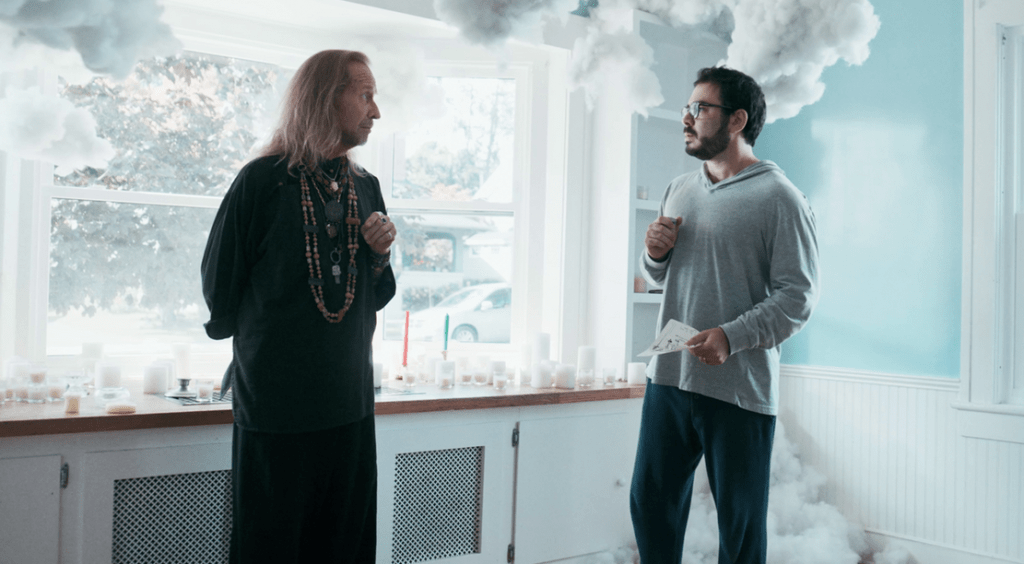
Finding a cathartic way to distraction themselves from their loss and embrace a renewed sense of purpose during a time of debilitating grief was a powerful journey for both the protagonist and filmmakers of the new fantasy comedy-drama, ‘The Secret Art of Human Flight.’ Actor-producer Grant Rosenmeyer not only led the main character, Ben, down a path of self-discovery filled with melancholy and poignancy following the death of his wife, but also his fellow filmmakers as they shot the movie during COVID-19.
The comedy-drama was written by Jesse Orenshein. Once the screenplay was completed, H.P. Mendoza stepped in to direct, compose and edit the movie.
‘The Secret Art of Human Flight’ is set after the sudden and tragic loss of Ben’s wife and fellow children’s book author, Sarah (Reina Hardesty). In an effort to help himself contend with his sadness, he turns to a mysterious self-help book he finds on the dark web that promises to train him to learn how to fly. Or at least he hopes, as he turns his life upside down under the advisement of the book’s eccentric spiritual guide Mealworm (Paul Raci), who may be a con artist. Fending off his worried sister Gloria (Lucy DeVito) and the ambitious Detective Reyes (Rosa Arredondo), who’s convinced he killed his wife, Ben risks it all to fly in an effort to get through his grief.
‘The Secret Art of Human Flight’ had its World Premiere in the U.S. Narrative Competition of this year’s Tribeca Festival. Mendoza and Rosenmeyer generously took the time to talk about starring in, helming and producing the film several days after its initial screening at the festival during an exclusive interview over Zoom.
Film Factual (FF): Grant, you play Ben in the new fantasy comedy-drama, ‘The Secret Art of Human Flight.’ What was it about the character, as well as the overall script, that convinced you to take on the role?
Grant Rosenmeyer (GR): The script came to me during the beginning of COVID. It really resonated with me on an emotional level because of the themes of loss and grief, as well as the feeling of destabilization. That was something I thought a lot of people could relate to.
It was also a beautiful, metaphorical story, and it reminded me of a live-action version of ‘Up.’ So I just loved it.
I then had the idea for the perfect director for it, who’s sitting to my left. (Rosenmeyer and Mendoza laugh.)
H.P. Mendoza (HPM): Yes, he came to me with the script. It’s funny; while he had films like ‘Up’ in his head that he felt this movie was similar to, I had films like (Steven) Spielberg’s ‘Always’ and Richard Donner’s ‘Radio Flyer,’ which are grounded but all culminating in flight. The ‘80s and ‘90s were all about these dark but magical movies about flight.
So I thought, this is the chance to make something like one of those bigger movies. But we can do whatever we could to make it feel big, no matter how much money we have.
But it was also a little bit scary because everything I’ve directed before this movie I’ve also written; this is the first time I directed something that I also didn’t write. I think what that gave me was the chance to like the script, if that makes sense.
When you’re a writer-director, you have this double anxiety; when you think you’re doing a good job directing a scene, you’re like, “I’m going to pat myself on the back for making that happen.” But you also question, “Is the writing good?”
But with this film, we already said this is a script worth doing beforehand. I wasn’t just some punk kid with a script that I loved and made a bunch of my friends also work on it because they love me. This was something in which Grant assembled a bunch of people who all had the same goal – to make the movie be the best movie possible.
FF: H.P., speaking of the fact that you directed the movie, how did you approach your helming duties on set once the production began?
HPM: I’ll expand on what I just mentioned. One of the beautiful things about working on a script you didn’t write is you’re not treating it like a blueprint; you’re treating it like a piece of literature. You think, let’s do it right and let’s do it good so we can service it.
But since we were getting together in the middle of the pandemic, all of us were experiencing our own versions of loss. I had lost two dear friends, and while on set, my father, to COVID. So I was able to share that with our prop master, Kyle Wallace, for instance, who also lost his father. With every meeting on set, everyone looked at each other and paused and said, “You lost someone, too.”
So we said, “With every step that we take, let’s do the script right. Let’s pay it the proper service and do it with authenticity.”
When we were working on the script, Grant was great. He’s a machine; he will give you exactly what you want or exactly what the page says. I think what’s great about that is with someone like Grant, who’s already at a 10, he can either push it to a 20, or give you something completely different.
I had already seen Grant in previous films like ‘Come As You Are.’ The one thing I thought was, I want to see him play someone I’ve never seen him play before. I think he did a pretty good job! (Rosenmeyer andMendoza laugh.)
FF: Grant, besides starring in ‘The Secret Art of Human Flight,’ you also served as one of the producers. Why did you also decide to produce the film? How did you balancing your acting and producing duties throughout the production?
GR: If this movie had just come to me as an actor, it would have been a gift. But the fact that I also got to have a voice in the process, let alone one that was really respected, was amazing. The whole process was extremely creative and rewarding every step of the way.
If you join a production as a producer early enough, like I did with this film, you’re able to take a piece of literature – I like that word – and build on it. You start communicating your ideas and what you see to your fellow collaborators. You then stop talking and start listening and receiving other ideas from a wildly imaginative director and experienced producers who have their own resources and innovative ideas.
Then you bring on an amazing cinematographer, like Markus Mentzer. He’s one of the most versatile innovators and operators I’ve ever seen. Then I was going to go down the list to editor and composer, but that’s you. (Rosenmeyer turns to Mendoza, who laughs.)
Then there’s also our production designer, Charlie Textor, who comes with his whole book of ideas. He was making Pinterest boards of these incredible cloud rooms. Everything he sent us was amazing.
I equate producing to throwing a party; you tell people what it is, when it is, where it’s going to be and why. Then you just sort of sit back and watch as the guests as they start showing up and become the life of the party.
As an actor, I’ve been doing this for 23 years. So now as a producer, to be able to walk into something that you’ve said, “Here’s the who, what, where, when, why and how,” you guys figure it out, and see that they did figure it out, is tremendously fun.
But it is also very stressful because there is a lot of responsibility. There is also money at stake, even if it’s not a lot of money, so there is still pressure there. But ultimately if you can look at it like, this is an adventure, then you’re in good shape.
FF: Besides you, Grant, the comedy-drama also stars Paul Raci, Maggie Grace, Lucy DeVito, Nican Robinson, Reina Hardesty, and Sendhil Ramamurthy. What was the casting process like for the supporting cast?
GR: Once I decided to play the role of Ben, it was just asking the question of who wants to play with me? As a producer and an actor, that’s a very scary thing to put out there because you don’t want to hear no. But with this film, it was such a beautifully surprising thing to find out that people did want to come play with me.
We talked about H.P.’s vision of Mealworm and several of the other characters. I sort of imagined sort of a Jeff Goldblum-type for Mealworm. Then H.P. said that this sort of needs to feel like a home invasion, so it needs to be a bit scarier than that.
We had just both seen ‘Sound of Metal,’ and Paul Raci’s in that film, as well. He’s such a dynamic actor. But he’s also a little enigmatic because we haven’t seen him in that much. So audiences don’t have movie star baggage with him. He brought a level of danger to it.
So he was the first person we offered the part to, and then he said yes. That made the whole process go much faster.
From there, casting my (character’s) sister was a very tricky thing. (Rosenmeyer turns to Mendoza.) Would you say that she has to be sensitive and sympathetic, but also have great comedic timing? (Mendoza nods in agreement.)
Maggie Grace, who plays Wendy, wasn’t old enough to play the widow character who we originally had in our minds. But she had such a gravitas that we wanted to cast her. Which would you use to describe it? (Rosenmeyer turns to Mendoza.)
HPM: I was never really able to encapsulate it in a word; it was more of an ethos that I had about this character. It might sound like I’m stereotyping when it comes to people of an older age, but I am older. But I thought Wendy should be older.
But it wasn’t completely about age for her…we developed Wendy to be not only supportive of Ben through her experiences, but also a fully developed character. So the scene in which he shows up at her house doesn’t come out of nowhere. We thought, we’re going to see her again later on, and see her home life, and wanted to make sure she, as well as the rest of the characters, stayed grounded.
FF: Once the rest of the actors were cast, how did you work with them to build your characters together?
HPM: All of the actors showed up one-by-one as we were building our camp, as we had to be a COVID bubble with COVID officers. Like I said, we shot during the pandemic, so we were still masking, and there was still a lot of fear.
So as people showed up one-by-one, we started to build the culture. As they showed up, they realized that they had to wear multiple hats in order to get things done, and not just in making the movie; I’m also talking about even just getting food.
For me, when Paul showed up, there was something really interesting there. To be honest, I thought to myself, wow, this is the first time that I’m directing Hollywood people, so what’s it going to be like? Here I am, this indie kid, barking orders at him.
Every time I gave him directions, during which I talked to him like a therapist and would say it’s not about him doing something wrong, but me trying something new, he’d say, “I got it.” Then he’d turn around and do it. By the fourth time he’d say, “I like that too.” Then he turned back around and said, “You’re an actor’s director,” and that was day one. So then I had the confidence to keep on going.
From that point on, we all realized that we had a responsibility to each other. There was a moment we were filming on a mountain, and it didn’t have anything to do with the scene, but we all just hugged each other and cried…I then said, “Action!” (Mendoza laughs.)
GR: There were not only so many talented actors on this movie, but also thoroughly decent people. We lucked out, but we also did our research in that. When you’re casting a movie, you’re not just casting the characters, you’re also casting the people who you’re going to be working, and in our case, living with.
It’s not like we were able to send everyone to their respective homes at the end of every day. We really had to be a family and live together.
There was a general humility to everyone on set and back at the camp that we were staying at. Everyone was there to help and to be of service to each other and the story. I’ve never seen that before to this level, where everyone was so selfless and giving.
Everyone pitched in to wash the dishes, and Ben Wiessner, our producer, would do the cooking. Once dinner was done, someone would make the fire, and you’d see the camera operator sitting next to the prop master who was sitting next to Paul.
Everyone was just talking, even though they come from a different background with different perspectives. But that didn’t matter because everyone was so happy to be there, making movies again, for the first time in over a year.
HPM: That’s true. There were a few actors who said on take one, “Sorry about that. I’m a little rusty. This pandemic has affected me.” I get it.
GR: Yes, sometimes an actor gets a tough day.
FF: ‘The Secret Art of Human Flight’ had its World Premiere at this year’s Tribeca Festival. What does it mean to you both that the film premiered at the festival?
HPM: I’m going to start by saying that I never think of myself as someone who wins things, so this is all surreal. I’ve never been on this side of the velvet rope when it comes to festivals like this. I’m from San Francisco, and I generally always premiere my films there at my local festivals. They’re usually identity-based, like the queer and Asian-American film festivals.
Now here I am at Tribeca with this film. Here I’m like thinking, wow, is this what it feels like to play at such a festival?
Thank you to everyone who’s involved in the festival for choosing to premiere my film. It feels like I’m finally taking the next step.
But at the same time, I realized that I’m glad that this is happening to me now. Had it happened to me any earlier in my career, I don’t know if I would have been ready. So I’m happy it’s happening now. What about you? (Mendoza turns to Rosenmeyer.)
GR: I made ‘Come As You Are’ with his best friend, Richard Wong, and it came out a few years ago. That was the last time I had a film on the festival circuit. Every movie is a different beast. That one was a really fun crowd-pleaser, and was a road trip comedy that was heartfelt and heartwarming.
I would also use some of those attributes to describe ‘The Secret Art of Human Flight.’ But this one really makes you think more, and it’s not as straight-forward. I think H.P. and this collective team did what we set out to accomplish, which was to make something that people hadn’t seen before. We also wanted people to feel an emotional cocktail that they’re not used to digesting.
What’s’ cool about having these screenings and Q&As is to hear and feel how the audience reacts. I can tell that people have been affected, but it’s a bit more introspective. It’s taken people a moment to process the film.
I’ve gotten a lot of texts and notifications on social media from people saying, “This movie has really worked for me. I can’t stop thinking about it.” That is so valid and valuable…We’re starting to get that first feedback, and it’s nerve-racking, but it’s so fun.
We’re so grateful to Tribeca that they have put on such a great program here with other great filmmakers. It’s great to hear what they think about the film, and to experience not only our film, but also the entire festival, with them. It’s been really fun.
 Film Factual