
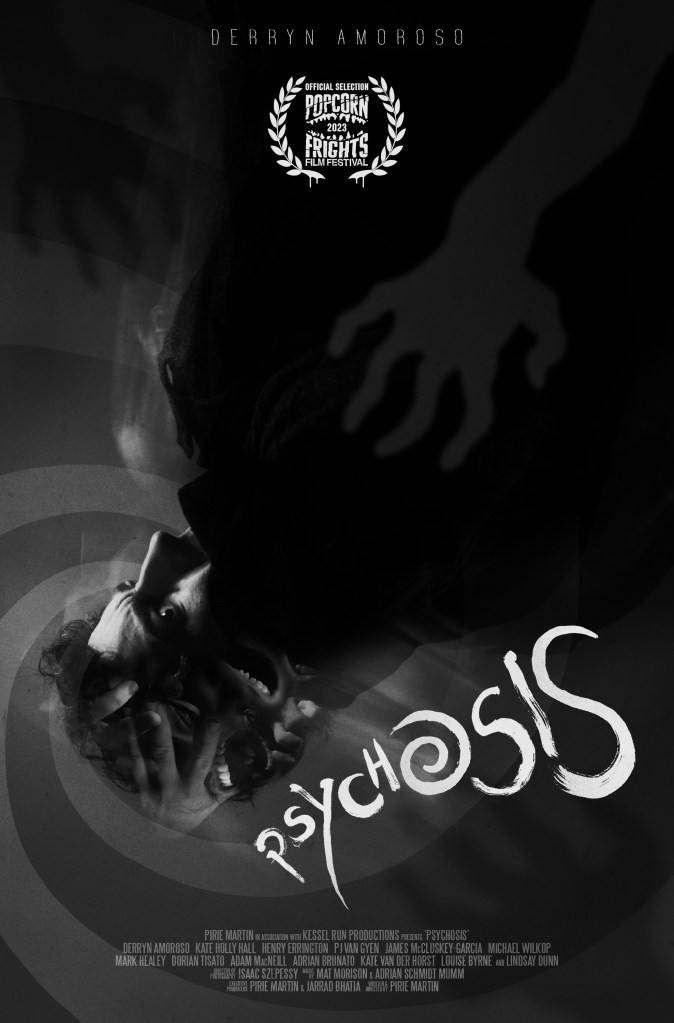
The most intriguing genre films often force the protagonists – and the viewers – to relive their traumatic pasts that they thought they escaped. The new audacious Australian horror thriller, ‘Psychosis,’ does just that through stylishly gloomy, high-contrast black-and-white cinematography and a dramatically gripping plotline.
The neo-noir movie was written, produced and edited by Pirie Martin, who made his feature film directorial debut on the project. ‘Psychosis’ stars Derryn Amoroso, Pj van Gyen, James McCluskey-Garcia, Kate Holly Hall, Henry Errington and Michael Wilkop. The drama had its World Premiere on Saturday, August 12
‘Psychosis’ follows criminal fixer Cliff Van Aarle (Amoroso) as his unique psychological condition gives him an edge in the criminal underworld. But when he’s hired by two amateur drug dealers claiming they were attacked by zombies, Cliff is dragged into a terrifying and bizarre mystery that will test him to his limits.
Amid a cacophony of hallucinatory voices guiding him from his subconscious, Cliff searches for answers along a hauntingly familiar path of death and psychological torture. The case gets stranger still with the arrival of a delusional vigilante, LoneWolf (van Gyen), and the revelation that the mastermind behind it all may be more monster than man.
The situation is a surreal conspiracy of mind control, psychedelic drugs and a criminal underbelly terrified of the enigmatic drug lord Joubini (McCluskey-Garcia), who uses hypnosis with lethal effect. Cliff may be the only one equipped to bring him down, but only if his mind survives the trip.
Martin generously took the time during the week of ‘Psychosis’ World Premiere at Popcorn Frights to talk about scribing, helming and producing the feature. Among other things, the filmmaker discussed that he was in part driven to pen and direct the thriller because he’s a fan of film noir and detective stories, and wanted to interweave those components with elements of psychology that he had researched for his own interest. He also mentioned that he enjoyed working with the cast, especially Amoroso, and the crew to create the visuals and sound design for the movie.
Film Factual (FF): You wrote the script for the new neo-noir horror thriller, ‘Psychosis.’ What influenced you to scribe the screenplay for the movie?
Pirie Martin (PM): I started off as a big fan of film noir and detective stories, so I wanted to write one. I had about five or six ideas in my head that were all at various stages of development, and in various stages of not being very good.
I was also doing a bit of research into psychology for my own interest. I came across not specifically any one condition, but auditory hallucinations in general in a broader sense. I discovered that some people have a voice that narrates their life almost full time. Some of them can be specific people, or it can be their own voice, or a voice that’s familiar to them.
So it was very interesting to learn about while I was doing the research. The voice may not be aggressive or something that you associate with bad mental health.
That immediately reminded me of film noir narration, and the gritty kind of detective story where you have the voice over the whole time. So I thought it would be really fun to do a detective story where the narrator is just another character in the main character’s head, but no one else can hear it.
That got me really excited. So I started reading a little bit more about paracusia, and it sent me down a rabbit hole. I became really interested in all of this stuff.
It brought together all of these different ideas that I had that weren’t working on their own. I had one idea about hypnosis, and another idea about gritty underworld drug dealers. Then suddenly I could combine them all, including psychedelic drugs, hypnosis and people who have these auditory hallucinations.
So it became this crazy mix of different ideas that I really liked. They all kind of overlapped really neat in a way that I thought, I have to do it now. So it all kind of snowballed from there, and I got really excited about it.
FF: In addition to penning the script for the drama, you also made your feature film directorial debut on the project. How did writing the screenplay influence your helming style throughout the production? How would you describe your overall directorial approach during the production?
PM: I approached this like I would anything else, but it was a little bit challenging. The script couldn’t include all of the voices that I wanted to include because then it would have been 500 pages with lots of disjointed words and people talking over one another.
So I kind of wrote the script just for me, in a way. I made a note of what I might need. There was the character dialogue and the narrator, and maybe a few hints of where the voices would turn up. From there, we did our best to put them all together.
Derryn Amoroso, our lead actor, did a great job keeping track of all of this with very little information. He went online to find simulations of what it would be like to have auditory hallucinations.
I also gave him a bit of a sense of what it might be like, and told him: “This is kind of what’s going on with this guy. If you can react to it on set, and give some kind of indication that all of these voices are going on, that would be great.”
But there was nothing for any of these guys to really react to on set. So it was a bit challenging for everyone on board to get what we were doing, since they couldn’t hear anything. We had one person on set who would read the lines really plainly when the narrator talks, just for timing.
So everyone was like, “We have no idea what this film is going to look like.” Obviously, the film’s cinematographer, Isaac Szepessy, and I knew what the film would look like with the 1:1 aspect ratio and in black and white.
But most people who were working on the film would get to a point where they were like, “Hang on, what is this going to look like?” Some of the gaffers and the extras who would come on set for a few days were like, “So everything’s going to be crammed?”
So it was very difficult making sure that everyone knew exactly what I was imagining. It really took awhile for everything to come together because people really needed to see it and hear the voices in their place. That was one of the bigger challenges for me.
But I’ve worked with a lot of these actors before, and a lot of the new actors we brought on were really amazing and easy to work with. Derryn was incredible, and I didn’t really have to give him much. He’d go off and change the script, and I wouldn’t even know it. But he’d just make it better. So that was really nice.
But the real challenge was making sure when things were happening on set, we’d reassure ourselves and everyone else that we were going to fill all the silences with interesting stuff and that it would work.
FF: ‘Psychosis’ features hypnotic action sequences. How did you approach working with the actors to create their characters’ physicalities?
PM: It was fun. We approached it the same way that we always approach filmmaking here in Adelaide; it’s always a little smaller scale. We had a very small crew, and a lot of the actors hadn’t had a lot of on-set experience. We were lucky that we had a great armorer who came on board who helped with a lot of the weapons stuff. Throughout the process, we also had a few people who had some stunt experience, and they made sure that everything was safe.
But we shot everything very carefully. You can get away with the kind of framing that we had, especially with fight scenes that were flipped upside down. You have to make sure it remains coherent, so none of the stuff got really crazy.
Also, we did all the costumes ourselves. I have a background in art, and my mom’s a seamstress, so she helped out with the costumes. That was a lot of fun, and I had fun making all the masks.
I also brought on a friend of mine who’s a surrealist artist. He designed some of the masks, based on a few different sources that we found. So all of that was really good. We had a close-knit group who worked on that side of the film, which was really good.
FF: You mentioned the drama’s cinematographer, Isaac Szepessy, earlier. Like you said, ‘Psychosis’ features grainy high-contrast black-and-white photography and arresting visuals. How did you work with Isaac to decide how you would visually shoot and frame the film?
PM: That was really interesting because we didn’t have a lot of references to go by. A lot of films shoot very central frame. Like a lot of West Anderson films, we said it’s possible to do coverage that’s dead center and flipping back and forth. But there wasn’t a lot to go on with the harsh crop we have in our film.
So what we did was have our monitor sit on top of the camera and tape it off, so that we couldn’t see what was going on outside of the frame. After a couple of shooting days, we got used to it.
But we had to do a couple of tests early on. We had to test how jarring it would be if we panned too quickly on the horizontal latitude. Even our widest lens became almost like a close-up lens half the time. So almost half the film is almost a close-up. So a lot of that stuff was test earlier.
We put together some of the little mock fight scenes to make sure that people would still be able to follow what was happening if they’re really locked in. So it was tricky not really seeing anyone else really have done that, but we made it up as we went. I also tried to pick some locations that were nice contained environments that we could shoot cropped in.
FF: Like you also mentioned earlier, ‘Psychosis’ follows a criminal fixer who experiences auditory hallucinations must confront old demons when a new contract drags him into a surreal maelstrom of mind-altering drugs, delusional vigilantes, and a sadistic hypnotist who seems more monster than man. How did you create the soundtrack and score for the thriller?
PM: I had a pretty clear idea in my head from the beginning what I wanted it to sound like. I had access to these simulations of auditory hallucinations, which were very helpful. They gave a bit of a benchmark of how far I could go, and how many voices we could have going at once.
But obviously, you still want people to understand what’s happening. There are a few scenes in the film where the voices completely take over. There are characters talking, but you can’t hear what they’re saying. You also can’t hear what some of the voices are saying.
There are a few sequences in the film that I feel that if you watch a few times, you start picking up some more bits and pieces of what they’re saying. I left a few Easter eggs in there.
I had a bit of an idea going in that I would need to leave spaces open. I knew we needed to shoot enough that I could extend or compress it if I needed to.
Then we crossed our fingers and hoped that it would work for nine months. I didn’t write or record the voice dialogue until we shot the whole film. We then went back and filled it all in. I could then look at the timing and how much timing for the important things you’re supposed to hear, and how much we would need to record. I think we ended up recording about eight hours of dialogue that I had to layer up.
For the music, I went and got a lot of temp stuff. I then found some music I thought might suit, and filled the film with these ambient tracks. I then kept adding and taking away.
I took that to the composers, who did an amazing job translating that into something that would suit the film. They gave all of the characters their own unique sounds…The music helps you along and helps you keep track of where you are, as it replays something that you’ve heard before.
Then with the voices, if they became too much, I would pull back a little bit. I would take voices out in certain places and replace them with other voices, and assigned them to all the surround sound speakers that surround the audiences.
It was a very finnicky process, but it was also good because we had a lot of flexibility with it. If something wasn’t working, I could change things around. I could also ask the actors to come back in and record two or three other lines if we needed to and change things up. If something wasn’t clear enough or something wasn’t pronounced, we could change things. We had a lot of iterations.
FF: Besides writing and directing the movie, you also served as one of the producers. Why did you also decide to produce the drama? How did you balance your helming and producing duties throughout the shoot?
PM: It was very challenging. Again, Adelaide has a very big culture of independent filmmaking doing things themselves, so I was brought up doing multiple jobs. I have background in a lot of different areas, so I have a bit of experience, and I’m a bit of a control freak at times.
The producing was not too bad because of the way that we had to structure a lot of the shoot. Many of the actors had full-time jobs and weren’t able to take a lot of time off. So we weren’t shooting non-stop in a really constricted four-week block.
So I had more time to produce the upcoming shoot and have it all ready to go. I could then delegate it off to my Assistant Director, or someone else on set could help out answering a phone call if they needed to, so that I could direct, in theory.
But a lot of times it would become chaotic because people would get sick and couldn’t come along, or other stuff would come up. One of our actors broke their leg in a motorbike accident, and they really destroyed their leg, which set he film back about eight months.
So I had plenty of time to get my head around everything. I think if I had been doing this six days a week, I wouldn’t have been able to handle it. But we structured it in a way that gave us more time and freedom.
I got so excited about it that I went ahead and did everything. I wrote the script without really consulting anyone if it really was achievable. (Martin laughs.)
Then we got it going, and I kept showing people things. I was doing a lot of the design work already, so it all just came together like that.
But the crew was really good. Everyone was doing their jobs to a really high standard, so I didn’t have to micromanage people too much.
FF: ‘Psychosis’ (had) its World Premiere at this year’s Popcorn Frights Film Festival. What does it mean to you that the thriller (screened) at the festival?
PM: I (was) really excited to show it. It’s been such a long process, and it’s such a bizarre film. So I’m really keen to hear what people think about it.
It’s a little bit tricky being stuck in Adelaide, while the festival (was) in the other side of the world (in Florida), and we (had) the time zone difference to deal with. So I’ll wake up in the morning and have emails, and then have to wait a day to send everything back.
But the festival has been really great and supportive, and we have had really good communication. I (was) really excited to see how things go. During the build-up, there (wasn’t) a lot happening on my end, because I (was) waiting for it to come along.
But it (was) really cool seeing all the updates about all the other films, too; there (were) a lot of other really cool films that I (was) mixed in with. There (were) a lot of other Australian films, as well, which (was) really nice; there was a woman who’s also from Adelaide, as well as a couple of guys from Sydney, which is cool.
It (was) nice that there (were) a lot of Australian films breaking out into the world all at once. (Martin laughs.) We had a similar thing last year, were a lot of films from Adelaide went to Sundance and SXSW. So it was really nice to see the Adelaide film scene represented. Hopefully everyone enjoys the film!
**Note: ‘Psychosis’ is next set to play during the Paracinema Cult Film Festival at the Quad Cinema in Derby, United Kingdom on Sunday, September 24 and Monday, September 25. Buy tickets for the screenings here.**
 Film Factual