
Kidnapped: The Abduction of Edgardo Mortara
Cohen Media Group
Reviewed for FilmFactual by Abe Friedtanzer
Director: Marco Bellocchio
Writer: Marco Bellocchio, Susanna Nicchiarelli in collaboration with Edoardo Albinati, Daniela Ceselli
Cast: Paolo Pierobon, Fausto Russo Alesi, Barbara Ronchi, Enea Sala, Leonardo Maltese, with Filippo Timi and Fabrizio Gifuni
Screened at: Walter Reader Theater, NY, 9/29/23
Opens: October 3rd, 2023 (New York Film Festival)
Family separation is a painful thing that should never have to happen at all, yet unfortunately does in many situations. The rationale behind it is rarely agreed upon by all parties, with parents or other family members typically very upset about having to part with those close to them. Veteran filmmaker Marco Bellocchio’s latest film explores a historical case that made international headlines a century and a half ago, where the religious state deemed itself authorized to take a child from his home to raise in the appropriate faith. It’s a worthwhile and momentous story brought to cinematic life with a great deal of drama and intrigue.
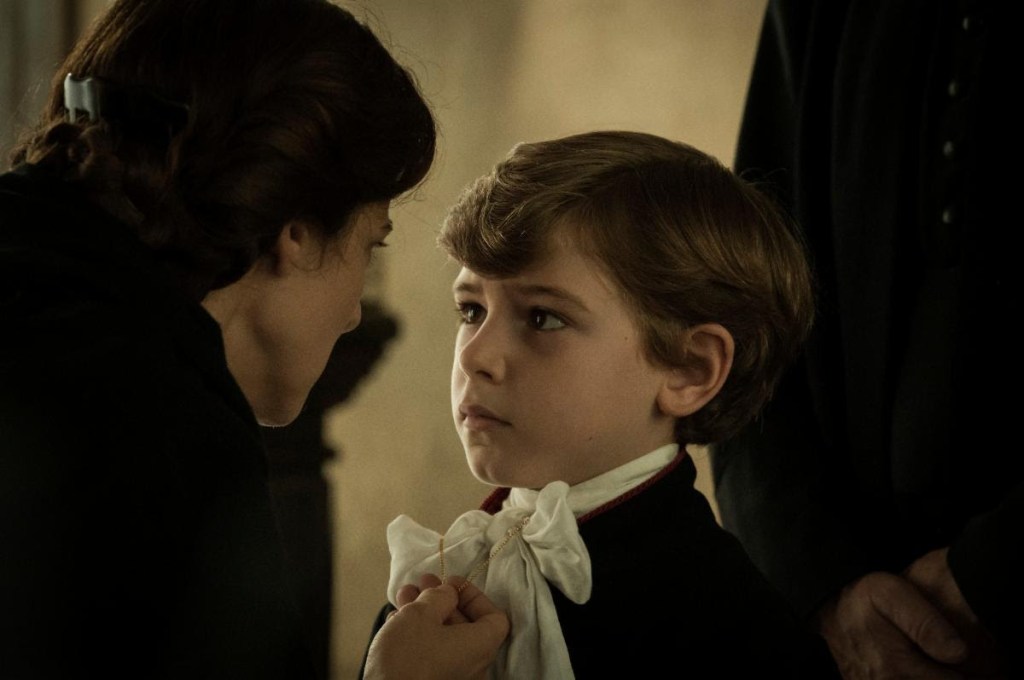
Seven-year-old Edgardo Mortara (Enea Sala) is one of many children of Momolo (Fausto Russo Alesi) and Marianna Mortara (Barbara Ronchi), a prominent Jewish family in Bologna. In 1858, soldiers of Pope Pius IX (Paolo Pierobon) arrive one night to take the child, stating that they have learned that he was secretly baptized years earlier. Despite the family’s protests, Edgardo is taken away to begin his Catholic education alongside a number of other such children. As his father tries desperately to get him back, Edgardo chooses to be agreeable and play the part of the eager young student, hoping that his cooperation will result in his being sent home soon.
While the real-life Edgardo’s removal from his home was major news back in 1858, it feels like a distant relic of the past in today’s present, where Christianity remains a dominant religion in many Western countries but no longer actively courts subservience like in the days of the Inquisition. The way in which the affair plays out is one where divine authority seems to trump any logic or legal proceedings, with the alleged baptizer’s identity kept secret and Pius unmoved to change his decision even after it becomes clear that the world is mostly against him. It’s an instance of making any counterargument seem unwinnable since no one could possibly go up against the word of God himself.
Bellocchio, who has been making films for almost six decades, treats his subject matter with reverence, employing a heavily dramatized approach to tell this story. Director of photography Francesco Di Giacomo uses the camera to highlight the distance between Edgardo and his family and the grandeur of the church, and the figure of Jesus, that is now introduced to him as his true faith. The film has a particular look to it that evokes the era and the prominence of certain colors and designs that frame all aspects of life within a religious lens.
One curious decision that doesn’t work all that well is the animation of the political cartoons Pius reads as he digests the pushback to his authoritarian regime. The pictures move playfully as Pius looks at them, and he later has a nightmare about Jews coming in to his bedroom during the night to circumcise him after hearing about an American performer such a scenario. It’s a bizarre bit of comedy that feels out of place within the context of this much more intense and harrowing tale, insensitive to the severity of Edgardo’s abduction and the impact it had on his family. It does speak to the imagined mindset of the Pope, whose downfall was soon to come with the changing times, but doesn’t match the tone of the rest of the film.
Kidnapped: The Abduction of Edgardo Mortara boasts a strong cast led by Pierobon in a maniacal but focused turn as Pius. He plays him as a ruler who knows just how far his power can take him and isn’t keen on being reined in by those who tell him to play politics rather than merely assert himself as undeniable king. Alesi and Ronchi deliver passionate performances as Edgardo’s distraught parents, and Sala makes an extraordinary debut as the young Edgardo, matched well by Leonardo Maltese as the older version of the character. Gifuni is a memorable standout as Father Pier Gaetano Feletti, the local figure responsible for enforcing Edgardo’s removal and a fervent defender of the unmatched superiority of his religious duty. In its portrayal of the inflexibility of those who purport to serve divine will, this film is both extremely effective and chilling.
134 minutes
Story – B+
Acting – B+
Technical – B
Overall – B
 Film Factual