
Alvaro Keding/© AMNH
How do elephants “hear” with their feet, use the 16 muscles in their trunks, or reshape the forests and savannas they live in, creating an environment upon which many other species rely? ‘The Secret World of Elephants,’ a special exhibition opening this Monday, November 13 at the American Museum of Natural History (AMNH) in New York City, reveals new science about both modern and ancient elephant relatives. The exhibition particularly highlights elephants’ extraordinary minds and senses, why they’re essential to the health of their ecosystems, and inspiring efforts to overcome threats to their survival.
“We are delighted to present ‘The Secret World of Elephants,’ a comprehensive look at these intriguing and important animals and the latest scientific thinking about their abilities, environmental roles, social structure, history, and future,” said Sean M. Decatur, President of the AMNH. “This exhibition is an example of what the American Museum of Natural History does so well: by starting at a point of shared curiosity and fascination we can share larger stories about evolution, the environment, animal behavior, and the interactions between human and animals, thereby expanding understanding of the natural world and our impact on it.”
Life-size models – including a scientifically accurate representation of a woolly mammoth shedding its fur – as well as fossils and casts, engaging interactives and videos reveal the amazing story of these massive mammals.
Majestic as they are, today’s elephants offer just a glimpse of their former glory. Once, animals with tusks and trunks lived on almost every continent and many islands. Today, only three elephant species survive, but their abilities remain remarkable. Elephants’ trunks, for example, are strong enough to pull down a tree, yet nimble enough to pluck a single blade of grass. They communicate extensively with each other, maintaining complex emotional ties with other herd members. They shape their environment, creating habitat for countless plants and animals. And over centuries of interactions with humans, they’ve been trained for war and work, and are powerful religious and political symbols across cultures.
“Elephants are the world’s largest land animal, but we understand surprisingly little about them,” said ‘The Secret World of Elephants’ curator Ross MacPhee, curator emeritus in the Museum’s Department of Mammalogy. “Researchers are working toward assembling a much more complete picture of elephants and we’re learning new secrets about their minds, bodies, and ecological importance every day. We also know elephants face an uncertain future. The global demand for ivory, along with climate change and habitat loss, are pushing them along the path to extinction. If we don’t act quickly, elephants could be gone before we ever truly get to know them.”
In ‘The Secret World of Elephants,’ visitors are introduced to the greater elephant family tree, which reveals that the elephant’s closest living relatives are not, as some might assume, large mammals with thick, wrinkly skin – like hippos and rhinos – but aquatic sea cows and furry, rabbit-sized hyraxes. Visitors will encounter a full-scale model of one of the most iconic extinct elephant relatives – a woolly mammoth, depicted in the process of shedding its winter coat—and a life-size model of an adult and calf pair of dwarf elephants, which lived in what is now Sicily and only grew to about 4 feet tall at their shoulders. Two touchable teeth, one from a mammoth and one from a mastodon-like species, demonstrate differences in the ways these giant proboscideans chewed; and an interactive mammoth tusk model demonstrates how scientists use isotope “”ingerprints” to reveal how mammoths traveled across what is now Alaska about 17,000 years ago.
‘The Secret World of Elephants’ also explores these massive mammals’ incredible abilities through interactive exhibits, including’The Secret World of Elephants’ also explores these massive mammals’ incredible abilities through interactive exhibits, including: a station where visitors can feel the extremely low sound waves elephants use – called infrasound – to send messages through the ground and to other elephants; feet, which conduct vibrations up their legs and to their brains.
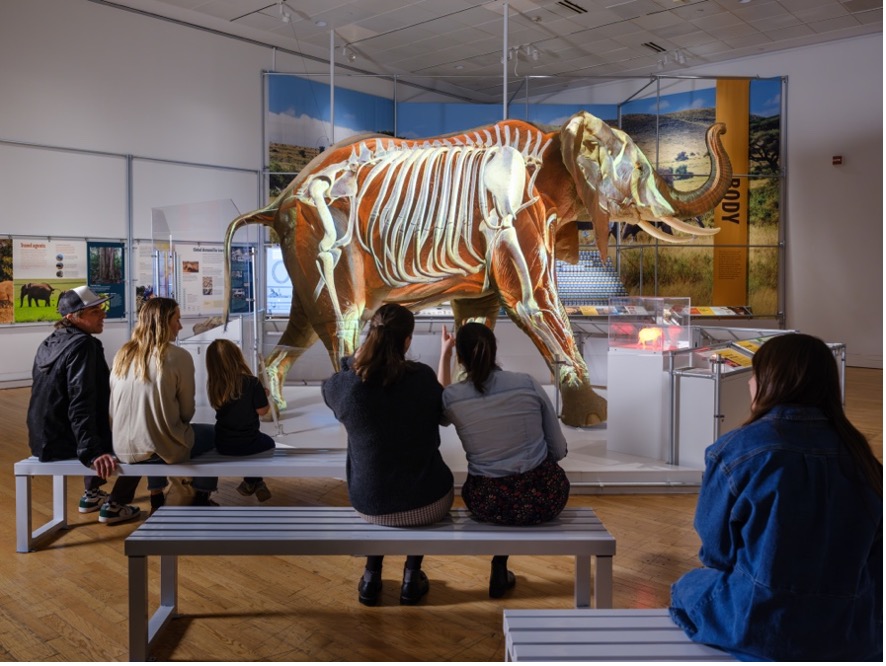
There’s also a life-size African elephant model with a video projection on one side of its body showing the skeleton of this massive mammal and providing an inside look at how it processes the huge amount of food it eats – about 300–500 pounds per day. The model also explores elephant gestation, which can last for nearly two years, longer than any other living mammal. There’s also a miniature elephant model that prompts visitors to turn a wheel to flap its ears, a process that helps elephants keep cool in hot environments
For thousands of years, humans and elephants have lived together – often uneasily – in the same forests and savannas, sometimes competing for the same resources. Although never fully domesticated by humans, these intelligent animals have long been trained for war and work, historical and contemporary examples of which are explored in the exhibition.
Elephants remain powerful religious and political symbols across cultures today. Cultural artifacts on display in ‘The Secret World of Elephants’ include puppets from Vietnam depicting the Tru’ng sisters, national heroes who, according to local history, rode elephants into battle some 2,000 years ago against an invading Chinese army. There’s also a large figure of the Hindu god Ganesh, known as the remover of obstacles, with an elephant’s head and a human-like body.
Conservation-themed interactive exhibits throughout the exhibition examine the impact of killing elephants for ivory, how climate change is affecting elephants, and ways that humans and elephants can share the planet and reduce human and elephant conflict. The exhibition features a documentary film about an elephant sanctuary in northern Kenya called Reteti, which is owned by the local Samburu community and takes in orphaned and abandoned elephant calves with the aim of releasing them back into wild herds. The video tells the story of Shaba, a 15-month old orphaned female who grew to become the sanctuary’s first matriarch.
‘The Secret World of Elephants’ is curated by MacPhee, curator emeritus in AMNH’s Department of Mammalogy, with consultation by Raman Sukumar, honorary professor at the Centre for Ecological Sciences, Indian Institute of Science; and Alexandra van der Geer, a researcher at the University of Leiden, Netherlands.
The exhibition is designed and produced by the AMNH’s award-winning Exhibition Department under the direction of Lauri Halderman, senior vice president for exhibition.
‘The Secret World of Elephants’ will open to the public on November 13. Museum Members will be able to preview the exhibition from Friday, November 10 through Sunday, November 12.
The Museum is open daily, 10 am–5:30 pm. The Museum is closed on Thanksgiving and Christmas.
Tickets that include admission to ‘The Secret World of Elephants’ start at $28 for adults, $16.50 for children (ages 3-12) and $22.50 for seniors and students. Timed-entry tickets must be reserved in advance on AMNH’s official website ticket page. For additional information on the exhibitiom, call 212-769-5100 or visit the museum’s website.
 Film Factual