
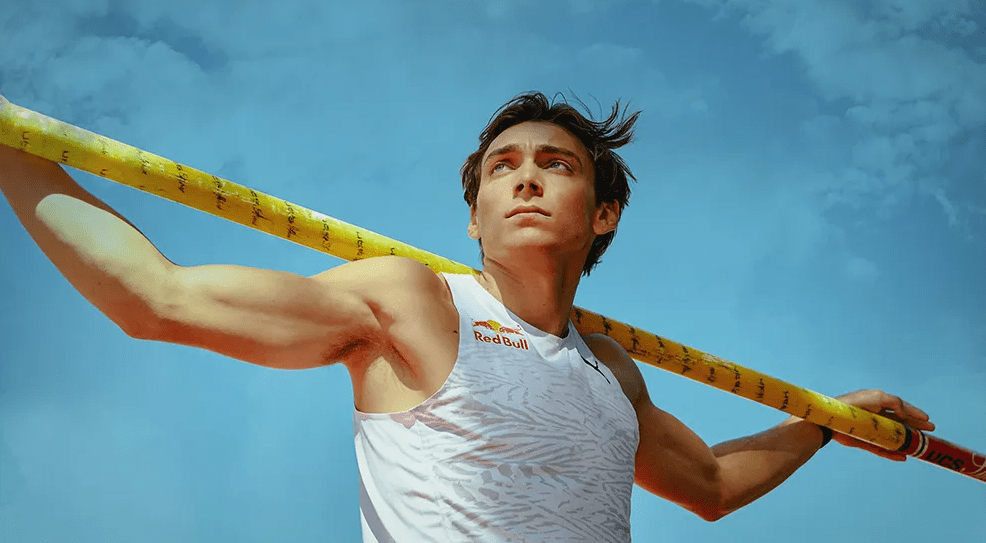
The most successful young prodigies are those who firmly remain dedicated to their visceral determination in achieving the seemingly unreachable goals they set for themselves. The new biographical sports documentary, ‘Born to Fly,’ is a powerful coming-of-age tale that chronicles two young men’s unrelenting drive to attain his elusive professional goals – both in front of, and behind, the camera.
The project marks the feature film directorial, editing and producing debuts of experienced shorts/Louisiana-based filmmaker, Brennan Robideaux. The movie chronicles the ambitions of Olympic Gold Medalist, Mondo Duplantis, one of America’s most renowned young pole vaulters, who embarking on a journey to be the best in such an obscure sport.
‘Born to Fly’ showcases that by the age of 4, Duplantis became a child prodigy, a Louisiana boy chasing the feeling of the perfect jump. By 21, he became the greatest pole vaulter of all time, breaking world records and winning Olympic Gold.
Raised by a family of pole vaulters in a small southern town, Duplantis was an outsider amongst his peers but was determined to go pro before graduating high school. Begrudging his father’s advice, Mondo decides to complete his freshman year of college before chasing his dreams of Olympic gold.
But shortly into his professional career, Duplantis suffers a crushing defeat at the World Championships – sending him home, downhearted and dejected. After reuniting with his father, a burning passion is reignited within Duplantis, and fuels a comeback attempt at the Tokyo Olympic games.
‘Born to Fly’ screened during the 34th Annual New Orleans Film Festival, both in person on Sunday, November 5 at the Prytania Theatre Uptown, as well as during the virtual program. At the festival, the documentary won the Louisiana Feature Jury Award. Robideaux generously took the time the week before the movie’s in-person screening to talk about helming, producing and editing the feature during an exclusive interview over Zoom.
Film Factual (FF): You directed the new documentary, ‘Born to Fly.’ What inspired you to make a film exploring the life and career of Mondo Duplantis?
Brennan Robideaux (BR): The truth of the matter was that I was a college drop-out, living at home with my parents. I was a filmmaker, and filmmaking was all I’ve ever done. At the time, I was a filmmaker but not making films, which is not a fun place o be in as a filmmaker.
I joke about it, but it was born a bit out of desperation. There was a need to create and do something. I do believe that desperation breeds necessity, opportunity and creativity.
There was a little blurb in our local paper about this kid, Mondo Duplantis. He had been jumping some pretty incredible heights in the sport of pole vaulting, which I knew very little, if anything, about.
But I’ve always heard of the name Mondo Duplantis. The whole Duplantis family had a lore in the town, as they’re all such talented athletes. We knew that his mother was Swedish, so the whole family is this Swedish-American hybrid.
Most people, including myself, knew that there was a pole-vaulting pit set up in their backyard. I’ve never seen it, but knew of it, and knew that it was quite strange. When I saw in the paper that he was jumping these incredible heights and had the pit in the backyard, and I paired it with my knowledge that he’s half-Swedish, I was immediately attracted to the idea of making a documentary about it.
I thought the idea was so unique and different. Those are the films that I really like – the ones that tell the stories of outsiders who are really passionate about their thing. Then to add to it that he’s really good, it had everything that I really like. So that was the seed of inspiration for the film.
FF: Like you mentioned, you didn’t know much about pole-vaulting, as well as Mondo’s life and career, before you started working on the movie. What kind of research did you do into Mondo’s life and career once you began directing the documentary?
BR: Most of the research began with me just starting production on the film. since it was my first feature, I just went in completely trial by fire. I wasn’t really thinking about the pre-interview phase, or trying to develop the story ahead of time; I just started filming.
At the time, I was living with my parents across the street from the high school that Mondo trained at when he was younger. So once I got his approval to start filming him, I would just walk over and start filming him.
So the research happened, in a way, by just being out there and learning about how pole vaulting works. I also learned that your dad isn’t just your dad; he’s also your coach. Your mom is both your trainer and your mom, which I thought was interesting.
As far as the numbers go, I was able to look up and find that he had in fact jump these heights at these ages. I called it a calculated risk because I looked at the numbers and thought, if he continues jumping on this path, he could be the greatest in history. A lot of prodigies sort of fizzle out, but there’s no guarantee of that. When you see the heights he was jumping at the age he was jumping, you realize this is truly an anomaly.
We premiered the movie at the Austin Film Festival, and I was on a panel for documentary filmmaking. It was fun because it was good group of people, including two really talented female filmmakers; one was there with a short, and the other was there with a feature. It was cool because we all had different approaches to how we made our films.
FF: How did you decide who you would speak with about Mondo’s life and career for ‘Born to Fly?’
BR: Again, I didn’t know exactly what kind of film I wanted to make in the beginning. By the end, I think I made three different films, and then had to compress them into what the final film became.
But we did interviews throughout the process, both with Mondo and his parents. We also did a lot of other interviews that ultimately didn’t make it into the film. When you have to condense about 400 hours of footage into a 90-minue movie, you have to ask, what is the core of this film?
We decided that this is a father-son and family story, so we condensed the extraneous people, including really good interviews with people I love. Unfortunately, they just didn’t work in the film that we were making.
But I interviewed the family throughout the process. I was also embedded with the family for years. I slept on the floor of Mondo’s hotel rooms. I also stayed with them at the homes of Helena’s (Mondo’s mother) family in Sweden. They were extraordinarily kind and let me stay in their homes, and we ate dinners togethers.
It was a multi-year process of me basically being embedded with the family. So I was there with them for a lot of things.
FF: Speaking about putting the film together, in addition to helming the feature, you also served as a co-editor with Nils Nouchi. What was the process like of editing the movie together?
BR: Editing the film was extraordinarily difficult. There were so many hours of fooage – more than 400 – and we had to condense them into 90 minutes. I’m an editor not necessarily by trade, but it’s something that I like to do on my own projects.
So we brought on Nils, who’s a professional editor. He did the bulk of the editing in the beginning, and shaped the story to hone in on the father-son connection.
But it was difficult…Since it was a solo project for so long – it really was just me for years – developing the team aspect, besides my producer, Bill Ramsey, was a challenge. Bill, who also acted as the production legal at the same time, came on board in 2020, and really believed in me. So it took awhile for a team to form.
Since it was such a solo endeavor for so long, I was able to hide my bad footage. I was like, I don’t even want to look at it! (Robideaux laughs.) But when you work with an editor and a team, they want to see everything. So it was like exposing my dirty laundry to everyone because it’s hard to look at that footage, knowing how bad it was.
I’ve improved so much as a filmmaker, so that was the difficult part – having to sit with an editor and watch the early footage. I was cringing, knowing it was terrible. But we were able to find good nuggets, and they’re all in the movie.
FF: Speaking about producing ‘Born to Fly’ with Bill Ramsey, how did you approach collaborating together as producers on the project?
BR: Bill is someone who’s been there for me since 2020. At that point, I had been filming for almost four years. But having him there to bounce ideas off of, as well as be there for me logistically and legally, making sure I had the proper forms and was doing the right things to make a movie, was so helpful.
He really helped facilitate things; he was on every call with me, and helped bring on partners and make sure that deals were in place. He was there to help do all the things I couldn’t have done without him. So that part was extraordinarily helpful – it was amazing to have someone with that knowledge and really guide me through the process when the project became a serious film.
FF: ‘Born to Fly’ screened (earlier) this month at the New Orleans Film Festival. What does it mean to you that the documentary (screened) at the festival?
BR: It’s very special to bring the movie home. The New Orleans Film Festival is extremely special to me because I used to work as a projectionist for the festival for a couple of years when I was living in New Orleans. I also love the people at the film festival.
Also, when I was working as a projectionist there and no one was around, I would sneak my short films into the project booth so that I could see what it would be like to have my film play on the big screen. I would imagine what it would be like to have a film at the festival. So to not only have a feature, but also my first feature, play at the festival at the Prytania Theatre Uptown, which is a historic venue, is very cool and exciting.
 Film Factual