
The most rewarding – and harrowing – aspects of the human experience are often driven by the complexities of friendship, love and desire. The seemingly diverse characters of the new romantic drama, ‘Shoulder Dance,’ bond as they learn how to contend with the reemergence of long-suppressed emotions when the delicate balance of relationships is put to the test.
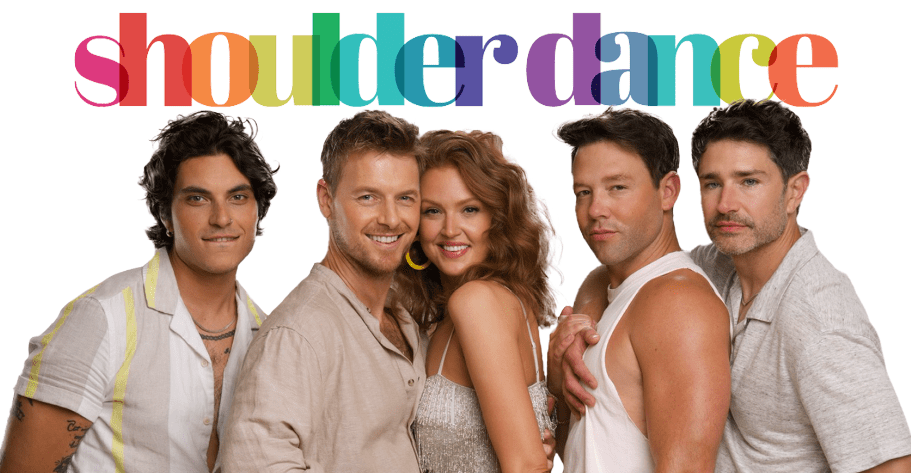
The film was written, directed and produced by Jay Arnold (‘What Happens Next’), who crafted a romantic but equally honest tale out of a nearly-lost weekend of true confessions and realizations no one saw coming. The movie stars Matt Dallas (‘Kyle XY’), Rick Cosnett (‘The Flash’), Taylor Frey (‘It Chapter Two’) and Maggie Geha (‘Gotham’), whose characters engage in an enchanting exploration of the gaps between their unexplored fantasies and what’s really going on in their hearts.
‘Shoulder Dance’ won the Best Supporting Actress award for Geha, as well as the Best LGBTQ Film Award, at the Hollywood Reel Independent Film Festival. The project also won Best Feature Film, Drama at the Philadelphia Independent Film Festival. The drama is now playing on digital platforms, courtesy of Breaking Glass Pictures.
After 24 years of radio silence, ‘Shoulder Dance’ follows Ira (Dallas) as his former high school best friend, and forever crush, Roger (Cosnett), suddenly announces he’ll be stopping by Ira’s Hamptons hideaway. The news comes as a shock to Ira’s long-time, patiently smitten boyfriend, Josh (Frey), who can’t help but feel upended by this visit from a significant stranger he’s never even heard mentioned before.
But when Roger shows up having matured rather nicely – with his glam, adventurous girlfriend Lilly (Geha) at his side – it seems the foursome are in for an encounter to be remembered. It’s just a question of whether it will be remembered for epic heartbreak or a liberating new start.
Arnold generously took the time recently to talk about scribing, helming and producing ‘Shoulder Dance’ during an exclusive interview over Zoom. Among other things, he shared that he was in part driven to pen and direct the movie because thestory isso universal that it’s relatable to everyone. He also mentioned that he feels the dynamic between the four main actors is so authentic because they all related to something in their characters in a personal way.
Jay Arnold (JA): They say to write about what you know. So I’ve been thinking about this story for quite awhile; I’ve wanted to tell it for a long time. It’s one that everyone, universally, can relate to, as it’s about a broken friendship, particularly when we’re younger, as teenagers.
At that age, we haven’t really honed our communicating skills so much. But we sit in our rooms and talk to our best friends. We have a lot of emotional intimacy because we tell them everything.
I think for a gay kid, like myself, there were challenges with other boys, with one friend in particular. We had a fight, and I don’t even remember what it was about. (Arnold laughs.)
But it happens when you’re younger – you have these fights and broken relationships. I think sometimes, to a certain extent, we carry that stuff around with us. We question, what happened? Did they not like me? Did I do something wrong? Is it because I’m ugly or gay? I was not a cute kid, by the way.
I think in the back of your mind, we carry these things with us subconsciously. I don’t know how many times over the years I wondered, what did I do wrong? Am I not good enough?
I think sometimes, that questioning informs our future. Then we can’t go on a date or make a commitment. We can’t do certain things because we’re carrying that baggage.
So I wrote the film in a way that I could envision it encompassing those questions I had. So the inspiration was real life experiences, and really just wanting to tell this story.
FF: In addition to penning the screenplay, you also directed the movie. What was your overall helming approach throughout the production?
JA: I had a very specific approach to this film. Since the film has a very intimate nature and it’s an ensemble cast, I felt it was important that there be chemistry between all the characters, and that it felt authentic.
So instead of just putting out casting, we cast Matt as (the character of) Ira first. Once we had Matt, we cast Rick as Roger to Ira. Once we had Rick, we cast Maggie as Lilly to Roger. That way, it felt authentic…we wanted to curate that process.
So we not only did that, but we didn’t have a table read. The cast didn’t meet in advance of the production. We shot the film in chronological order, which everyone told me wasn’t a good idea because isn’t cost effective.
So if there were 20 kitchen scene, we didn’t shoot all 20 scenes at the same time; we went back to the kitchen, since we shot the story in a linear fashion day-by-day.
I chose to do that because my instinct was that if the actors could become more comfortable with their characters and intimae throughout this journey, that would translate better throughout the film. I think that worked, actually.
FF: Speaking about the ensemble cast, once the actors joined the film, how did you work with them to create their characters’ relationships?
JA: I think one of the reasons why the casting is so good is that each and every single actor related to something in their character in a deep and personal way. When I would talk to each actor, they would say, “That was me.”
So it was almost transformative in a way. These are all really fine actors. When you get into independent films, which don’t have a lot of money, you’re not always fortunate enough to get seasoned, fine actors who’ve almost all had multiple television shows, like we had on this movie.
So they all embraced their characters…and were all in character the whole time during the entire shoot. I knew when I talked to each one of them individually, each of them had experiences that they could relate to in the film. So there was something personal for all of them in the film, and they all saw the heart in it. So that was a wonderful experience.
FF: ‘Shoulder Dance’ is set in the Hamptons. How did you decide where you would actually shoot the film? What was your experience filming the feature on location?
JA: Well, the movie is set in the Hamptons, but we thought it would be more cost-effective to shoot it on the west coast. It’s very expensive to travel, house and feed talent for a couple of months. We thought, we’ll get a lot of great talent in L.A., so we should find a location that’s beachy, and can be read as the Hamptons.
So we shot it in Malibu. We did have to take out a bunch of palm trees digitally, as they would not be in New York. (Arnold laughs.)
But it turned out that almost none of the talent I loved, and who loved this film, lived in L.A. (Arnold laughs.) So we had to travel them to L.A.! So I guess we could have filmed it in the Hamptons, but it just turned out that way. So we just intercut the movie with signs from the Hamptons. Beaches look similar, for the most part, so the locations in the film do sell.
I do love the house that’s in the film. It’s not only beautiful, but also minimal and not gaudy crazy. Since the story is so intimate, I really just wanted the characters to be there in that moment, and not have a visual distraction.
Overall, the house was pretty light. We went in and removed every single piece of artwork. We didn’t use any primary colors in the house, except in one painting of Josh on the wall. Everything was light and muted because I wanted to have very intimate, positive visuals; I didn’t want any harsh visual distractions, so we took all of those away. (Arnold laughs.)
FF: Besides writing and directing the drama, you also served as one of its producers. Why did you decide to also produce the film? How did you balance your helming and producing duties throughout the production?
JA: I said to myself in the past, I would never write, direct and produce because it’s simply too much. But of course, I wrote, directed and produced this film.
We have several producers on this film, and they really worked hard, including Rod Hamilton and Frank Lomento. They really contributed substantially.
But I think when you have a film that you write and direct, you want to have some producing control.
FF: Breaking Glass Pictures recently released ‘Shoulder Dance’ in U.S. theaters and On Demand and Digital. Why do you feel the dual distribution model is beneficial for this type of movie?
JA: Well, we were a little late to the festival game because we shot the film last summer. But then COVID resurged, so we had to take a break and come back. So the film was late to the festival season.
But we were able to attend some festivals, and I just finished the festival circuit in Florida (at the Fort Lauderdale International Film Festival) alongside the film’s official theatrical release. So we just had a festival screening and the official theatrical release. So far, with the exception of this last festival and if there’s something I don’t know about, we’ve won at least one, if not more, awards at every festival we attended, which is super exciting.
I also woke up to many texts (the day of the interview) that say we’re the number one selling new release on Amazon, and the third best seller in the LGBT category. So I’m excited about that; even if it’s just for a fleeting moment, it’s exciting.
I think all of the actors in this film, which there aren’t that many, as it’s a small cast, were, and still are, very committed to the film. They have a vested interest – and in general, an interest – in the film. We knew when we shot it that we had something special.
I’m a tough critic, but the cast are all seasoned actors – some of them have three or four shows on television. Matt’s been an ABC Family star forever (having played the titular character on ‘Kyle XY,’ and also having a recurring role on the second season of the 2010s sitcom, ‘Baby Daddy’).
We kept asking ourselves, “Is this really what we think it is, or are we too close to it? But it feels different – it feels special.”
Interestingly, the wife of our cinematographer, Michael Franks, who made this independent film feel like a gorgeous studio film, said at the time, “This is going to be great. This is an important movie.” She said it for many reasons. (The morning of the interview), I got a text from Michael that said, “My wife was right!” She was right.
As a filmmaker, you have to have tough skin because not everyone is going to like your work. There are evem Academy Award-winning movies that people hate. So you have to have tough skin because there are going to be people who are going to have issues with your work. But we haven’t really encountered much of that yet. We have had two reviews so far, and both of them are beautiful, so we’re grateful for that!
 Film Factual