
Viewing characters from various angles at different times in their lives captures their true humanity. That’s certainly the case for the protagonists of Will and Jane in the new romantic dramady, ‘Which Brings Me to You.’ The young adults have both been riddled with flaws since their adolescences, yet still yearn for self-transformation, no matter what type of struggle they must take in order to do so.
The film is based on the 2006 novel ‘Which Brings Me to You: A Novel of Confessions’ by Steve Almond and Julianna Baggott. The screen adaptation was written by Keith Bunin (‘Onward’) and directed by Peter Hutchings (‘The Hating Game’).
Decal distributed ‘Which Brings Me to You’ in theaters on January 19. The movie was also released On Digital and On Demand this past Friday, February 2.
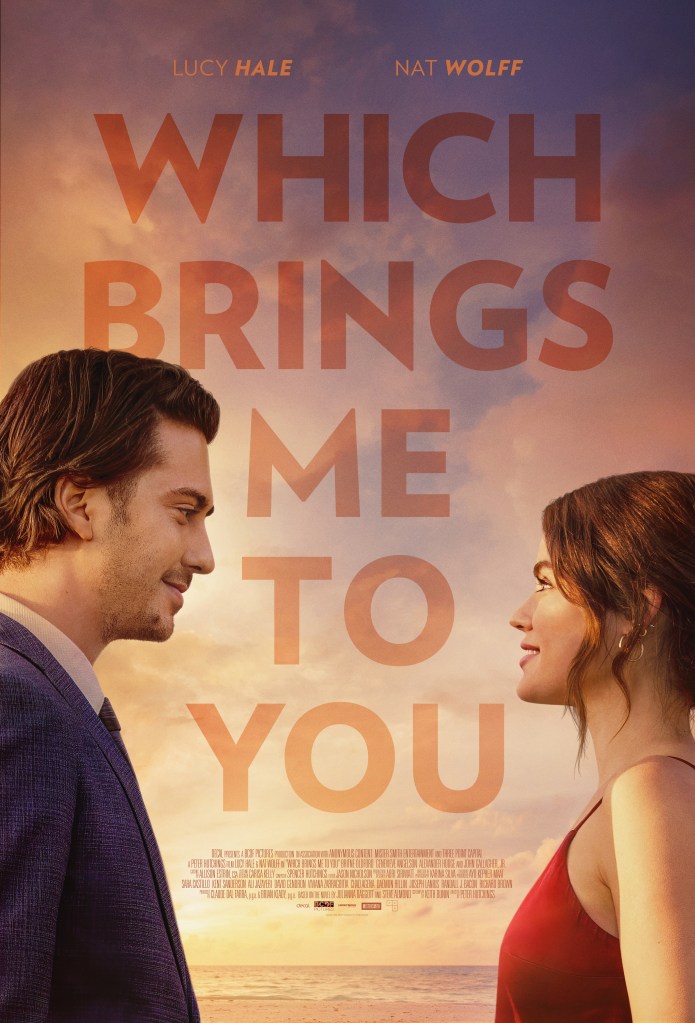
‘Which Brings Me to You’ stars Lucy Hale (‘Truth or Dare’) as Jane and Nat Wolff (‘The Fault in Our Stars’) as Will. The dramady’s supporting cast includes Britne Oldford (‘Free Guy’), Genevieve Angelson (‘The Upside’), Alexander Hodge (‘Insecure’) and John Gallagher, Jr. (‘10 Cloverfield Lane’).
In ‘Which Brings Me to You,’ Jane, a freelance journalist, and Will, a photographer, are immediately drawn to each other at a mutual friend’s wedding. After the pair sneak off to hook up in the coat room, all initial signs point to an empty one-night stand
Instead, over the next 24 hours, they share stories of their most embarrassing sexual encounters, first loves, heartbreak and whirlwind romances. As they discover each other, especially the ways in which they’ve grown and changed, through heartwarming, hilarious and sometimes tragic tales, they start to truly find themselves and what they want in life.
Hutchings generously took the time recently to talk about helming ‘What Brings Me to You’ during an exclusive interview over Zoom. Among other things, he discussed that he was in part interested in directing the film because he appreciated that the script shows Jane and Will from many diverse perspectives throughout their dating histories. The filmmaker also mentioned that he was in part interesting in casting Hale and Wolff as the protagonists because he knew they would take ownership of, and personalize, their characters.
Film Factual (FF): You directed the new romantic dramady, ‘What Brings Me to You.’ What was it about the script, which was written by Keith Bunin, that convinced you to helm the movie?
Peter Hutchings (PH): I read the script some years ago. It really was these two characters that drew me in. They were funny, charming and messy. By the time I was done, I felt like I really knew these characters.
I think it’s rare to find a story in a movie where you get to know two characters from so many different angles at different times in their lives, as well as their ups and downs. But I really felt that connection with these characters.
By the time I got to the end of the script, and I don’t want to give anything away, I was left with such a powerful emotion. So I told myself if I can be a part of bringing this movie to life and share this emotional experience that I just had with an audience, that would be something really worthwhile and a special experience.
FF: The film is based on the 2006 novel of the same name by Julianna Baggott and Steve Almond. How closely does the screen adaptation stay true to the book, and how much creative liberty did you take with the story in the feature?
PH: So the book was written as a series of letters back and forth between these characters. So when Keith Bunin, the screenwriter, came on, he moved away from that structure to created something that would feel like a road trip movie. First of all, we had this unity of time of everything in the story being set in one day, with the flashbacks departing from that.
Then when I came on, I worked with him, and then I worked with the actors to really make these characters their own. I gave them ownership of the characters.
I wanted for Nat and Lucy to really be able to get inside of them. I didn’t want them to feel like they were any lines of dialogue that felt off to them, or have any false moments. It was really important to me and them that that these characters and the tone were as authentic and honest as possible. So a lot of work went into that.
FF: Speaking about the actors, ‘What Brings Me to You’ stars Nat Wolff and Lucy Hale, who you just mentioned. What was the casting process like for the movie?
PH: When I started working on this film, I had just come off shooting (the 2021 romantic comedy,) ‘The Hating Game’ with Lucy Hale. We both really wanted to work together again after that project. We were looking for something, and this script became available.
So I jumped on it and sent it to her, and she loved it. So it was very easy in that respect. (Hutchings laughs.)
It was same with Nat. Lucy knew Nat, and I’ve known Nat for over 10 years and have always wanted to work with him. This was just the perfect opportunity. I knew that the two of them were just going to bring so much to the roles and also be great together on screen.
FF: Once the actors, particularly Lucy and Nat, were cast, how did you approach working with them to build their character arcs?
PH: So the three of us had a lot of Zooms together, just running scenes and working on dialogue. Again, Keith did such a great job on the screenplay.
But I really wanted Nat and Lucy to take ownership of these characters to personalize them. There’s this mysterious equation where the more specific you are, the more universal you are. I knew that the more specific we could be with the characterization of Will and Jane, the more it would resonate with our audience.
And it’s really interesting to have gone through that process of workshopping the script, making the movie and then showing it.
to people, and people really finding themselves in these characters. The movie made them think about their own past relationships and maybe seeing them in a new light, and maybe also seeing their current relationships in a new and more hopeful light.
FF: Speaking about the flashbacks, which you mentioned earlier, how did you work with Lucy and Nat to chronicle how their characters change in each of their relationships throughout those memories?
PH: It was a lot of fun. You can imagine seeing the two of them come out with their hair and makeup for the high school scenes. Lucy played this Catholic school girl, and we had a lot of fun with that.
At the same time, we didn’t turn it into a joke; we wanted it to be honest and authentic. We also really wanted to have a continuity so that we could have these flashbacks. But there’s also this development of the character and a through line, even though it’s not necessarily the most traditional linear structure to be in a movie.
So having it feel like a cohesive story was really important to us. That was something that we always had as a touchstone whenever we were doing these flashbacks. We would ask, where are we in the story? What’s going on in the present day? We would then modulate the story in that way.
FF: Speaking about having a cohesive throughline with each flashback and storyline, the film was edited by Jason Nicholson. How did you collaborate with him to chronicle the protagonists’ transformations?
PH: Jason Nicholson is the editor who I’ve worked with now on several movies. He’s so talented, and he’s such a great mix of this powerhouse rational brain and emotional brain. So he really has this artistic touch, but is also always thinking about structure and pacing and the rhythm of these scenes.
He’s just such a smart guy. He’s also a great sounding board for me because on a movie, you start off being on set with 100 people. That’s very exciting but also a bit stressful because the sun is going down and you’re burning money.
Then all of a sudden, it’s just you and the editor alone in a room together for a few months. It’s a totally different part of the process.
But it’s almost like you’re going to the supermarket and shopping for ingredients during the shoot and production. Then it’s like you’re in the kitchen and you’re cooking when you’re in the edit room.
There are very little changes where you put a cut. But deciding where a moment goes can completely change the feeling of a scene, so it’s a very delicate process. It takes a long time, and it’s such an important part of the overall story that we’re telling.
FF: Also speaking about the costumes and hair and makeup, like you mentioned earlier, how did you create the look for each flashback to show how the characters changed in each stage of their lives?
PH: I started with this idea that this movie is thematizes history, which is something that was really important to me. Each of these characters is dealing with the weight of their past and their past relationships. So I wanted to find locations that had a sense of history, whether it’s the amusement park or these harbors or this great landmark seafood restaurant in Atlantic Highlands, Bars Landing. It was important to me to have these characters in these environments.
That also extended to wardrobe and hair and makeup, and to the way that we shot the movie. So that way, when we flashback, you know what time period we’re in.
There was a conversation early on with Karina Silva, our wonderful cinematographer. She asked me what I was thinking about in terms of the flashbacks, including if I wanted to have a specific look for them.
The old school cheesy version of that is where all of a sudden, everything has a sepia tone, and neither of us wanted that. But one of the things that I said was that I didn’t want to have a separate book for the flashbacks. Instead, I wanted for it to all feel like one story.
For both of these characters, their pasts are really present for them. They’re in the present, where they’re dealing with the weight of these pasts. So it’s not something that feels distant to them.
Since the film follows them telling these stories, it’s not me as the storyteller doing flashbacks; it’s them telling the stories. Everything is through their lens. Do I thought that made the
most sense.
FF: Also speaking about the locations, what was that process like of deciding where you would shoot both the flashbacks and the present-day settings?
PH: As soon as I came onto the project, the first thing I wanted to do was start finding locations. I knew there was a long list of 38 locations. But we only had 22 days to shoot the movie. So that’s a lot of locations to get to. But I knew the locations were so important because they tell so much of this story.
So I finally found this little enclave centered around Red Bank, New Jersey. It extended out about a half an hour in every direction in Monmouth County, up to Atlantic Highlands and Kingsburg and down to Asbury Park.
We were able to find everything that we needed almost entirely within that zone for these different times and phases that they’ve gone through. So it was a real gift to be able to have a small footprint, but also be able to have such variety.
FF: DECAL (distributed) ‘What Brings Me to You’ in theaters on January 19, and then On Digital and On Demand February 2. What does it mean to you that the dramady (was) released in theaters and On Digital and On Demand?
PH: It’s everything. I hear filmmakers sometimes say that they make their movies for themselves, whether it’s well received or not.
But I never think that way. I’m always thinking about the audience. It almost feels like the joy of buying and wrapping a gift for someone, and then the excitement of getting to give it to them.
So I’m really excited for people to see the movie. I’m really proud of the work that this cast and crew did, and excited to share all of their work with people. I hope that people connect with it and have a fun time, but also have a moving experience while watching it.
 Film Factual