
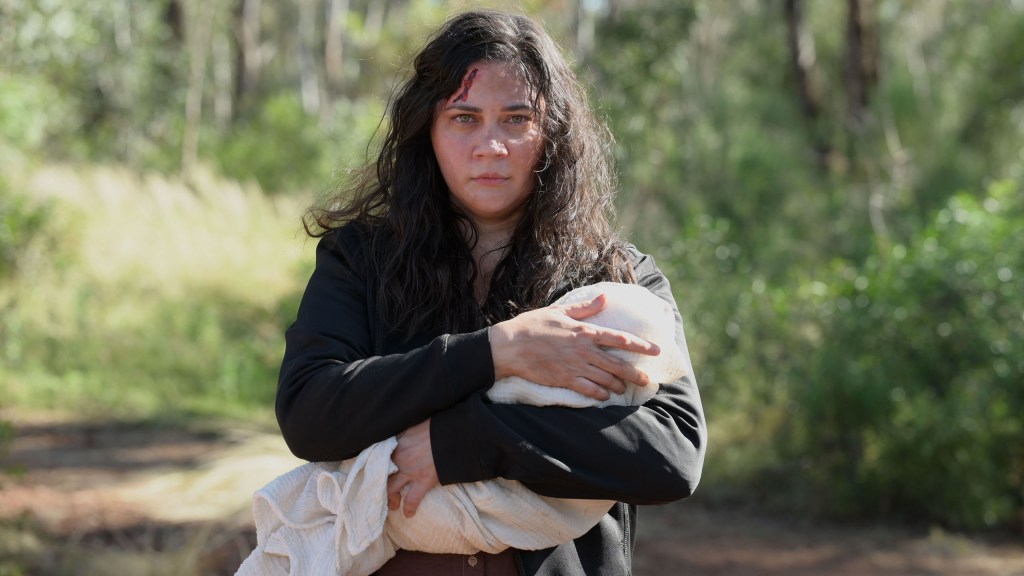
The fragile psychology of a new mother can provoke a powerful examination into the psyche of an entire society. Adults who have long struggled within their culture can often sublimate their trauma into many aspects of their lives, even those that are meant to bring them happiness, such as bringing home a new child. That transference of pain largely drives the actions of Sarah, the protagonist of the new Australian horror thriller, ‘The Moogai.’
The movie was written and helmed by Jon Bell. The filmmaker made his feature film directorial debut on ‘The Moogai,’ which he adapted from his 2020 award-winning short of the same name. He reunited with some of the crew from the short on the feature, including cinematographer Sean Ryan.
The new feature draws from Indigenous lore to create a thematically rich supernatural tale that quickly establishes the lurking menace of a child-stealing spirit. Its simmering suspense blurs the lines between exhaustion, paranoia and postpartum depression as it exacerbates Sarah’s isolation and hopelessness.
The drama also shrewdly accentuates traditional tools of oppression to reveal a darker allusion to Australia’s stolen generations. Those groups include tens of thousands of First Nations children who are forcibly removed from their families through the government’s assimilation policies.
‘The Moogai’ stars Shari Sebbens and Meyne Wyatt, who reprise their roles as Sarah and her husband, Fergus, from the short. The feature also stars Tessa Rose, Clarence Ryan with Toby Leonard Mooore and Bella Heathcote.
‘The Moogai’ follows Sarah and Fergus, a hopeful young Aboriginal couple, as they give birth to their second baby. But what should be a joyous time of their lives becomes sinister when Sarah starts seeing a malevolent spirit that she is convinced is trying to take their baby. Fergus, who can’t see it but desperately wants to believe her, grows increasingly worried as she becomes more unbalanced. He begins to question if the child-stealing spirit real, or if she is the biggest threat to the safety of their family?
‘The Moogai’ had its World Premiere at last month’s Sundance Film Festival in the Midnight section. In honor of the thriller playing at the festival, Ryan generously took the time to talk over Zoom about serving as the cinematographer on the project on the day of its premiere screening at The Ray theater in Park City.
Film Factual (FF): You served as the cinematographer on the new horror feature, ‘The Moogai.’ What was your inspiration in shooting the thriller?
Sean Ryan (SR): It all began with a proof of concept short, which was released in 2020. We shot it in January 2020, right before the COVID protocols took hold.
A friend of mine introduced me to the producers at Causeway Films (which is one of the production companies that worked on both the feature and short). So I interviewed with them and Jon.
Jon had really resonated with some of the earlier work that I had done, and felt like I had the right tone to put forward on the short. So when they let me know they were happy to have me on board, I jumped at the chance.
The short, effectively, is a small slice of the feature, in the middle part of the film. So in essence, what we made in the short stayed true in the feature. So it was really lovely process and evolution from there.
FF: In addition to the feature, you also shot the 2020 short film, of the same name, like you just mentioned. How did working on the previous iteration of the story influence the way you wanted to visually shoot the feature?
SR: The process of discovering and finding the tone on the short helped us evolve the story in the feature. A lot of the short takes place within Sarah and Fergus’ home, and it’s the same in the feature. But the world in the feature grows much further beyond that.
So it was nice to have that DNA of the familiar environments, and the overlapping of the two scripts, in the feature. But it was also nice to have an evolution go beyond that as the story grows for the feature.
FF: The feature and short were both written and directed by Jon Bell, who you just mentioned. How did working together on the short influence the way you collaborated together on the feature? How early on did you began working together on the feature?
SY: What I’ve enjoyed working with Jon the most is that he’s an exceptionally talented writer. His ability to craft what’s such an incredible story that touches on Australia’s past, but also incorporates the present-day experience of our First Nations People, is exceptional. It’s very carefully interwoven throughout the script in a way that I find very clever and subtle at times.
So working from that amazing starting point, and then executing his wonderful words, was amazing. With this project being his first feature, which was adapted from one of his first shorts, I went to him with some ideas about coverage and blocking.
Together with Bethany Ryan, the production designer (on the feature and short), we created the visual identity of the film. Jon was really passionate about his words and the characters, so we helped supplement the visuals there. We worked under his guidance to find something that we felt was right for the story.
FF: Speaking about the movie’s location and production design, Bethany Ryan served as the production designer on the new feature, like you just mentioned. How did you work with her on set to determine how to best shoot the drama?
SY: The locations on this film were really tough to nail down, especially the main house. We knew we were going to be there for at least two weeks.
Jon always described Sarah’s house as feeling disconnected from nature. It was always written as being an apartment, as well, so it would feel a bit disconnected from the Earth. She’s a bit disconnected from the world when we first see her in the film.
We ended up finding a house with a lot of exposed concrete walls and had a cavernous feeling to it. Once we walked into that house, we knew it was the right place to be for the story.
As a cinematographer, when you have to film a lot of night interiors, you know it can be tricky at times. But this house helped us with that. It also allowed us to shoot with children during the day, and shoot day for night, which was a massive advantage.
FF: When you’re shooting a genre film like ‘The Moogai,’ how do you decide which light sources work best to create the most emotions in the story?
SY: Speaking more about the house, we have a lot of scenes that take place in the living room, which have these beautiful floor-to-ceiling glass windows and doors. But we were so high up, we never had a chance of controlling the light that would come through there.
So we carefully scheduled our shoot to avoid any direct sunlight in those rooms. That way we could lean into those colder, cavernous kinds of places, and build on Sarah’s psychology throughout the film.
This wasn’t a warm family home, as there were a lot of cold textures and dark colors. Sarah’s a very successful lawyer, so that corporate aesthetic has bled into her personal life.
When you see her biological mother, she’s covered in warm tones. That earthy aesthetic kind of contrasts Sarah’s space. So avoiding any direct sun really helped with that.
Then figuring out the nighttime bedroom scenes was always a tricky thing. You have to see what’s going on, but they’re also meant to be very dark. So we just added some moonlight for ambiance around the place. So I think we found a balance with the lighting, where it’s as natural as it can be.
FF: Speaking of the colors that are included in the thriller, how did the colors of the costumes and production design influence the way you shot the feature?
SY: Again, I think we were trying to be informed by the script all the way through. In this instance, we had such a fantastic script that we always tried to live up to its premise.
So collaborating with our production designer, Bethany Ryan, and our costume designer, Joanna Mae Park, we specifically worked on Sarah’s arc. We decided that she should start to embrace a bit more color throughout her journey in the film.
The story takes us into some exterior locations, in both day and night. It was through those choices that a lot more color started to come into the film. Those colors included the greens and browns of the trees, the blue of the sky and the red of the earth. So it became richer and richer as we went along, until we reached the finale.
FF: Speaking about ‘The Moogai’s exterior locations, how did filming in those spots compare and contrast to shooting in the interior spaces?
SY: Well, we had a lot more control in the house. When we got to the last week of the shoot, it was pretty much all day exteriors. That’s a tricky thing for any cinematographer, as they’re trying to maintain consistency when a lot’s outside of their control.
But luckily for us, we were really striving for an essence of naturalism with this film. So we did our best to try to schedule around the sun. We tried to wait for the sun instead of clouds as much as we could.
But on a film of this scale, you just have to go and hope that the story’s really holding an audience. Then you won’t notice if one shot in the sun, and the other is in a bit of cloud.
FF: The feature stars Meyne Wyatt and Shari Sebbens, who reprised their roles of Fergus and Sarah from the short. What was your experience reuniting with them to visually chronicle their characters’ journeys through the feature’s story?
SY: It was a joy. Working with Shari Sebbens and Meyne Wyatt was amazing, as they’re real professionals. Both of their characters required quite a bit of physicality, as they were falling and running. Sometimes they were holding a real baby, and other times they were holding a fake baby.
So we did our best to kind of protect them. But we also listened to what they had to say and their opinions.
When I watched the film for the first time, I was really blown away by their performances. I think what they gave to the project really made it what it is today.
FF: ‘The Moogai’ (screened) at this year’s Sundance Film Festival. What does it mean to you that the drama (played) at the festival?
SY: It (was) super exciting. From the beginning, Jon had talked about how he felt that this story would resonate with a North American audience. So he couldn’t be happier that Sundance (was) the film’s birthplace. There (was) such a fantastic energy at the festival, and I (saw) some other fantastic films, so I (felt) like we (were) in fantastic company. So it (was) such a real privilege to be (there).
 Film Factual