
Nothing paralyzes genre fans quite like personal creature features that are driven by a deeply personal, emotionally layered family story. The new horror thriller, ‘Sting,’ is one such project that thrives on the personal theme that filmmaker Kiah Roache-Turner always fuses into his stories – a broken family that finds its way back to each other through the power of love after they experience a perilous situation together.
Turner-Turner wrote, directed and co-edited the drama, whose creature design was crafted by WETA Workshop and its Creative Director, Richard Taylor. The movie stars Ryan Corr, Alyla Browne, Penelope Mitchell, Robyn Nevin, Noni Hazelhurst, Silvia Colloca, Danny Kim ad Jermaine Fowler.
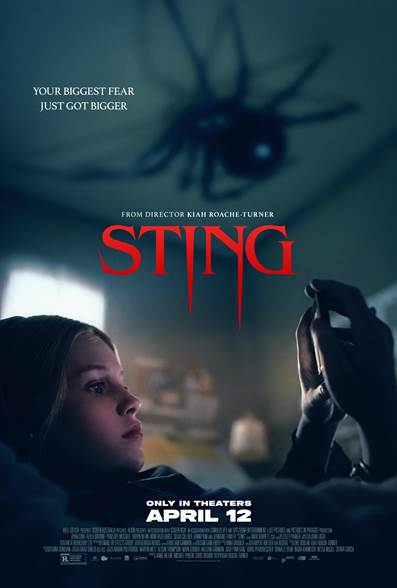
In ‘Sting,’ a mysterious object falls from the sky one cold, stormy night in New York City, and smashes through the window of a rundown apartment building. It is an egg, and from this egg emerges a strange little spider.
The creature is discovered by Charlotte (Browne), a rebellious 12-year-old girl obsessed with comic books. Despite her stepfather Ethan’s (Corr) best efforts to connect with her through their comic book co-creation ‘Fang Girl,’ Charlotte feels isolated. Her mother and Ethan are distracted by their new baby and are struggling to cope, leaving Charlotte to bond with the spider. Keeping it as a secret pet, she names it Sting.
As Charlotte’s fascination with Sting increases, so does its size. Growing at a monstrous rate, Sting’s appetite for blood becomes insatiable. Neighbors’ pets start to go missing, and then the neighbors themselves. Soon Charlotte’s family and the eccentric characters of the building realize that they are all trapped, hunted by a ravenous supersized arachnid with a taste for human flesh…and Charlotte is the only one who knows how to stop it.
Well Go USA Entertainment will distribute ‘Sting’ in North American theaters this Friday, April 12. In honor of the thriller’s release, Roache-Turner generously took the time last week to talk about penning, helming and co-editing the project during an exclusive interview over Zoom.
Film Factual (FF): You wrote the script for the new horror thriller, ‘Sting.‘ What was the inspiration in scribing the screenplay for the film?
Kiah Roache-Turner (KRT): Well, the idea‘s been germinating in my head for most of my life. I’m hideously arachnophobic. I come from Australia…and every single thing over here wants to kill us! We’ve got crocodiles, giant sharks and some of the most poisonous snakes in the world. We’ve also got spiders the size of dinner plates.
So for somebody who’s naturally arachnophobic, it’s a pretty hard country to live in. I’ve had to deal with a lot of big spiders. So when I do see a spider, my whole body reacts, and I want to have a heart attack.
Then about four or five years ago, I started thinking about what the scariest thing that could possibly be for me. That’s kind of my job, and is what I do for a living. So I was just sitting around thinking, and I was like, man, what could be worse than a spider the size of a jaguar?
Then people kept asking, “Why didn’t you do a spider the size of like a dump truck?” I was like, no, no, no, no. The thing that’s the scariest to me is a spider the size of a big dog. They can actually bite and incapacitate you, and then drag you into an air conditioning duct. I just couldn’t imagine anything scarier. So I wrote a film around that subject.
I then started looking around for who was going to be in the film. But I just got lazy and just looked at my own family. At the time, we just had a newborn baby. I’m also the stepfather of a girl, who I love dearly. It was in the middle of COVID, so it was a rough time. So I just put all that stuff into the script. Now here we are, a couple of years later.
FF: Speaking about the actors, the drama stars Alyla Browne in the lead role of Charlotte. What was the casting process like for the movie?
KRT: Well, basically if the spider didn’t work, the film doesn’t work, and we all knew that. So that’s why we were very happy to have WETA and its Creative Director, Richard Taylor, come on board, and we knew we could relax on that end. But that’s a different story.
But we also knew that if whoever played Charlotte didn’t work, then we wouldn’t have a film, either. There’s nothing worse than spending 96 minutes with a moderately talented child actor; it’s just like pulling teeth.
There are all those great child active performances in cinema history, whether you’re talking ‘Paper Moon’ with Tatum O’Neal or Anna Paquin from ‘The Piano.’ You want one of them, like a Natalie Portman from ‘The Professional,’ or ‘Léon,’ depending on which country you’re from.
So we went to our casting director, Nikki Barrett, and she goes, “Before you say anything, just cast Alyla Browne; don’t look, don’t think, just cast Alyla Browne.” We were like, “Oh, who’s this Alyla Browne?” I looked for about 45 seconds at some of the stuff she’d done before and went, “She’s a genius.”
So we basically just cast her immediately. It wasn’t about an audition process; it was about me meeting with her and her mother, and convincing them to do a spider movie.
So once we cast Alyla and WETA came on board, we knew we had a movie. So the only person who could mess it up was me.
FF: Once the actors were cast, how did you approach creating their characters together?
KRT: Well, once you cast somebody who’s really good, most of the time it’s kind of just stepping out of the way and not messing with their performance. A great actor will usually give you a really good performance.
Most of my work involves shepherding them through the action, and just making sure that they’re looking good in front of the camera. (Roache laughs.) Most of the acting is taken care of by them.
We had some of the best actors in the country working on this film – Ryan Corr, Penelope Mitchell, Noni Hazelhurst, Robyn Nevin and Silvia Colloca are just phenomenal.
We also had to have one native New Yorker, or an American who could at least do a decent New York accent and had some kind of visibility. So we cast around for a while, and thankfully, Jermaine Fowler read the script. He loved it and signed on.
Jermaine is one of my favorite people. I think he’s brilliant and incredibly funny, and he elevates the whole film. He’s not in it for a huge amount of time, but every time he pops up, the audience just gets happy.
So intermittently throughout the film, we’re just giving the audience these little energy boosts, just from having cast Jermaine. So that was lucky, too.
But basically, I just try and stay out the way and let them be awesome.
FF: Besides working on the emotional arcs for the characters with the actors, how did you collaborate with them and the Sting‘s stunt coordinator, George Saliba, to create the performers‘ physicality?
KRT: That stuff’s hard. I always take all my actors aside and am very careful to just go, “Look, if you want a soft or a comfortable experience, don’t sign on to this movie; you’re going to be covered in goop and dragged through very tight spots You’re also going to be rained on, and we’re going to be throwing life-size, giant spider puppets at your head. It’s going to be very uncomfortable.”
Having said that, if you do very intense, hardcore horror action films like I do, you really have to be very respectful. You have to understand that you are putting them through the ringer. You also have to listen to when they’re in pain and when they need to stop.
You basically have to be a football coach and push them, but try not to break them. So that’s mostly my job in that regard
FF: The creature design on the titular spider and the physical effects for the thriller were crafted by WETA Workshop and its Creative Director, Richard Taylor, who you mentioned earlier. What was your experience like of working with them to creating the creature design and physical effects for the film?
KRT: Some of the designs early on were very alien, so I was like, “I don’t really want to do that.” To me, there’s nothing scarier than a spider, so I was like, “Don’t mess with the shape – it’s scary enough as it is.”
It’s like a great white shark; you don’t need to change the design, as they’re incredibly scary already. So that was my first big conversation with Richard.
Then I figured, Peter Jackson had already done big hairy spiders with Shelob, which was based on an Australian tunnel web spider. Most of the spiders in movies, whether it’s ‘Eight Legged Freaks’ or (last year’s horror movie,) ‘Vermines’ (which is also known as ‘Infested’), they go down the Huntsman spider route. They have long legs and are hairy. They have that tarantula look.
I eventually was like, one of my favorite films of all time is ‘Alien.’ I love the shiny black reflective in the creature; I found that to be a very alien kind of look.
So for this film, I was like, “I think the redback spider would probably work best.” It’s this spider we have over here in Australia. It’s slick and black, and it looks alien-like. It has a really cool racing stripe up the up the top. So I was like, “Well, that’s a cool design; let’s go with that.”
Then I started doing little thumbnail pictures. I had big, long conversation with Richard about keeping it like a natural spider. Then he started looking at my little thumbnail pictures, and he was like, “I noticed that you’ve given it like a dog’s mouth with teeth like a snout. Do you want to do that?”
I was like, “You know, I hadn’t really thought of it; my hand just did it and drew this crazy big mouth on it. What do you think?” He goes, “I think it’s a great idea,” and that’s how that happened. So that’s how we decided to give our spider a dog’s mouth.
FF: Fiona Donovan served as the ‘Sting‘s production designer. With the drama being set in the rundown New York City apartment building where Charlotte and her family live, what was the experience like of working with Fiona to craft the way the location looks?
KRT: I wanted to make this a bit like a classic horror template. So we decided early on to just have a single monster, with one family going through peril in a single location. That’s a really standard horror template.
I like condensed plots where it’s small, so putting this movie’s story in a single apartment building just made sense to me. It’s kind of like a video game theory where you just have layers that you need to go through.
Then you’re either traveling upward towards the boss or downward towards the boss. In this case, it’s down towards the basement to beat the spider in its layer. So having the single location kind of worked.
I just wanted it to be like a haunted house movie with a giant spider. In my theory, that’s kind of the template that was set up by Ridley Scott in ‘Alien.’ That’s effectively like a giant floating haunted house spaceship with a giant spider-like creature eating everybody in it. So I took that template and just applied it to my narrative.
So it was Fiona Donovan’s job as the production designer – and she’s a brilliant production designer – to make it look all scary. So we decided together that the corridors were going to be dark and the basement was going to be hideously terrifying, like a spider’s layer.
So we had to design all of these long, dark air conditioning tunnels that they characters would be dragged through and crawl through.
So it was a process. The production design for this was very complicated, but I think it turned out pretty well.
FF: With ‘Sting’ being a horror thriller, how did you work with the project’s cinematographer, Brad Shield, to create the story’s visual language?
KRT: Brad Shield shot it and he’s just a genius. He’s a wonderful DP (Director of Photography). He shut on ‘The Thin Red Line’ and with Terrence Malick. He was one of the best Steadicam Operators in the country. So he really knows how to get those long, beautiful Kubricky tracking shots through corridors.
My original idea for this film was to make it very monochromatic, very much like ‘Alien.’ But slowly but surely, they talked me into opening up the palette, so we’ve got these big flashes of red, green and yellow in a midst of all this monochromatic darkness, and it’s beautiful.
We talked about it and decided we wanted a lot of shadow.
But at the same time, I did want it to have that feeling that you get from films like ‘Poltergeist’ and ‘The Thing’ that have that kind of ’80s palette I like. So it’s a little bit of a throwback, and I think Brad did a really good job with that.
FF: Besides penning ‘Sting,’ you also served as one of its editors, along with Jeff Cummings and Luke Doolan. What was your approach in putting the final version of the drama together?
KRT: I do a weird thing – since I’m an editor, I do my director’s edit. Those edits are very comic book and pretty crazy.
I also had a key editor come in on this film, Luke Doolan, and Jeff Cummings came in to help. We had such a good team.
But one of the things I really liked about this was that Luke is one of the greatest editors in Australia. He’s an Australian who now works over in L.A. and I think he’s one of the greatest editors of his generation. He edited ‘Animal Kingdom’ and a whole bunch of other stuff. He’s really good.
He came in and did a funny thing; he goes, “I love this edit. I don’t even know if we need to touch it.” I was like, “Oh, that’s great for my ego!”
But he touched the hell out of it. He changed it quite a bit, but left my style. I did my Sam Raimi edit, and then he came in and just Spielberged it.
I think in the end, the edit has a really nice combination of Raimi and Spielberg. I think that’s the style that I’d really like to move on with.
It should feel like a really crazy, violent comic book. But at the same time, it should also have a commercial feel to it because
I’d like to be able to make horror for the masses, not just for a small indie crowd. So I think we really hit the right balance with the edit.
FF: Speaking about the director’s cut, in addition to writing and co-editing the feature, you also directed the movie. How did penning the screenplay influence your helming style? What was your overall approach to directing the thriller?
RRT: Well, this is the first film I did without my brother, Tristan. We were kind of following in the footsteps of (fellow Australian filmmakers,) the Spierig Brothers (who are known for writing and directing such genre fils as ‘Daybreakers,’ ‘Predestination,’ ‘Jigsaw’ and ‘Winchester’).
So I feel like I grew up a little bit on this film. My brother and I have a tendency to just throw a lot of shotguns in and just go crazy. But with this one, I wanted to make a grown-up film.
But making this movie was less fun than when I make a film with my brother. When we work together, it’s like just one long crazy party, but this one was work.
But it was good. I really felt like I went to work ready to just direct something that feels like a commercial horror film, rather than something that’s just explosions and fun.
FF: Well Go USA Entertainment is set to release ‘Sting‘ in theaters this Friday, April 12. Why do you feel the theatrical release is beneficial for this type of film?
KRT: Well, the distributor in America, Well Go USA Entertainment, has been phenomenal and so good to work with. They just champion the film.
I’ve never really had a distributor call me up and go, “We love this!” Usually, they’re like, “Well, there are good things about it.” But they’re just like, “We love this, and we’re going to push this really hard!”
So it was exciting to work with a company that had almost like a childish passion. I’m like, oh, it’s so good that people in the industry still have that. It was just wonderful to be in such good hands.
In terms of the release, I’m always terrified with releases. But most of the reviews for this movie have been fantastic. It seems to be going well, but it’s one of those things that I don’t have any control over.
As a director, I’m a control freak, so anything that I can’t control scares me. But I think in this case, it seems like it’s going really well. So, I’m tentatively excited!
 Film Factual