
A northern coastal village in Norway is being invaded – and not just by the typical technologically advanced investor. The community is also being infiltrated by both quirky and darker moments of surrealism that offer a profound social critique of modern society in the new musical comedy, ‘The Bitcoin Car.’
Up-and-coming filmmaker Trygve Luktvasslimo wrote the project, which is presented in Norwegian, English, Finnish, Estonian and Latin with English subtitles. In addition to penning the script, he also made his feature film directorial and producing debuts on the Norwegian project.
Victoria Sergeenko served as the composer on ‘The Bitcoin Car.’ The movie stars Sunniva Birkeland Johansen, Zoe Winther-Hansen, Henrik Paus, England Brooks and Johannes Winther.
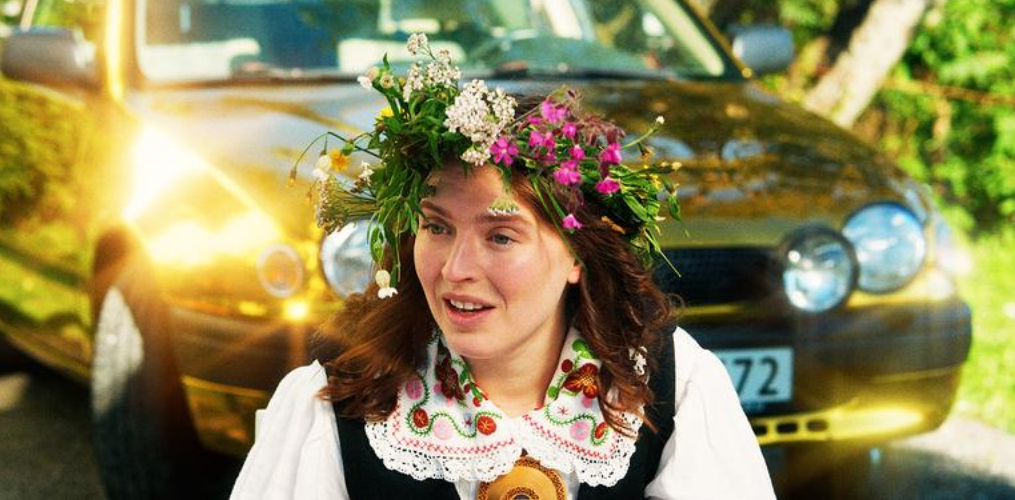
‘The Bitcoin Car’ follows a young Baltic goat farmer, Gloria (Johansen), in a small coastal village as she finds herself on a collision course with the megalomaniac death wish of a young crypto investor. After her younger brother, Lukas (Paus), comes home for the summer, she has to explain to him that she’s partially responsible for the gold-plated bitcoin mining facility located on top of the cemetery where their parents are buried. The facility was built after Gloria accepted a lot of money in order to gold plate her old Toyota.
However, now unexplained natural disturbances have begun to occur. When her baby goat Klamydia is found dead and turned completely white, the siblings team up with an electrician and a priest to find out what’s going on inside the crypto mine before everyone is put into danger.
‘The Bitcoin Car’ had its North American premiere at this year’s Slamdance Film Festival on Saturday, January 20 at 4:30pm MT at The Yarrow – Theater B in Park City. Luktvasslimo and Winther-Hansen generously took the time to talk about co-scribing, helming, producing and starring in the comedy during an exclusive interview over Zoom the morning of the project’s Slamdance screening on January 20.
Film Factual (FF): Trygve, you wrote the script for the new musical comedy, ‘The Bitcoin Car.’ What was the inspiration in penning the screenplay for the film?
Trygve Luktvasslimo (TL): So it kind of departs from where I live and my own life, in a way. We’re situated in a tiny little village up close to the Arctic Circle, in a remote place.
It’s a story about a young, small-scale farmer on one side, where we have nature and animals. On the other side, we wanted to contrast that with cryptocurrency coming to the village. So we wanted to showcase the contract between the individual and nature.
I also decided from the beginning that it was going to be a musical. So this all happened really fast, and it was a parallel process. So my composer, Victoria Sergeenko, started writing music at the same time as I started writing the script.
So we sort of created one song and genre per character. So it was a really good way to get into the characters because the lyrics are like the essence of each character. This all happened within two years from the beginning to the end of the film. We had to do everything together.
FF: Zoe, you played Rita in the movie. What was it about the character, as well as the overall script, that convinced you to take on the role?
Zoe Winther-Hansen (ZWH): Well, I found out about the film because Trygve contacted me e and told me about the film. I was in one of his earlier movies – his last short film, called ‘Shallow Water Blackout.’ For that movie, he met with me and he wrote me a special little part.
Then when he got to this movie, he contacted me personally. He said that he really would like me to play this character. I’m very glad he did. The character is very interesting.
I don’t have that many lines in the film, even though I am the antagonist. It’s an interesting way of portraying an antagonist – it’s very closed off.
But then in these singing moments, you feel like I completely open up. You really understand and feel for her, even though she’s a bad guy. That’s what I found very interesting about the character.
There’s a lot of playing with looks and body language, which is honestly my favorite part about acting – the process of completely getting into character. You’re really feeling it, in terms of the body language, so that you don’t have to just say the lines to be the character.
TL: It’s your process, Zoe, and I’m a fan of it. I hope we can keep making movies together. You’re always super ambitious.
Zoe’s in another new movie that premiered in the fall, just before Christmas, called ‘There’s Something in the Barn.’ It’s a horror comedy. It’s actually streaming on Amazon Prime, so I recommend everyone see that one, as well.
But I just love working with Zoe. It’s such a nice energy, and we have an enthusiasm that’s just wonderful for me as a director.
FF: Speaking about previously helming shorts in your career, Trygve, you made your feature film directorial debut on ‘The Bitcoin Car.’ How did you approach helming the feature, especially after you scribed the screenplay?
TL: It’s been such a roller coaster ride, but it’s been amazing. I’m just so grateful that we finished it. But it’s just been so much fun.
As I mentioned earlier, it happened within two years, which is a relatively short time to make feature like this one. But that just kept the energy on a maximum level at all times through all the stages. It’s been so much fun.
There’s always a risk to burn out if you do too much or you’re left with too much of the burden. So I decided at the beginning that I was going to try not to jump off the train. I was imagining that we’re on a train and it keeps going. So I thought, just hold on and don’t jump off. Also, use your friends and your colleagues to help you.
For me, I also said, “I don’t know, maybe this is my first – and also my last – film.” So I was just going to enjoy it and allow myself everything. I thought that would keep the good vibes, really. In that respect, I think we’ve succeeded.
I would have done it differently next time, obviously but I wouldn’t have done anything differently this time. It was such a pleasure to release the film into the world. We’re happy about it
ZWG: If there’s one thing that Trygve doesn’t do, it’s hold back, which is super fun.
TL: Yes, this is advice I give to everybody. All people in the world shouldn’t hold back.
FF: Once production began, how did you both work with the other actors to build the characters and overall story together? Did you have time to rehearse together?
TL: Yes, we did. My motto working is that the script sets everything. I don’t improvise very much, but there are always adjustments. Overall, I write out the lines and then we kind of stick to them, so it’s kind of very planned.
So that means that I like to prepare really well with the actors. I worked closely with Sunniva Birkeland Johansen, who played Gloria, the protagonist, as well as Henrik Paus, who plays her little brother, Lukas. They actually did a really good job together.
We had a lot of rehearsals. They also teamed up and sort of became friends. I think you can tell that this is really kind of warm sibling energy between them.
I can’t take all the credit for that. I learned afterward that they had been meet meeting at night and rehearsing together. I think Sunniva took care of Henrik. who’s not as experienced of an actor.
But I like to rehearse a lot. I think it’s helpful for everybody.
ZWH: It makes you feel very safe as an actor because then you know exactly what you’re going to do that day or in the scene. No one’s pointing the camera at you and asking, “What do you think? What do you want to do?” It feels very comfortable and safe.
Also, with such a small crew, it’s very intimate. Everybody knows everybody’s name. It’s very different from bigger productions.
What also makes it very nice to work on one of Trygve’s films is that all of us actors, and some of the crew, live in the same house. So a house was rented during the production, and we all lived communally together. We ate all our meals together. We also slept in rooms that were adjourned to each other. So we all really got to know each other and rehearse with each other. That’s a very nice initiative that Trygve did to get us all very comfortable with each other.
TL: It’s a dream situation because we could just minimize everything else around. When you need to focus on something, you have to try and have as little else going on as possible.
ZWH: We were also in one of the most beautiful places on Earth. We were basically on the water and there are mountains all around. When I had a day off, I didn’t just sit in my room and watch Netflix. Instead, I went on a hike and just soaked in the nature.
FF: Speaking about living with the rest of the cast during the shoot and filming the comedy in Norway, how did the location help influenza just the filmmaking process?
TL: That was kind of the backdrop of the whole production – that small village gave us local perspective on the larger things in life. Those things include existential ideas, like faith, death, life and nature.
ZWH: It’s all very metaphorical, like many of Trygve’s films are, so you can enjoy them at many different levels. Someone like Neil deGrasse Tyson would enjoy it as much as a kid in kindergarten.
TL: Yes, that was the thing we wanted. There are some professional actors, but there are also some really local people in the movie.
There are these two ladies, for example, who are from my village. They have these two alter egos – they’re two ladies from the 1800s. I saw them perform at a birthday party, so I thought, these women have to be in my films. So I asked them and they said yes.
So it’s this mix of layers of characters. Some are very natural, while others are weirder and more eccentric. Then you also have these characters who are more of a parody; they’re comedy characters, who are almost slapstick. So they’re all a little bit different.
ZWH: Yes,the common trope is that it’s all kind of absurd and surrealistic.
FF: Trygve, besides writing and directing the movie, you also served as one of the producers. How did you balance your producing and helming duties throughout the production?
TL: You do what you have to do to get the film made. I also produced my shorts in various degrees with co-producers. But they’re all carried by my own little company.
I enjoy it, but we all dream of a world where we can only do what we love the most. The accounting and figuring out the budgets aren’t that much fun.
But it’s really useful to be on several sides of the table. As a producer, I know what the budget situation is. So as the director, I can’t say things to another producer like, “I want this and that.” As the director and a producer, I have to figure out the problems. So it’s useful to be on both sides because then I’m responsible for all of it.
But I think the goal was to finally get this film made. I’m just so happy that we were able to get to that side of the business. Now it’s all about meeting partners for the next project.
That’s why this phase now is just so much fun; all the hard work is done and we’re just having fun. We came all the way from Norway over here to Slamdance, so we can meet all the other filmmakers and talk to people like you in the press. It’s such a pleasure.
FF: Like you just mentioned, ‘The Bitcoin Car‘ (had) its North American Premiere at this year’s Slamdance Film Festival. What has the experience been like to show the movie at the festival?
TL: So our premiere (was) in about six hours (after the interview), so that is super exciting.
ZWH: I always find it a little bit weird to watch myself on screen. But I’ve seen the film a few times now. So now I am fully just going to relax and watch it and listen to people’s reactions. I’m also hoping that we have a good Q&A after and I can answer as many questions as I can.
That’s really what I’m just looking forward to – talking to people about the film afterwards. That’s going to be really fun.
TL: We’ve had such a warm welcome by the Slamdance team. They’re heartfelt and present, and it’s been so nice to meet them. It’s just so nice to be here and such a privileged in so many ways.
 Film Factual