
NINA is an ATHLETE trailer premiering at Slamdance 2024 from NEWLOVEFILMS on Vimeo.
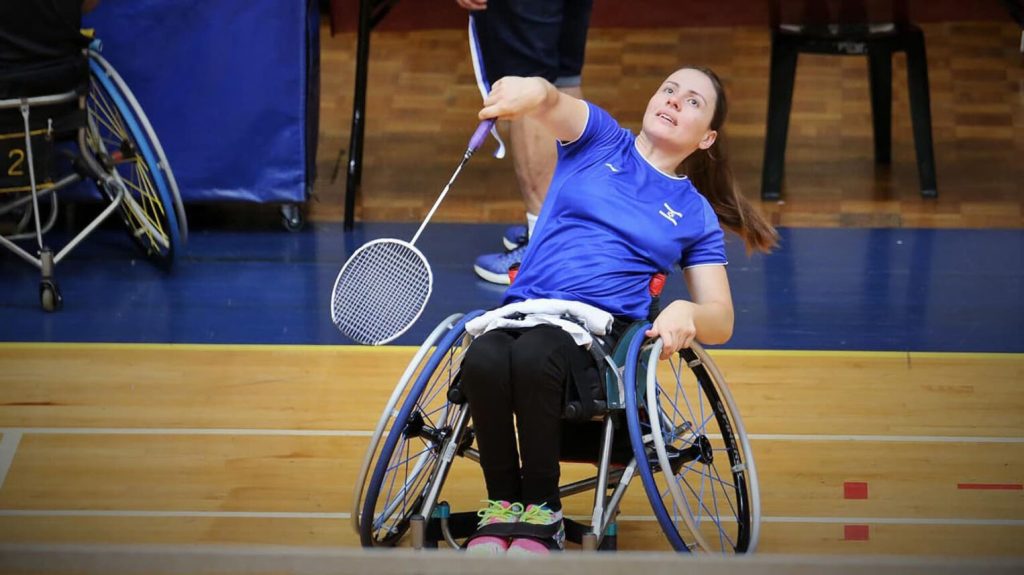
The most inspiring athletes confront not only their competitors, but also their personal obstacles during their journey to become champions. That’s certainly the case for Israeli para-badminton champion Nina Gorodetsky. Her determination to challenge her disability – and age – in order to succeed in not only the Paralympic competition, but also in motherhood, is showcased in the new documentary, ‘Nina is an Athlete.’
The film was written, directed and produced by Ravit Markus. Her sister-in-law, Livi Kessel, served as the co-helmer, co-producer and one of the cinematographers on the movie. The feature is in Hebrew and Russian, and is presented in English subtitles.
‘Nina is an Athlete’ showcases that Gorodetsky is on the cusp of turning 40. Just before her birthday, she faces her first and possibly last chance to make it to the Paralympics.
However, while the wheelchair-bound athlete aspires to represent Israel in the 2020 Tokyo Paralympics, she also wants to have a second child. As a result, she’s put in the crosshairs of a ticking biological clock, both as a mother and as an athlete.
Then, as if that wasn’t daunting enough, everything – the planning, the training, living a normal life itself – comes to a stop due to the COVID-19 pandemic. The documentary tracks the titular character’s unpredictable three-year journey to defy the odds and realize her Paralympic dream at the same time that she attempts to fulfill her maternal desires.
‘Nina is an Athlete’ had its World premiere during the Unstoppable program at this year’s Slamdance Film Festival. the screening was held on Friday, January 19 at The LUMIX Theater at The Yarrow Hotel in Park City. Markus generously took the time to talk about scribing and directing the movie during an exclusive interview over Zoom following the project’s premiere screening.
Film Factual (FF): You wrote the new sports documentary, ‘Nina is an Athlete.’ What was your inspiration in making a film chronicling the life and career of the titular wheelchair badminton champion, Nina Gorodetsky?
Ravit Markus (RM): So I really set out to make a sports documentary. I thought it would be cool. Like what often happens with documentaries, it just evolved to something else. It wasn’t exactly what I planned, but in a good way. Life surprises you, and it’s better than you can think of sometimes.
I realized that I do know a successful athlete, Nina Gordetki – she’s actually the sister-in-law of my sister-in-law. My sister-in-law is a wonderful documentary filmmaker in her own right.
So I called her and asked, “How about we try filming Nina and see what happens? She and your brother are good on camera. Is there a good story there?”
The moment I saw the footage, I knew that we had three stars – she, her spouse and her coach. They’re just wonderful on camera and so natural.
What was great is that not only are they great characters for a documentary, I also found out only after we started filming that Paradminton became an Olympic event for the first time. She was now vying for the Paralympics for the first time in her life.
So I thought, okay, now we have also a great story, not just a great character.
FF: Once you began working on the movie, what kind of research did you do into Nina’s journey as she aspired to not only represent Israel in the 2020 Tokyo Paralympics, she also to have a second child?
RM: I definitely needed more information as we were going. One thing that didn’t come up very much in the film, but we researched a lot because we thought it would be a major element in the film when we were working, was that she was in the first cohort of serious Paralympic athletes.
They took Paradminton to a new level for the last 50 years. That’s why it ended up being recognized as a worthy Paralympic event.
Most of Paradminton athletes were European and Korean. But the Chinese government wasn’t so interested in this sport until it became a Paralympic event. Then they started investing a lot in it.
Suddenly, all these young Chinese athletes showed up on the court. They were amazingly well trained because they live in these camps where they just trained from dawn until night. That was very tough competition.
The film’s story is very much about women’s reconciliation with the changes that come with age. A lot of athletes are definitely expected to hang their shoes up as they approach the age of 40.
This was a very clear kind of metaphor that the young generation is coming and kind of kicking the older athletes off the courts. So there’s just a little bit of that in the film. But it’s not as much as we expected. But it was something interesting we found out while working on the film.
FF: In addition to penning the documentary, you also served as the director on the feature, along with your co-helmer, Livi Kessel. What was your experience directing the film?
RM: So my approach is definitely as naturalistic as possible. That means that the main character dictates the style of the film. So a lot of this film is just following Nina’s no frills style.
Also, there were these budgetary constraints. So even if I wanted to do something more elaborate, I just didn’t have the budget to do it.
So it was very minimalistic. Usually we only had one camera following Nina around in a very close, intimate way. But luckily, she’s so charismatic on camera.
So that actually worked in our advantage. The main thing the audience said at the premiere screening at Slamdance was that they appreciated that the honesty and authenticity really came through on camera. You can see nothing is made up. There’s just no budget for it. It’s just really life as it unfolds.
Obviously, the editing is a very creative process. You do your best to make the film as engaging and entertaining as possible. So you pick and choose what you think will help the drama and emotion. But generally, it’s naturalistic. A lot of times, we’re just a fly in the wall.
Even some of the wonderful interviews that my sister-in-law, Livi Kessel, conducted, were very minimalistic. The camera was just very unnoticeable. It brought out something very real from Nina.
FF: Besides scribing and helming ‘Nina is an Athlete,’ you also served as a producer on the feature with Livi. Why did you decide to also produce the movie? How did you balancing producing and directing the documentary throughout the production?
RM: It’s hard because as a producer, a lot of your work is not only making sure everything happens, but also fundraising. You want to make sure that you can pay these wonderful people who are working with you on the film.
Sometimes you feel like for months, you’re just busy with that. You’re writing grant application after grant application.
It feels like you’re just stuck in that. You also feel like you don’t really have time for the creative process, which is why I do all this. So the balance is tough.
You try to make sure a few months are more focused on fundraising so you can keep doing the fun stuff. Then you spend a few months just focusing on the art and trying to move your brain back to the most creative side of it.
The two sides actually inform each other beautifully. So when I was writing grant applications, I had to think very deeply about what I was trying to do with this film. They ask you in advance what your film is going to be about and what its message is. But you’re still working on your method because you’re still editing.
But having to answer these questions in advance is helpful, even if the answer that you give in writing to some grand applications two years before you even finish the film is not what the film ends up being. But it helps with your thinking process.
Then, obviously, when you film and something exciting just happens, you can include it. In our case there was such a roller coaster of unpredictable events because of the pandemic and how it affected Nina and the Paralympics.
So this was a project that I could continuously update. I could say, “Well, we just had this happening in real life, so this is also going to be a great turning point for the film.” So it was a balancing act.
FF: Speaking about the editing process, Nir Guilat served as the editor on the film. How did you collaborate together to determine how the final version of the movie would look like?
RM: So Nir was my editor, and it was a pleasure to work with him. He was so sensitive to Nina’s background and family. He really gets her on a very deep emotional level. So it was wonderful to work with him in that sense.
We also worked with a wonderful consulting editor, Jacob Reika, who’s one of my favorite editors and has worked on many successful films. Luckily, he was available to be a consulting editor and give some very helpful input. He actually helped think about the name for the film which was helpful.
But one important thing I want to say is that to me, the audience is very important. I want to make sure that every joke lands. I also want to make sure that every emotional move is understood and really gives us the right emotional effects.
Some people say you’re actually directing the audience. So I want to make sure I’m directing the audience in the direction I want it to go.
The first screening (here) at Slamdance just was wonderful and showed it worked. But one of the things that helped the most for that was having a preview feedback screening with an amazing group that I have the honor to be a part of – FWD-DOC: Documentary Filmmakers With Disabilities.
The group was co-founded by Jim LeBrecht, the co-director of the Oscar nominated documentary, ‘Crip Camp.’ He became my advisor on this film. In general, he was always helpful throughout the process, including with the editing. He was thinking, what is really the core of the film?
He was also thinking, what do we want it to be, in terms of disability representation, to make sure we don’t fall into any pitfalls of just featuring the tropes that have been repeated over the years that we really wanted to avoid.
When he then invited me to have this feedback screening, that was incredible. Ten members of the group watched the film. I sent them the link, and then they sent me written feedback, so I could have time to think about and process what they said.
Then we had a big meeting where we all discussed things, and it was incredibly helpful. He had all these wonderful filmmakers who thinking together with me. We were thinking, how do make the film the best it can be, and that was very helpful.
Nir and I was on that Zoom. There were also people from all over the world on that Zoom. So there was this international perspective and really thoughtful feedback. That informed how the film turned out.
FF: Speaking about ‘Nina is an Athlete’s World Premiere screening at the Slamdance Film Festival, what does it mean to you that the feature played at the festival?
RM: So the first screening was just two days (before the interview), and it was incredible. I was there Friday morning (January 19), the first feature of Slamdance, a festival that I love. I’m blessed to actually have (had) a film there in the Unstoppable program two years in a row, which is a dream.
The audience response was just incredible. They really understood every joke, even the most subtle ones. Everybody laughed, and when I heard them laugh, I was so happy. It was the first time I watched the entire film with an audience in person; like I said, the feedback screening was each person receiving their own link online and watching it alone.
So watching it with the audience is exhilarating, especially when you feel they’re getting it. They got it big time. So when I saw that they were laughing at every joke, I knew that they’re with me and Nina, and that they’re going to care about her journey.
When the movie ended, one of the people in the audience said, “I never care about any sport. But since I was so engaged with her, I actually cared what’s going to happen with her athletic badminton career.” So that was a great compliment.
Another woman said the film was the epitome of womanhood, which was very much what I was going for. I never thought of defining it that way, but I always said it’s a very feminine film. It really shows what it’s like to be a woman. So to get those kind of responses was just heartwarming and worth this whole five-year journey.
 Film Factual