
The most captivating films can also sympathetically highlight life’s most vital lessons. That’s certainly the case with the new relatable sci-fi dystopian movie, ‘South of Hope Street,’ which masterfully showcases the importance of valuing and supporting mental wellness and self-discovery.
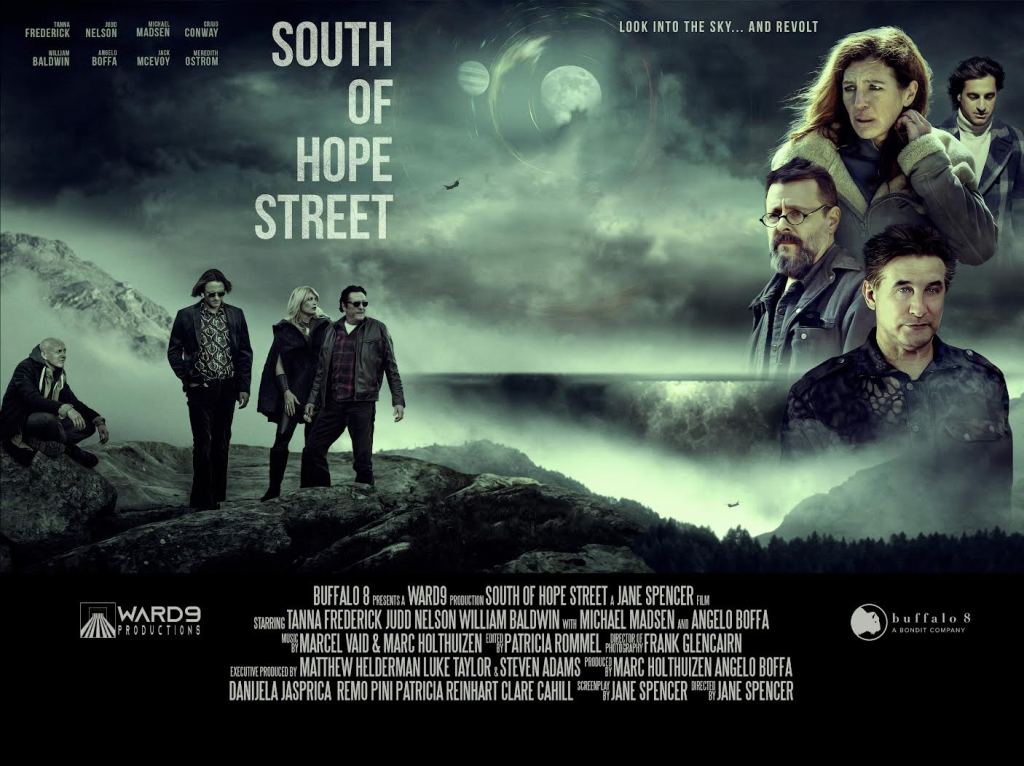
Jane Spencer wrote, directed and produced the drama. The film stars Tanna Frederick, Judd Nelson, Billy Baldwin and Michael Madsen. The movie is now playing On Demand, courtesy of Buffalo 8 Productions, following its theatrical premiere on April 18 in Los Angeles.

Set in 2038, ‘South of Hope Street’ follows Denise (Frederick), who lives in the relatively safe world of a neutral European country, as she notices that strange things are starting to happen. Earthquakes and tornadoes are occurring in places where they never used to happen, and there are two moons in the sky.
Despite her efforts to make people notice, nobody seems to care or believe her. Even her roommates, Xenia (Patricia Sluka), a pretentious performance artist, and her sycophant friend, Universe (Stefanie Alder), belittle Denise’s concerns and urge her to focus on other matters, like getting a job and maintaining her appearance. Denise’s only ally is Patrick (Gianin Loffler), who is also trying to fit in with society.
Denise observes that people are beginning to wear big black shoes as a symbol of conformism, which makes her feel lost and even more out of place. She begins to wonder why she would want to fit into such a world.
Life seems to improve for Denise, however, when she meets Tom (Nelson), a janitor/poet, and his young nephew Andre (Maximilian Preisig), who lost his arm in war. They are both fugitives from a new world war that has broken out, along with Wes (Craig Conway), a dispirited army veteran. Tom is trying to keep Andre from being drafted, and avoid being sent back to the war where he was once injured. As a result, they’re both hiding in Denise’s neutral country.
As the sky becomes stranger with each passing day, the media focuses only on the war and its casualties, diverting attention away from the unusual phenomenon involving the moons. When Denise’s country enters the war, the four characters must hide from the city where fascism is spreading, and the Black Shoe Movement is gaining power.
Wes knows a professor named Eduardo (Angelo Boffa), who has formed a group with other nonconformists seeking refuge in the mountains. Denise joins them, and she discovers a world of nature and freedom that makes her feel happy and in love with Tom.
However, the reality of the war keeps intruding on their idyllic refuge. Tom’s vision of a utopian world where art can make a difference seems foolish to Denise in light of everything happening. Her dream starts to turn into a bleak reality as she realizes they are hiding and doing nothing but dreaming. She must now make a choice on how she wishes to live her life and save her future.
Spencer generously took the time to talk about penning, helming and producing ‘South of Hope Street’ during an exclusive interview over Zoom. Among other things, the filmmaker discussed that she wanted to make a feature that serves as the metaphor for anything that’s not what the powers that be want to be accepted as normal. She also shared that she cherished having the opportunity of working with the actors because they were open to building the characters and story together.
Film Factual (FF): You wrote the script for the new sci-fi film, ‘South of Hope Street.’ What was the inspiration in penning the screenplay for the movie?
Jane Spencer (JS): I started the project quite a long time ago. I just had an idea about what it would be like if something unusual happened. So I thought, that’s an interesting and philosophical concept for a sci-fi film.
So I then asked myself, what if one day there are two moons in the sky? How would the reaction be? What would it mean to people? Would they be afraid? Would they ignore it, or try and put out scientific explanations for it from the government? So as time went on, it kind of became symbolically representative of the idea that people don’t want to see things like that, including the abnormal and the strange. That can be used as a metaphor for anything that’s not what the powers that be want to be accepted as normal. So it became slightly political.
I also kind of had inspiration from the novel, ‘The Sheltering Sky,’ by Paul Bowles. The title means the blue color in the sky represents a shield being around the safety against what we don’t understand, which would be the two moons.
It was hard to translate that onto the screen and make it a full story. So after I started writing it, I put it aside for a few years. But with the current political climate being as it is, and the fact that I’m a Democrat, I wanted to include those elements into the film. With the fear of immigrants, fear of the unknown and the, fear of anything that goes against the status quo, I thought I would make this movie.
FF: In addition to scribing the script, you also directed ‘South of Hope Street.’ How did writing the screenplay influence your helming style throughout the production? What was your overall approach to directing the drama?
JS: Well, at first we did a little teaser film with Tanna and a wonderful actor out of Iceland. So we put them together with a bunch of great actors who are friends of mine. We put together a five-mite teaser film to raise money for the feature.
It ended up taking us about four years to raise the money. We had a wonderful group of producers helping us, including Patricia Reinhart, Angelo Boffa, Clare Cahill, Danijela Jasprica and Marc Holthuizen, as well as Ward9 Productions. It was just a whole group of us, and we were all working together to get this thing on its feet.
Then I started directing the feature film in 2019, right before COVID was about to hit. We were all in a mountain hotel. It kind of reminded me of ‘The Shining’ because nobody else was there except the actors and the crew.
But in terms of directing, it’s just a matter of letting the actors interpret their characters and the story. Then I shape it a little bit. If I’ve cast it correctly, I don’t have to shape them a lot. I just have to see what they bring, and then bring it into what I want them to convey thematically to the audience. They do the emotional work, which is their job.
We had a wonderful cast. We had Judd Nelson, who Tanna brought to the project because she’s old friends with him. They have a relationship that works, as far as chemistry. We also had Michael Madsen, who I had worked with before. He brought a wonderful kind of comedic feel to his character, even though he was a darker character. But Michael gave a great performance. He’s very funny.
I also really love Billy Baldwin, who I think is a great actor. His character was the leader of the more conservative forces in the movie. The character’s cooperating with keeping people from looking at the two moons. He’s really good in this. He’s very strong but interesting enough that people would want to follow him. That’s what I wanted. He did a great job with that aspect of the character.
It was almost like an ensemble cast, even though Tanna and Judd were our romantic leads.
We also had Angelo Boffa. He’s a new actor, but he’s really interesting and good. He played a professor who’s very liberal in his leanings. He gets everybody to go to the mountains to get away from the forces that won’t let them look at the moons.
So I tried to include a lot of different actors from diverse nationalities on this mountain to fight the powers that be. So it was like everybody banding and fighting together, which is symbolically what I think should happen in the world.
We had just an amazing group of actors, including Jack McEvoy, Patricia Sluka and Barry O’Rourke. They’re all so funny, and everybody brought so much to their characters.
The work that they did was pretty amazing, so it was easy to direct the movie. I just had to aim the camera, and if they got off their mark, I had to bring them back on their mark, but it worked beautifully.
I studied at the Actors Studio, so that’s how I work with actors. I allow them to go into what they need to do with method or whatever they use, and then I just kind of shape it. That’s how I like to work.
FF: You mentioned shooting the film in the Swiss Alps. What was your experience of shooting the movie on location in Switzerland?
JS: It was really cool. I’ve never filmed in the Swiss Alps before, but a one of the producers, Patricia Reinhart, said, “Hey, I know somebody who has a hotel in the mountains that might work for what we want to do. Meredith Ostrom, who’s a co-producer and is also brilliant as an actress in the film, helped us put this together, as well.
Meredith and Patricia found this hotel in the mountains of Switzerland, near St. Moritz. So we met with the hotelier, and he said that he could let us use the hotel as a base for the cast and crew. That was cool because there were so many empty rooms, as there was nobody else there – it was off season.
It’s it was a really old hotel, and has a lot of history. All of these amazing writers have stayed there. So we were happy we filmed there,
In front of the hotel, we were also happy that we had a forest and a lake. We filmed inside the hotel, as well.
I had a great DP (Director of Photography), Frank Glencairn, who was really open to shooting handheld in the mountains. He was also open to shooting more stills in Zurich, where we filmed some early stuff.
It was crazy in the mountains, but we had fun! It was very cold. But overall, we formed a family. It was a real group of people coming together to make a film. We didn’t have a big budget, but we had an adequate budget to make this happen. Everyone was brilliant, and sacrificed a lot of time and effort to make this movie happen.
The hotel was very beautiful. We’ve gotten a lot of good reviews on the location because we had such spectacular visuals.
FF: What was the experience like of capturing the visual and special effects for the drama?
JS: Well, we had to carefully do it. We had wonderful help on that from Fiona Bavinton, who was doing second unit camera. But she also does special effects. So she kind of told us what we could and couldn’t do, and how we should film if we’re going to use special effects later, which we did.
We used our visuals, of course, because they’re natural and they worked. Then we also had some work done by Marc Holthuizen, who’s one of the producers and also specializes in visual work. So he did a lot of wonderful work on the special effects.
But this movie’s not like ‘Dune;’ it’s more lo-fi. But it works within the context of what we were doing. So we’ve gotten a lot of good reviews on it. So I think it was a good choice to go that way.
FF: Besides scribing and helming the film, you also served as one of its producers. What was your overall experience collaborating with the rest of the producers, who who’ve mentioned, throughout the production?
JS: Yes, there were a lot of us! I want to say thank you to all of them for all of their hard work over the years. We didn’t have a huge budget, so working with all of the producers definitely helped. Everybody had their own personality that they brought to it.
I also liked that these producers were never discouraged; they always worked hard to get the film made. They all fix problems – usually that’s the life of a producer while trying to get a film made.
They also have to follow what the script gave them in the beginning, and support the director and writer. As the director and writer on this film, I got a huge amount of support from our producing team, which was really great.
There were a lot of us because it takes a lot of people to make an independent film. But we made it work and we got it done, and now it’s out in the world.
Rima Moogli did a lot of work on the L.A. premiere, which went really well. We had a great receptive to the film there. We had a huge audience of about 500 people. We screened at the at the Regency Bruin Theatre in Westwood.
We had all the actors there, including Judd Nelson and Billy Baldwin. Michael Madsen didn’t attend because he had to go to a (Quentin) Tarantino event, of course, which happened the same night. So I had competition, big time!
We had a very glitzy premiere in L.A. It was very big and fun, and we had a great party afterwards at the W Hotel. That was due in part to Remo Muggli and Angelo Boffa, who made sure that that happened…In general, I’m looking forward to seeing how people respond to the movie… It’s an unusual film, and I will say that I know that!
Note: ‘South of Hope Street’ is next set to screen on Friday, November 8 at the Terra di Siena International Film Festival. Baldwin is nominated for the Best Actor Award, Frederick is nominated for the Best Actress Award and Boffa is nominated for the Best Emerging Actor award, at the festival. The drama is also nominated for Best Foreign Film.
 Film Factual