
The surreal environments in both the worlds of tech startups and filmmaking are surprisingly similar in some regards – the stakes to quickly deliver results are extremely high. Therefore, the protagonist in the new short thriller, ‘The Coder,’ who’s a brilliant software engineer, is captivatingly showcased to be ground down by the chaotic forces around her at her job.
The drama was written and directed by Will Crouse. He was inspired to showcase how he has endured a work environment that has no regard to for quality or employees’ mental health while working as a software engineer as his day job in his latest movie.
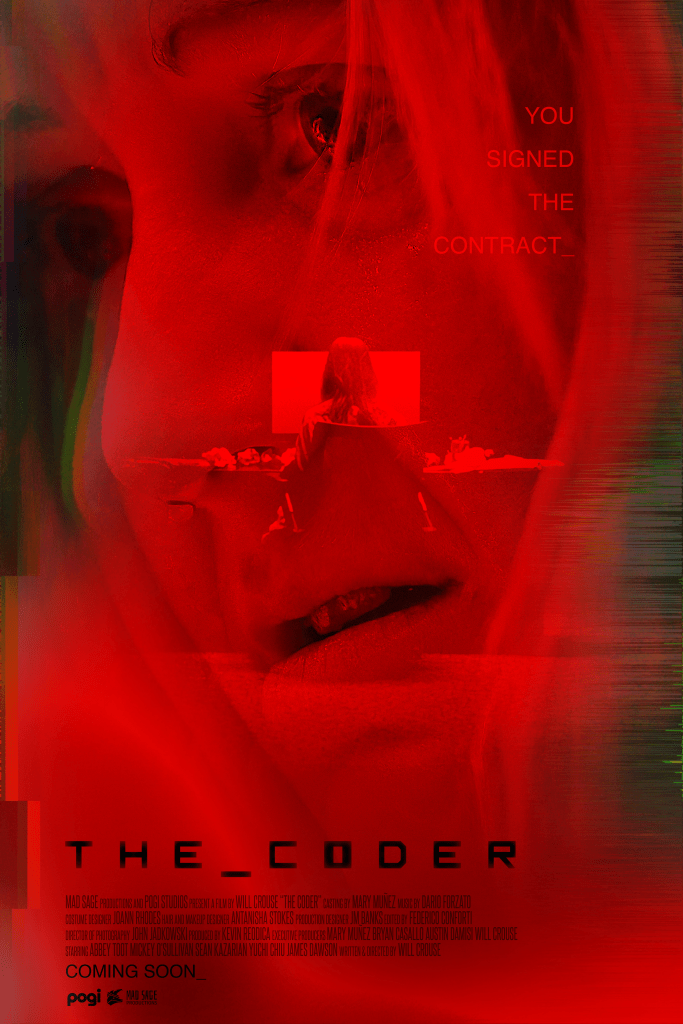
In ‘The Coder,’ Mary’s (Abbey Toot) crypto startup and mental health are spiraling. A flood of emails reported the app losing customers’ money, her thoughts keep fracturing and her CEO, Thad (Mickey O’Sullivan), seems not to have any regard for his employees’ well-beings. Time is running out for Mary to rally her team and avert catastrophe – or risk more than just her company collapsing.
‘The Coder’ had its World Premiere during the Shorts Block 7 on Saturday, December 7 at 4:15pm during Dances With Films: NYC 2024. The screening was held at Regal Union Square during the festival’s third annual event in New York. To help promote the movie’s screening, Crouse generously took the time to talk about penning, helming and producing the drama during an exclusive interview over Zoom.
Film Factual (FF): You wrote the script for the new short thriller, ‘The Coder.’ What was your inspiration in penning the screenplay for the film?
Will Crouse (WC): ‘The Coder’ is a short film about this software engineer named Mary, whose cryptocurrency company is spiraling out of control, along with her mental health. The film is about whether she can rally the troops and save the company and solve the bug. Otherwise, she’ll lose her job, and possibly more than just her job.
This film sort of came out of many years of my own experiences, as well as a lot of my friends’ experiences, in software developing. I’m a software engineer for my day job. I’ve worked at various startups, and have friends who have also worked at various startups.
The startup software life is a wild environment, particularly in cryptocurrency. The catchphrase that came along at the beginning of the startup era was “Move fast and break things.”
It’s a wild philosophy that I think can put a lot of pressure on people. People work really long hours. They’re trying to have their company break through the noise. I think that can be not great for people’s mental and physical health.
So the film started gestating by me seeing all of that. I then realized that I’d never seen a thriller, or even a story, really, from the software engineer’s point of view. Sometimes you get the founder’s point of view of their brilliant idea and how they’re going to launch their company.
But you never see the engineers who are the backbone of the company and what they’re going through. I think that there’s a really interesting story to tell there for the people who have the huge burden of actually making the thing that is supposed to transform the world.
FF: After scribing the script, you also directed the drama. how did writing the screenplay influence the way you approached helming the film? What was your overall approach to directing the short?
WC: I love the whole experience of writing and directing; it all kind of feels like one continuum to me. It feels like even in the directing, I’m still retweaking the script.
There was one part later in the film where a nightmare happens. I was just not happy with what I had written.
We shot this over the course of five days. On day one of the shoot, I realized what that final scene really should be, and what would be better than what I had written up until that point.
So the writing and directing bleeds together for me. I’m also very big on working with the actors. I’m not super precious about the dialogue being totally word perfect. There are certain things that if I really feel like it’s exactly right, it needs to be exactly that way. So I’ll make sure that happens.
But otherwise, I’m very open to having the actors bring their own life to it. That’s generally how I work as a director.
I think there’s a big continuum of Hitchcock when he said that actors are just furniture that you move around. The directors come in, they’re like, “It’s my idea. I see everything perfectly. It must work perfectly this way.”
Then I feel like there are people more like maybe Jim Jarmouche who are more like, “I come in and things happen. We figure it out later in the edit.”
I feel like I’m somewhere in between. I have visions in my head of what I want to happen, but I very much believe that the film is made by a group of people. The best thing that I can do is to take everyone’s individual artistic gifts and allow them space and a voice to make the thing bigger
It’s a film made of about 40 people, if you count everyone involved in pre- and post-production, and everyone who had some hand in it. So it’s a film of 40 people who really made it.
FF: Speaking about the actors, ‘The Coder’ stars Abbey Toot and Mickey O’Sullivan in the lead roles. How did you cast the actors who appear in the thriller?
WC: Well, Abby Toot, who plays Mary, is the lead in the film. I’ve actually worked with her for a decade. So I wrote this role kind of with her in mind. The idea of the character came first, but almost immediately after that, I thought about Abby. When I was writing it, I was seeing her.
So very thankfully, she was available. She’s an acting professor in North Carolina, so we figured out a time to shoot it over the summer that would work for her.
So that was interesting in that I didn’t audition her, or anyone, for the role; I just knew she was just right for the role.
I really think if you’re a young director, finding people who you just love and trust working with, and who just elevate your joy, elevates the whole experience. I think it’s huge to find your people and keep bringing them back.
We also have a great second lead, Mickey O’Sullivan, who plays the CEO, Thad. I found him and the other actors through a general casting call. I had a great casting director, Mary Munez, who’s also an executive producer on the project.
She brought in some awesome people. I saw incredible talent. When I saw Mickey, for instance, it was great. There was something of a kind of mania to the way he played Thad that I didn’t see otherwise. Other actors were great and had different choices, but the mania was amazing. It’s this word I keep coming back to – the wildness of him was great. You felt that he was the center of the tornado, and that instantly drew me to casting Mickey in that role.
FF: Once you began working with the actors, what was the rehearsal process like to build their characters?
WC: I’m pretty big on rehearsal. Life is long, and I like to say maybe my methods will change. But right now, I really enjoy having a rehearsal period.
This is my fifth short film. Most of the short films that I’ve written feature characters in the story who are supposed to have known each other for a while.
So I really like trying to build their relationships. Sometimes I’ll write scenes that we don’t see in the movie that are other days in the life of these people. So I’ll have the actors even rehearse that and just get used to each other and each other’s rhythms. This should feel like people who’ve known each other for a long time and have been working together for a while.
Also with this film, I really want to give the actors everything they could possibly need to succeed, and to feel deep in the role and to really feel like they could be these people. None of my actors are software engineers, but four of them play software engineers.
So one of the things that we did was that I got all of them computers and I taught them some very basic stuff about how you might use the computer like a software engineer would use it. I actually had commands made that if you typed them out and hit enter, things would happen on the computer.
That way, they were actually typing things out on the screen and seeing things really happen on the screen. That was happening while we were shooting.
I just feel like it gives it another level of reality. I could have just told them to just imagine it. Of course, many actors do and are amazing at it. But I just wanted to give them as many tools as possible so that it was easier for them to lock into it. So that was a lot of the process of rehearsal and building into it.
Then in terms of giving them their own space for their own ideas, I very much support their ideas. I had an actor with whom we did quite a few takes. It was a tough shot and got to take number six or seven when he asked me, “Do you want me to just do kind of what I’ve been doing, or do you want me to do something different?”
I said, “Yes, do something different if you feel it. Most importantly, I want you to be going with your impulse. I want you to not have the gate in your mind that says this is how the director wants it.”
It’s a fine line and you have to guide a little bit. But most importantly, I want them to feel like they can just go with a flow that’s coming to them naturally.
FF: ‘The Coder’ was shot on location in Chicago. How did you decide where you wanted to film, and what was the process of securing the locations?
WC: That was a really interesting process because this was mostly shot in an office. There’s a doctor’s office and there’s kind of a nightmare dreamscape.
So there were three locations we had to find. It was very hard to find the right location. We searched for a while.
We got a location scout and they search for a bit. We just got lucky. They came to us and said, “I found the perfect thing.”
It’s the longest building in Chicago – it’s enormous. It’s a lot of different stuff. There’s warehouse space and office space. There’s also a tunnel that looks like the deep tunnel into the void. You stand at one end of this tunnel and you can see it just goes for about a mile; it just goes forever.
There was an office space in there, and no one had been in it for a while. It was huge. It had these beautiful fluorescent lights. The building had another office space right next to it, which was the same size.
It’s funny – when we walked in there, my first instinct was, this is too big; we can’t do this.
But there was another office space that had a bunch of cubicle furniture in it. At first, I thought maybe we’d shoot in the smaller space with the cubicle furniture.
Then my DP (Director of Photography), John Jadkowski, really brought this. He said, “Let’s shoot in the bigger space. Let’s bring the cubicle furniture in here. We’ll make our own space in here. We’ll make a set.”
So it was actually the first time I’ve ever built a set. But we carved out a part of that room. We got the cubicle furniture in there. We made the office feel authentic. We had those beautiful fluorescent lights, which I just love. Then we had this wonderful room next to it that we could use as a holding area where all the actors could be.
So it was just an incredible space to work in. It felt like going to another planet. We went to this office and hung out there for 10 hours and made the movie.
We made the nightmare scape there, too. So we got these giant black curtains and created this void that we could shoot in. There was actually a room that I think was a kitchen, and we repurposed it. We got some props in there and turned it into the doctor’s office.
So shooting in that little space for those five days was a really cool experience that I’m not going to forget.
FF: You also served as an executive producer on the movie. how did you approach producing the drama?
WC: So in the past I have been the sole producer and only had films made through my production company, Mad Sage Productions. But this time I paired with an incredible production company in Chicago, Pogi Studios.
Pogi had a wonderful producer, Kevin Reodica. So for the first time ever, I wasn’t the only producer. It wasn’t all on me to write, direct and produce. I had Kevin by my side.
Kevin was incredible. He could handle all the nuts and bolts of the budget. He could answer, “What do we need to cut?” He had great, hard conversations with me about such things as, we’re not going to be able to do that in that way.
Actually, talking about how the script changed, maybe a month before we started shooting, there was a kind of nightmare idea I had. But it just was that realization of, well, if I really want that, then we have to lose something else.
So I was like, you know what? I want these other things more than I want that. Let me rewrite the script.
So to have a partner like that was just incredible. A lot of this movie is owed to Kevin’s hard work and his vision of how to keep a whole team and a whole machine running.
So I did a decent amount of producing in that he and I had conversations all the time about it. But I really have to applaud and be thankful for Kevin’s hard work in producing this film.
I also have to thank Pogi Studios for everything that they gave. Everyone at the company is just awesome. They’re committed to doing things well in a healthy manner.
We shot 10 hours a day. The only day where we had any overtime was the day that we loaded out. Of course, we paid people for the overtime.
But we just really tried to do things in a way that’s stable and healthy. People show up to work and they leave at the end of the day, and we do what we can in that time. So I’m just super appreciative to Pogi and Kevin for all of that.
FF: ‘The Coder’ (had) its World Premiere in the Shorts Block 7 on Saturday, December 7 at 4:15pm during Dances With Films: NYC 2024. What does it mean to you that the thriller (premiered) at the festival?
WC: It’s so exciting. I love Dances With Films. I was there a couple of years ago with my short, ‘The Reception.’
I just love the people there who run it. Michael Trent, Leslee Scallon and Lindsey Smith with the short films program are just awesome. They really create a familial vibe. They have fun parties and you meet a lot of people. They also program awesome shorts.
I feel very humble and appreciative to (have been) a part of such a great festival. I (knew I was going) to show with four or five other shorts. I checked out some of their key art and trailers, and they look awesome.
It’s just a very exciting time. I (thought it was) going to be a super cool festival. I think it’s the kind of thing that you can go watch some cool art, and meet the people who made it afterwards. We all (hung) around afterward – the lobby’s always has a real hum of activity.
So it’s just a great vibe and a lot of fun. I hope people (who attended the festival enjoyed) the art and the people!
 Film Factual