
The most sentimental coming of-age comedies in modern society pay tribute to the romanticism and nostalgia of bygone decades. Like the new teen comedy, ‘Screams from the Tower,’ they’re crafting a love letter to old friends and heroes who forever changed filmmakers’ – and the audiences’ – perception of the world.
The movie is inspired by, and a tribute to, John Hughes and his iconic Chicago teen comedies from the 1980s. Like such classics as ‘Sixteen Candles’ and ‘The Breakfast Club,’ ‘Screams from the Tower’ focuses on the absurd, painful and often laughable journey of self-discovery every teen goes through before graduating high school.
Cory Grant served as the writer and director on ‘Screams from the Tower.’ The up-and-coming LGBTQ filmmaker pays homage to Hughes in the new feature, which is based on Grant’s teenage years growing up in the 1990s in the Chicago suburbs.
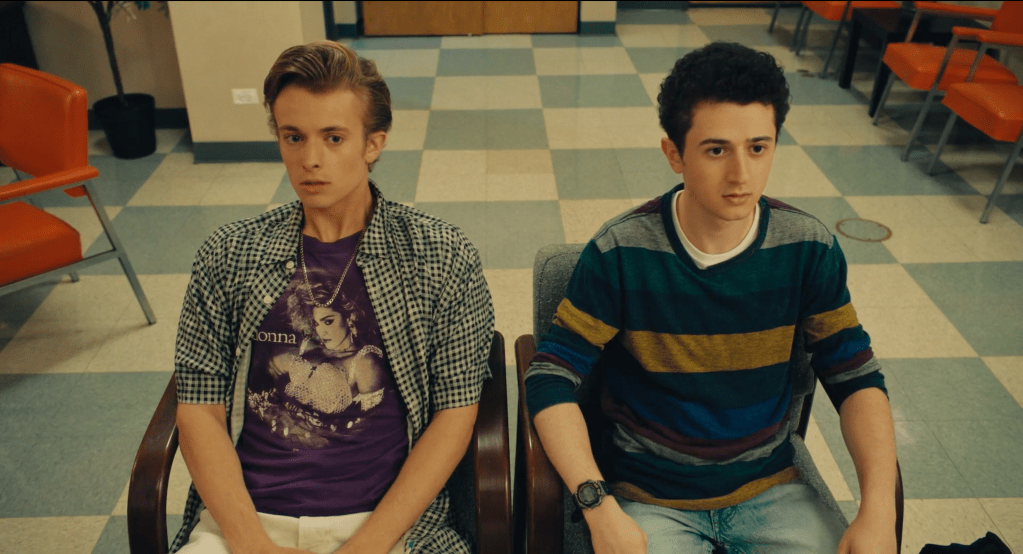
‘Screams from the Tower’ follows Julien (Richie Fusco), his best friend Cary (David Bloom) and their outcast friends through high school in the early 1990’s. Julien and Cary’s dream of having their own show on the high school radio station is finally realized, bringing them popularity and infamy they never imagined.
‘Screams from the Tower’ had its East Coast Premiere on Saturday, December 7 at 9pm during Dances With Films: NYC 2024. The screening was held at Regal Union Square during the festival’s third annual event in New York. To help promote the movie’s screening, Grant and Fusco generously took the time to talk about penning, helming and starring in the comedy during an exclusive interview over Zoom.
Film Factual (FF): Cory, you wrote the script for the new teen comedy, ‘Screams from the Tower.’ What was the inspiration in penning the screenplay for the film?
Cory Grant (CG): After I finished my first feature (2020’s ‘Painter’), which is very different movie from ‘Screams from the Tower’ – it’s a psychological drama with a lot of blood and sex – I wanted to just take a year and write as many scripts as I could.
This one idea came to me, as it’s a very autobiographical story of me and my best friend in high school, and the radio show we had at our school. My best friend happened to record all of those on cassette tape, and then I had them digitized.
I just thought I had never really seen a coming-of-age gay story about two kids that wasn’t about being religiously persecuted or about parents who didn’t support them. I just felt like that had been done 100 times before, and they were very well made.
So f I could make something even somewhat original, I had to do it. It was just a font of information that I just threw onto the page in about a month.
I was just amazed that around 200 people at this point loved the script enough to want to make it and give us money and the time to do it. I was very fortunate.
FF: Richie, you play Julien in the movie. What was it about the character, as well as the overall story, that convinced you to take on the role?
Richie Fusco (RF): Well, when this audition came in for the first time, it really stood out to me. I think the character was just this creative guy who just had all these amazing and quirky personality traits that I knew were just so out there and really made him an outcast.
He was so emboldened and so sure and unsure of himself at the same time. He had such a loud voice.
So when I saw this script come through, I thought it was just so much fun. I thought it was unlike something I’d seen in a while.
I loved that it was a very character-driven story. I just loved all the relationships that you get to see with Julien and his friends and his family. It’s just this nice, refreshing story where you can just go back to high school and have fun with these kids as they’re trying to figure out who they are and who they want to be. I think that’s what stood out to me the most.
FF: Cory, besides scribing the script, you also directed ‘Screams from the Tower.’ What was your overall approach to helming the comedy throughout the production?
CG: This was my second feature, and I worked with the producer, Alex Wenger, on both films. On our first feature, we built this incredibly candid relationship where we could really be honest with each other. We had the same goals and values on how we wanted to make a movie. He was just instrumental in forming this production and bringing in the most incredibly talented and diverse crew.
That then subsequently led to a similar cast. We have a deep ensemble of about 23 characters in the film, not including our extras. It was just a completely magical moment.
As a director, I really want to take actors out of their home environment and put them in a summer camp, for lack of a better word. That way we’re all only doing this movie, and no one has to worry about their kids and their job or about feeding their dog. That way we can all just assemble and function together. From my point of view, and I think I can speak for everybody involved in the movie, we had a great month in the suburbs of Chicago.
With every movie, there’s a lot of luck. Nobody got sick or came to set very hung over – or, to the point of it being a problem, anyway. I think every movie needs a lot of luck to at least get this far.
FF: Cory, peaking of the casting, especially of the main characters, how did you decide who you wanted to star in the lead roles?
CG: Again, I think we were really lucky. We had a phenomenal casting director I’d worked with on my previous movie. Her name is Rachel Reiss, and she’s out of New York.
But because we were just out of COVID, we had to do everything over Zoom. For me, who grew up in the theater, it was awful.
I want to be in the room with actors. I want to meet them, shake their hand, make eye contact. feel them out, and see if we vibe and click right there in the room.
That being said, one person for all 23 characters came in and just stole the role. It was just obvious from day one, for the most part, that this person owns this role.
Richie was no exception. The only bad part was that him and David Bloom, who is the other lead and plays Carrie Geller in the movie, had to do their chemistry read virtually. They had to read together on Zoom, even though they only live miles from each other in L.A.
But all that said, we found that synergy. Something out there deemed us to find that magic. So again, we were really fortunate.
FF: Once casting was complete, how did you work together to build the characters? Did you have any rehearsal time together and with the other actors?
RF: I loved working with Cory Grant. He is an excellent director, and honestly, really was a guiding light for me. He was very collaborative, which I think is so important in helping to find all of the characters.
I feel like the whole time, Cory, you were just so open to having fun. You also encouraged us actors to improvise and bring ideas to the table.
But also, with the movie obviously being a semi-autobiographical piece, Cory, pulled from real life experience. It was this beautiful blend of having the history to draw upon and having fun and being collaborative to create this movie.
Like Corey was saying, I think we totally achieved that summer camp feel. I think it’s totally rare that you find a crew that even on your off days, you still want to hang out with them.
So I feel like everybody got along and was just genuinely friends. We were all just hanging out. It was o much fun to make this movie. It felt like we making it at summer camp. It felt like it was like a class project almost. It was just a great time.
CG: Every movie and project is totally different. But overall, as a director, I’m not somebody who idealizes inserting myself into the actor’s process. I like to ask actors how they like to work before we get started. I try to find that harmony between us.
With Richie, David Bloom and the rest of the cast, since they were so great and so right from the audition for their roles, it was just about guiding them and just making the space to let them do what they do so well.
Richie is a humble guy. But he just came out of college, and COVID was the year before we started shooting. So to my understanding, he had never done the lead role of a feature film before.
That’s a demanding feat. It’s one thing to be the lead role of a play that is totally cohesive. But to do a film completely out of order, and to fight for continuity in your character and his arc, at the age of about 22 is a gift. It was just simply my job to make sure he was getting the performance Richie and I wanted. In all honesty, it was easy and a pleasure.
FF: Richie, you mentioned improvising earlier, as well. Was improv something that you and your co-stars did on set, or did you all mainly stick to the script? What was the experience like of creating new ideas on set?
RF: Improv was definitely encouraged, especially for the scenes in the radio station, when we were in the actual recording booth. To my knowledge, Cory would always have us pretty much start out with a copy that pretty much stuck to the script.
Then once we more or less got that one, it was always him saying, “All right guys – now pretend that these takes are you guys in high school, and just riff and crack jokes and play off of each other. Don’t be afraid to mess up and say the wrong things. We can edit all this stuff, so just have fun and mess with each other and really dive in.”
So improv was definitely heavily encouraged. I think that’s honestly why the relationships work so well. Obviously, we have those scripted beats, and for the most part, we followed the script a lot.
But there are these little key nuggets of improv in there that really bring out both myself and David’s personality, not just as the characters, but as friends and roommates during the project. So I think that that allowed our connection to seep through.
I feel like you can see the authenticity behind both of our performances because we’re actually having fun. We’re not acting that we’re having fun – we’re actually having fun. I think that really helps.
FF: With Julien, Cary and their working at their high school’s radio station, how did you create the production design for the comedy?
CG: We had a really phenomenal production designer. The radio station in our movie is a complete fantasy. We used a real radio station, but of course it was full of modern technology, as we shot the movie in 2022.
So our production designer, Kerri Lyn Walsh, had to facilitate everything in the radio station to make it look like it was 1995 and ’96. So that included removing everything that was in there and filling it back up with cassette tapes, CD players and old microphones. I think she just did a beautiful job.
It’s a trip to go back and shoot in high school, which for me, was at times highly traumatic. I was like, the smells and sounds of it, as well as the lockers and even the boy’s bathroom, brought me back. At times I would turn to someone on set and be like, “I’m freaking out in here, man. It’s just like all the PTSD of high school coming back.”
We shot in the suburbs of Chicago, and that was a real treat. It’s not like shooting in L.A. or New York, where they know to gouge you on price and they kick you out after a certain hour. There was a real authenticity to the place. So it was a trip of going back in time; there were many times I had to pinch myself.
FF: ‘Screams from the Tower’ (had) its East Coast premiere at Dances With Films: NYC. What does it mean to you that the movie played at the festival?
CG: We (played) at (Regal) Union Square (on) Saturday, December 7 at 9 pm in a huge theater. We (tried) to get as many high schoolers and college students there as we (could).
As much as this movie is for everybody, it‘s particularly for the youth of today. I want them to indulge in the ’90s, which they seem to be doing anyway because they’re wearing all the same clothes – they just look much better than we did at the time!
So it (was) a thrill to be at Dances With Films. We’ve been really lucky in terms of getting into film festivals and getting some really cool awards. So the next thing is just to get it streaming to the entire world as soon as possible!
 Film Factual