
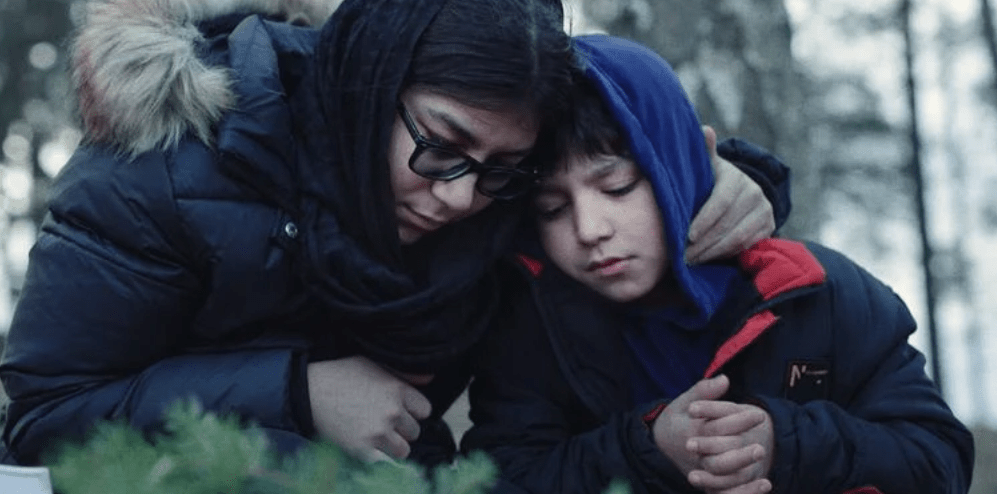
Update February 27, 2025: ‘Silent Trees’ won the Slamdance Film Festival 2025 Breakouts Feature Grand Jury Prize.
A coming-of-age story about a Kurdish teenage refugee girl who’s determined to start a new life with her family on the Polish-Belarusian border has never been so relatable to, and understood by, international audiences. The new documentary, ‘Silent Trees,’ chronicles the harrowing loss and fleeting joy of the grieving family, who represent the plight of refugees who are trapped by geopolitical obstacles in countries around the world.
Agnieszka Zwiefka wrote and directed the movie. She also served as a producer with Zofia Kujawska.
‘Silent Trees’ is set to have its U.S. Premiere in the Breakouts section at the Slamdance Film Festival, which is moving to Los Angeles this year. The documentary will hold its first screening at the festival this Friday, February 21 at 2:30pm PT at Summer & David Theater at Quixote. Its second Slamdance screening will be held the next day, Saturday, February 22 at 4:00pm PT at the LA Times Theater at Quixote. For more information on the movie and its screenings at the festival, including how to buy tickets, visit its page on Slamdance’s website.
‘Silent Trees’ follows Runa Husni, the 16-year-old Kurdish refugee, and her family as they have been stranded in an icy forest in the Belarusian-Polish border, denied entry into either country. Runa is forced into responsibilities beyond her years; she has to start caring for her younger brothers and being a support for her father after her pregnant mother dies due to their harsh living conditions. Eventually placed within a Polish refugee camp, the family grapples with the trauma of their loss while struggling to adapt to a new life in a new country.
While her father desperately tries to find work to feed and take care of his family while hampered by language barriers and other seemingly insurmountable hurdles, Runa finds comfort in drawing, which are morphed into animated sequences that capture her dreams and nightmares. Runa and her family are determined to keep fighting to survive and keep the hope of a better future alive, despite the daily horrors of the global refugee crisis.
Zweifka generously took the time last week to talk about helming and producing ‘Silent Trees’ during an exclusive interview over Zoom. Among other things, the filmmaker said that she wanted to make the feature because the refugee crisis is relevant and universal all around the world. She also mentioned that she’s happy that the documentary is having its U.S. premiere at Slamdance because it’s one of her favorite film festivals.
Film Factual (FF): You wrote and developed the story for the new documentary, ‘Silent Trees.’ What was your inspiration in making the movie?
Agnieszka Zweifka (AZ): The reason why I wanted to make this film is because the refugee crisis is relevant and universal all around the globe.
Suddenly, it lstarted to happen next to me on my doorstep. A new route for illegal migrants and refugees was opened in Europe right near me. It was a route designed by Putin and (Belarus President Aleksandr) Lukashenko in order to create chaos in Europe on the eastern frontiers of the European Union.
So people were literally freezing to death in a huge forest. Some parts of the forest haven’t even been penetrated by scientists.
So I thought this is not human, and I have to do something about it. So I started volunteering on the border.
I then pretty quickly realized that the most interesting story is about the teenagers, especially the girls. So that was how I decided to tell the story from their perspective.
Pretty quickly, I met Runa, our main protagonist, who is a 16-year-old Kurdish girl. It was like love at first sight. There was just something about her, like this silent strength.
FF: When Runa decided to participate in the film, how did you get to know her and her family, as well as their situation? What kind of research did you do into their life struggles?
AZ: We actually met them on the first day that they arrived in the refugee camp. It was an emotional roller coaster, as we were with them on the day their mother died and they found out.
We were also with them on the day they got a deportation notice. We were all convinced that they would get deported. So we were with them on all the darkest days of their lives.
But we were also with them in the fun parts of their lives, like when they were laughing and dancing. Kids are always kids, even when the worst things are happening around them; they somehow find a way to bring joy into life.
So in the film, we wanted to bring light into this darkness and offer them hope. But it was a roller coaster; we were with them in the darkest moments, and then the next day, we were all laughing dancing and enjoying life while it lasted.
FF: You also served as the director on ‘Silent Trees.’ What was your experience like also helming the documentary?
AZ: We tried to be as invisible as we could because I think that’s how you make the best documentary films –the people you film don’t notice you anymore because you are so much a part of their lives.
But that also means that you have to spend countless hours with each other. It’s all about the time you spend together, including cooking together, laughing together and crying together. All of these things create this deep bond that actually allows you to film life as it is.
So I think this is the biggest challenge – to find the right crew to be with you and gain the trust of the protagonist. I still think it was incredibly brave of them to let me into the darkest period of their lives with the camera.
The film starts when the mother died and they were lost in a foreign land and had no hope for a better future. We had no idea where their lives would go. But luckily, their story has a happy ending; Runa is now a full-bred European with straight A’s in high school.
FF: Like you mentioned, while you were filming the movie, you tried not to be too visible in Runa and her family’s lives. How did you work with the film’s cinematographer, Kacper Czubak, to figure ow the best way you would shoot the project?
AZ: I just worked with my cinematographer. We had a very small crew, so I did most of the sound. In some cases, I even filmed the footage myself.
It was about us being as compact as we could, especially since we were filming the first part of the story in a refugee camp. It was very difficult to gain permissions to film there.
It’s also very small; the rooms are very tiny. So I knew that I could only film with one person, Kacper Czubak, who is my friend and DOP (Director of Photography).
He’s an extremely tall and big guy. I have no idea how he does it, but he really disappears when he films.
FF: Besides including the live-action footage you shot with Kacper, you also included animation in the documentary. Why did you decide to also feature that animated footage in the movie?
AZ: At first, we just wanted to make a traditional observational documentary film. But we didn’t know the language – I didn’t speak Kurdish – and my protagonists didn’t speak English or Polish.
So very often, it was just body language or some psychological things that I cannot explain that allowed us all to communicate with Runa and her family. But somehow we knew that this was the way we should shoot the film.
Later on, I learned Kurdish and they learned Polish and English. So we all started to speak multiple languages.
But the idea of incorporating animations into a documentary came actually very early on, I noticed that whenever the worst things were happening in Runa’s life, she was shutting herself away from the world around her. She was instead just drawing in her sketchbook.
So we figured that this is something that Josh Oppenheimer called the documentary of imagination. I love this term a lot. This is the only way sometimes to recreate something or to enter someone’s mind and to really show the inner truth that’s not filmable otherwise.
FF: Besides directing ‘Silent Trees,’ you also served as one of its producers, along with Zofia Kujawska. How did you approach producing the movie?
AZ: I asked Zofia, my colleague, to join me on this as a producer. Then very quickly after that, we had HBO on board. We also had ARTE, which is a French-German television company that’s very important in Europe, on board. So we had the biggest TV stations basically working with us from the beginning.
I would say that the production side was actually super easy with this film. (Zwiefka laughs.) Everything was just the way it should be.
It was just the emotional tension that took a toll on us. Sometimes it still does because Runa escaped from the forest. She survived, but the forest never actually left her; it’s still somewhere inside.
She still hates trees now, even two, three years after these incidents. So she never walks through the park to reach her school; she just takes a longer way around the park to get there.
So there are some things that still haunt her, but overall, I think she will have a very bright future in Europe. She’s a smart girl and wants to be a lawyer.
FF: Once you finished filming, how did you determine how you would put the final version of the film together with the feature’s editors, Michal Buczek and Katarzyna Orzechowska?
AZ: Actually, we started editing while we were filming, so there was never this moment that we finished filming and then began editing When we finished shooting the last scene, we already had about 50 minutes of the film edited. So it was all happening at the same time.
However, we had no idea how the story would finally end. But we had a pretty good idea how to shape the beginning of it and many other aspects. So it was a chaotic way of working on this project.
I never worked like that before. But that’s because we really wanted to share this story as soon as possible, so that it can possibly change someone’s heart.
We are now bringing the story to the U.S. at Slamdance. This will be our U.S. premiere.
I actually just realized that it cannot be timelier in the U.S. than it is now because you have your own refugee girls. Maybe they’re not trapped in the freezing forest, but they are trapped on a different border.
FF: Speaking of premiering ‘Silent Trees’ here in America at the Slamdance Film Festival, what does that mean to you that you’ll be sharing the documentary with audiences at the festival?
AZ: I love it because Slamdance is actually one of my favorite festivals. It’s actually been one of the festivals on my bucket list! (Zwiefka laughs.) So I’m really thrilled to be having the movie’s U.S. Premiere there.
I love the vibe of this festival, and the quality of the films is amazing. So I can’t wait for the movie to play there!
 Film Factual