
With growing cultural divides and conflicts in modern society, one leading conflict that needs to end is people’s discomfort surrounding disability and disfigurement. The new documentary, ‘Disposable Humanity,’ supports normalizing and encouraging culture’s acceptance of everyone, regardless of their differences.
Cameron S. Mitchell made his feature film directorial debut on the project, which his family has worked on for the past 25 years. He also wrote, edited and produced, and served as the cinematographer on, the movie.
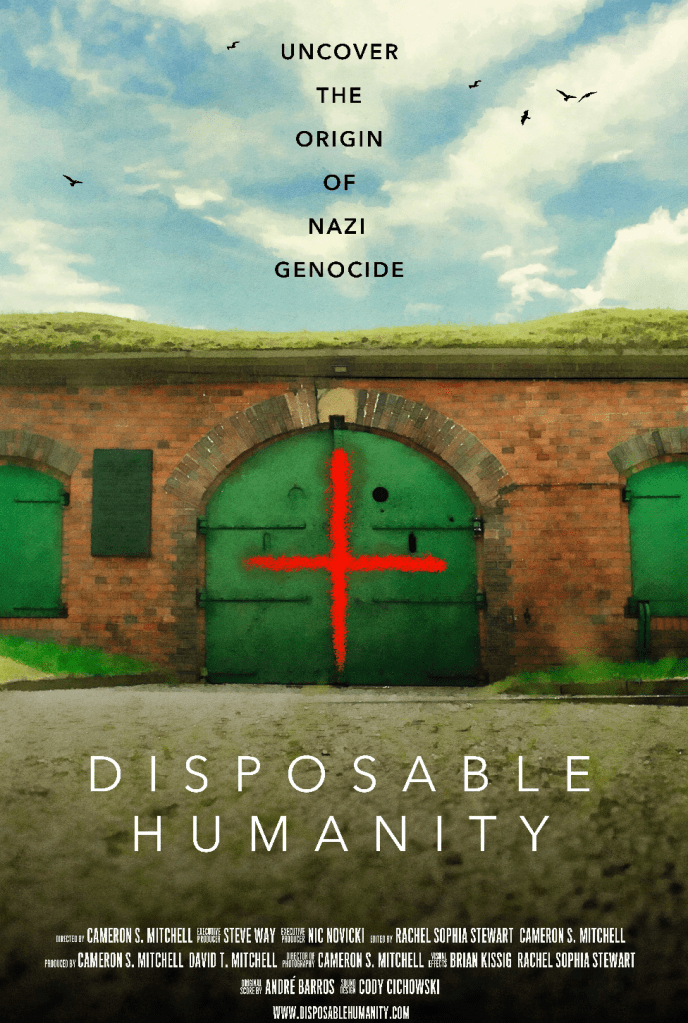
‘Disposable Humanity’ follows members of the Mitchell family, who are Disability Studies scholars and filmmakers, as they have researched The Nazi Aktion T4 program since the 1990s. Through conversations with memorial directors, disabled people and relatives of T4 victims, they uncover the horrifying truth that the Nazi Aktion T4 program was used by Nazis to train their staff, kill their victims and design the apparatus of mass murder that led to the Holocaust.
Disabled people became the first victims to be killed under the Third Reich. The Mitchells reveal this fact in the documentary, which has been covered over and erased from international public memory.
‘Disposable Humanity’ had its World Premiere in the Unstoppable section at the Slamdance Film Festival, where it was honored with the Unstoppable Grand Jury Honorable Mention and the Audience Award for Unstoppable. Mitchell generously took the time before the start of the festival last month to talk about penning, helming, producing, editing and filming the movie during an exclusive interview over Zoom.
Film Factual (FF): You co-wrote the new documentary, ‘Disposable Humanity.’ What was the inspiration in making the film?
Cameron S. Mitchell (CSM): So this is the question everyone wants to know. I got started from a very early age. My parents brought me to the Burnberg gas chamber when I was nine years old.
I automatically started drawing the interior of the gas chamber and the memorial there, which is also still an active psychiatric institution, interestingly. I drew myself and my family as mouse characters from Art Spiegelman‘s ‘Maus’ because at the time, I wanted to be a comic book artist.
That stuck with me. So I held on to the idea of wanting to make something.
My folks were filmmakers. They made films as a part of their academic careers.
We eventually went back and did it. In this film, we used footage that they filmed in the ’90s when we were there.
So you get this film is really time traveling. It brings you through time and space through decades and generations. So there are so many layers to go into with this film. It just contains so much of me.
It’s hard to speak about all of it, or even some of it. That’s what I love about film – you just have to see the film at the end of the day.
FF: Besides co-scribing the movie, you also directed the feature. How did you approach helming the documentary?
CSM: Well, for indie filmmakers, the question is always one of money and resources. I think we were very gifted in that somewhat strategically, I chose this subject because my folks had insider access to the subjects.
We knew all of the directors of all six T4 memorials. By the way, I don’t think I’ve defined the Aktion T4 program and what this film is about; it’s about this secret Nazi program where the Nazis targeted disabled people. They trained the staff and created the technology necessary to implement the Holocaust.
So this film really deals with a massive historical oversight. The disabled people were the first to be killed and the last to be remembered. The memorial to T4 in Berlin, Germany wasn’t open to the public until 2014.
So this film really fills a gap, I would say. It has a lot on its shoulders and a lot it has to do.
So in terms of directing, I leaned into my cinematography side because I’m a local 600 cinematographer and Steadicam operator. I wanted the camera to hold a lot of the weight and significance of the film. I knew there were just things you couldn’t convey except through an image and the things in the frame.
So the lenses that we use to shoot this film were actually lenses that were manufactured during the Third Reich in 1930s and ’40s in Leipzig, Germany. I wanted the film to look like how people would have seen representations of themselves at the time.
I think being the DP (Director of Photography) and director, and the unity between the two jobs, really helped me. I knew that I could make quick decisions of where to position myself in the scene without having to communicate that to somebody else.
Alot of my filmmaking has this improv aspect with the subjects, where I’m with the camera and the subject, moving through space, and we’re kind of dancing. That’s the best way I can think to describe it.
FF: As you were making ‘Disposable Humanity,’ how did you approach doing more research than what you had already known about the subject? How did your research help you shape the film’s story?
CSM: Well, making the film itself was a part of the research because we spoke to so many experts. We talked to Robert J. Lifton, who’s the author of the New York Times bestseller, ‘The Nazi Doctors.’ It’s a prolific book in Holocaust studies. For it, he interviewed a lot of the Nazi doctors after the Holocaust.
He also lent his expertise to this film. So we were able to learn about his perspective and how he saw that Nazism flowed through Hitler; the mysticism of Hitler is what enabled Nazism. I think that is really relevant to the world right now and what we’re looking at going on around us.
It’s important to remember. How can you remember something you’ve never forgotten?
So the job of this film is to teach audiences about the history, and to make it an engaging and cinematic experience. Then we can move on and approach the knowledge that disabled people were the first to be targeted and that they were the first victims. We can now look out for them and know that they will fall on the front lines of a lot of fascist policies that might directly or indirectly target them.
FF: The movie includes a diverse cast, including Sharon L. Snyder, Susanne Knittel, Jörg Waßmer, Andy Hechler and Andreas Knitz. How did you decide who you would feature in the documentary, and what you would ask them during their interviews?
CSM: I’m glad that you’re asking more about this because honestly, my father was a big influence here. He really earned his producing title on this film through the coordination of these interviews.
Almost all of the experts were lined up by him and my mom, really, because they do their research together. So they lined up these subjects and then we would get to know them a bit. We would then sometimes expand the filming at their places.
I did the whole filming of this with my family. So I was doing a documentary film production for two months in Germany with my mom, my dad and my sister.
There are two wheelchairs in that group. So we had a wheelchair accessible ramp van, and it was stick shift. But I couldn’t drive stick shift. So our second camera operator, Ryan Hammaker, would drive us everywhere, as he thankfully knew how to drive stick shift. So that was a very key part of making the production happen.
In terms of the subjects, I owe a lot to my folks for the research that they did. That was really the intention behind this film at the end of the day, as I wanted to highlight their research.
I wanted to bring it to a larger audience because they teach disability studies, and it’s influential in the field. But I wanted it to break out of disability studies and bring it to the world at large.
FF: Besides directing the film, you also served as one of the producers. Why did you decide to also produce ‘Disposable Humanity?’
CSM: That was a challenge. I had to be very flexible because my folks, while being academic documentary filmmakers, hadn’t really been on a film set before, other than their own sets. Maybe there’s a podcast in there about what documentary filmmakers’ expectations are about what a documentary film set looks like.
This film set was very family oriented. So you had to be willing to go with the moves and throws of the family. For example, sometimes my sister just didn’t have the energy anymore after the fifth interview in the eighth hour of questions. So she might have had to step out, or we might have had to call it a day.
So this film is really a miracle in some ways in how it happened. But we couldn’t have done it in any other way.
If you see the film, you’ll understand my family’s perspective, and that the disability perspective that is told is integral to the storytelling. I think that intimate family and disability perspective is what’s going to separate it from a lot of other Holocaust films.
FF: Once you finished shooting the footage, you also edited the movie with Rachel Sophia Stewart. How did you work with her to determine what the final version of the documentary would look like?
CSM: For that, I really have my editor, Rachel Sophia Stewart, to thank. When I filmed over the course of wo months, we had 20 terabytes of footage on two Sony a7ss.
Rachel came in and really worked with me. She helped me see things that I might not have used otherwise.
My favorite story to tell is there’s this shot of one of the subject’s grandmothers, who actually witnessed the smoke rising from the chimney of the gas chamber in Grafeneck.
There was a shot of her that I thought wasn’t usable because she was looking down the barrel of the lens. I was like, “Oh no, she spiked the camera. We can’t use that anymore.”
But Rachel pointed out to me that this shot kind of looked into her soul. It’s one of my favorite shots in the film now.
I have Rachel to thank so much for that process. I couldn’t have done this without her. Looking back on it, there’s no other way I could have made this film.
FF: ‘Disposable Humanity’ (had) its World Premiere at the Slamdance Film Festival. What does it mean to you that the documentary (screened) at the festival?
CSM: I (didn’t) know what to expect. I (thought) it’s going to be very powerful because the film is already spreading. It’s gaining traction and we’re hearing about it from different spaces that we had no connection to or knew about.
Our two showings (were) on (February) 21 and 22. Our World Premiere (was) on the 21 at 7:15pm at the LA Times Theater, which is inside of Quixote, West Hollywood Studios.
We (were) just so excited. This is my third film, and my first feature, to play at Slamdance. So to get to premiere my feature at Slamdance, which has been an integral part of my career as a creative filmmaker and director, is a full circle moment for me.
 Film Factual