
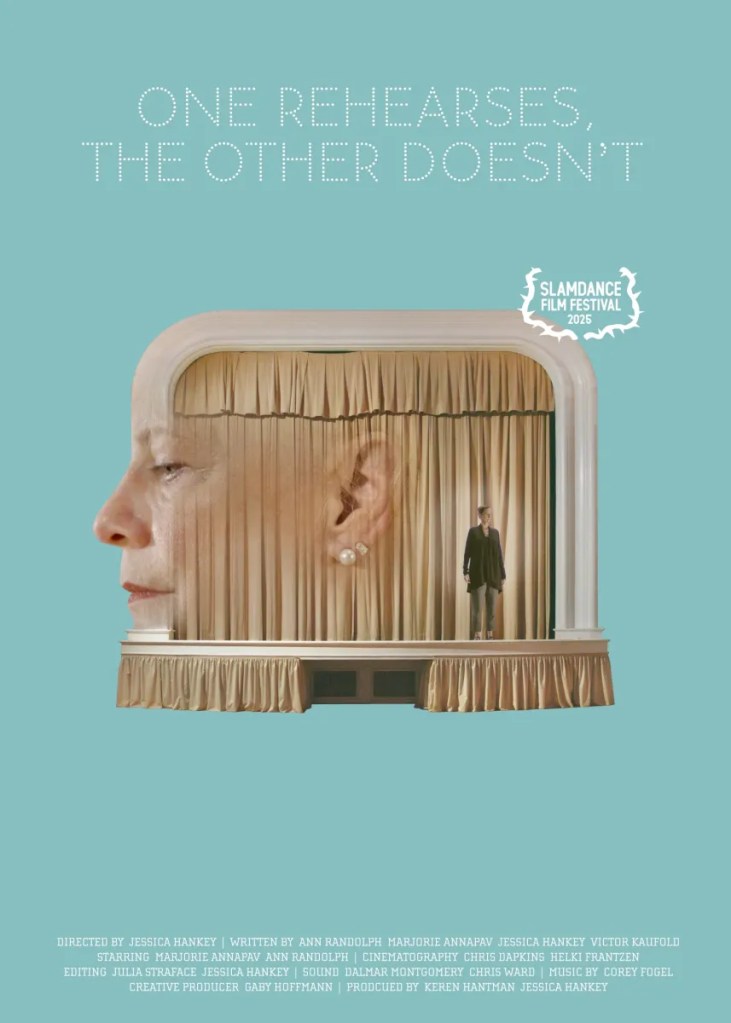
Obliterating personal boundaries by divulging unfiltered intimacy is an emotionally raw experience for filmmakers. That’s certainly true for both protagonist/actress Marjorie Annapav and director Jessica Hankey of the new biographically inspired short, ‘One Rehearses, the Other Doesn’t.’ As the main character and star of the meta movie, Annapav works with a gifted performance teacher to transform her life into an enthralling work of art.
Besides helming the film, Hankey also co-wrote the script with Victor Kaufold, Annapav and Ann Randolph. She also edited the project with Julia Straface. Randolph also starred with Annapav in the short, which was produced by Gaby Hoffmann and Keren Hantman.
‘One Rehearses, the Other Doesn’t’ is an experimental short film in which Annapav plays herself as she immerses in improvisational work and on-stage rehearsals with a fictionalized performance teacher. The movie draws from her personal history, she enacts scenes based on the murder of her boyfriend by the mob and her time as a sex worker in 1970s New York. In an effort to discover a version of her life that can play to audiences, she probes overlooked behaviors, desires and selves. A peripheral figure in American Surrealism, Annapav is noted for her relationship with artist William Copley, who once claimed he sold his art collection in order to pay her to marry him.
‘One Rehearses, The Other Doesn’t’ had its World Premiere in the Experimental sections at the Slamdance Film Festival, where it was honored with the Experimental Shorts Grand Jury Honorable Mention. Hankey generously took the time before the start of the festival last month to talk about penning, directing and editing the movie during an exclusive interview over Zoom.
Film Factual (FF): You served as one of the writers on the experimental short film, ‘One Rehearses, The Other Doesn’t.’ What was the inspiration in making the movie? How did you create the story for the short?
Jessica Hankey (JH): Well, Marjorie Anipav. who’s the blonde in the film, isn’t an actress, but she’s aspiring to tell her story in the film. I met her through a woman’s club in Los Angeles called the Santa Monica Bay Woman’s Club that was founded in 1905. She was a student in an art workshop that I was running there.
One day she brought in two art catalogs to class. One of them was the catalog from when she auctioned off a portrait that (Andy) Warhol did of her. I think she auctioned it off at Christie’s.
The other catalog was a catalog from 1979 from when her former husband sold his collection of art. That was an incredible collection. It blew me away when I saw the catalog.
Eventually it emerged that he told her that he sold the collection so he would have enough money to pay her to marry him. Marjorie agreed to marry him for money, so he sold the collection so that he could pay her $600,000. That really grabbed my attention.
FF: Besides co-scribing the film, you also directed the project. How did you approach helming the movie?
JH: Well, as I got to know Marjorie better, we became interested in the idea that she had been acting in different aspects of her life. We thought about what it would be like to bring some of that acting into an actual film set. We also thought about how a film set would function as an environment for her to find the version of her own story that she could share with other people.
I then brought in this incredible, brilliant performer, Ann Randolph. She’s a writer, a writing instructor and a performance coach in real life. I wanted her to work with Marjorie in the film.
In a way, Marjorie is acting in the film, but she’s also playing herself. But she would say she’s completely playing somebody else. She would also say that she’s breaking a lot of rules that she would normally have when she’s teaching people how to turn their own personal story into a performance. So she’s transgressing a lot of boundaries.
FF: Once Marjorie and Ann began working as co-stars on ‘One Rehearses, the Other Doesn’t,’ how did you work together to create the relationship between their on-screen personas?
JH: That’s a really great question. We started with Marjorie, as she’s a natural actress and she has years of experience acting.
But I think everybody on set, including Ann and Karen Hantman, who was the first AD (Assistant Director), were just so excited. It turned out that Marjorie was super open and ready to play, as she wanted to try anything. She showed incredible bravery and spontaneity that I deeply admire to this day.
I think that became a very natural force for her and Ann to work together as actresses. Ann was super impressed by what Marjorie was bringing to the film. She’s a natural for listening and responding to other people
An old friend of mine, Gaby Hoffman, came in and helped us with the improvisation scenes. She was really amazing in helping bring a third or fourth person in to those scenes.
We did long hours of improvisation. We started from a script, but we did hours and hours of improvisation.
FF: While Marjorie and Ann were improvising and acting together, how did you work with the short’s cinematographer, Chris Dapkins, to determine how to visually shoot the project?
JH: Well, this was my fourth time working with Chris Dapkins. He and Gaby are partners and have two children together. We all also went to college together. So it was really intimate and there was a lot of trust.
The days that Gaby was there, it was amazing to see how she and Chris communicated almost telepathically. I really enjoyed seeing how developed their communication was.
It was a very energized set with a lot of discovery happening. It’s really exhausting to direct a film, but everyone working together gave me energy.
You might not guess it from looking at it, but there was a lot of research that went into figuring out different ways that I wanted to shoot the film. I was thinking a lot about film language and the ways that a protagonist is shot in a film. One of the themes in the film is what it’s like to take your own personal story and try to turn it into a public story that other people can engage with.
So I was thinking about ways of filming Marjorie that treats her like she’s the protagonist and a star. Chris and I had conversations about that. I also looked at a lot of other films.
FF: You also served as an editor on the film, alongside Julia Straface. Once you finished shooting the project, how did you work with Julia to put the final version of the story together?
JH: Well, this was the second time I worked with Julia. She was extremely patient as she and I went through many, many rounds of different kinds of edits and approaches to the material.
.
There is a lot of history and context around Marjorie and her story that this film is drawing from but not explaining. So it was a balance for us to figure out how much factual material to include in the film. We thought about how much do audiences need to know in order to enter into some of these scenes and understand the emotional dynamics.
So we did a lot of paring of material so that the audience wouldn’t think, well, I need to know when she got married, and who Bill (Copley, her ex-husband) is, in order to understand what’s going on. It does enrich the story to know those things. So we had to find the right balance between those things.
FF: ‘One Rehearses, the Other Doesn’t’ (had) its World Premiere at the Slamdance Film Festival. What does it mean to you that the movie (screened) at the festival?
JH: Well, I was in California when the fires started. It’s such a very strange and difficult time for Los Angeles, with a lot of grief about how much has been lost in the fires, and how it’s affecting people in the area. People have different amounts of resources to be able to cope with so much destruction.
A number of my friends have lost their houses or been displaced. People who worked on the film who I thought were going to be at the festival have been displaced and (weren’t) able to (go).
So the festival comes with mixed feelings. It (was) amazing and beautiful that we (were) able to come together for the festival. But there’s also a lot of hardship, difficulty and uncertainty about the future for Los Angeles. But (sharing) the movie at the festival maybe (helped) audience really enjoy films again.
 Film Factual