
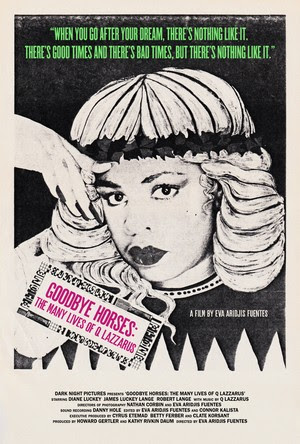
The long-lasting enigma of a talented artist’s life can often drive the continued intrigue and acclaim of their work. That’s certainly the case for the late singer Q Lazzarus, whose obscure professional and personal lives are chronicled in the new documentary, ‘Goodbye Horses: The Many Lives of Q Lazzarus.’
The musician is best known for her song ‘Goodbye Horses,’ which was prominently featured in the feature adaptation of ‘The Silence of the Lambs.’ After the psychological thriller swept the 1991 Academy Awards, filmmaker Eva Aridjis-Fuentes began to question why Q Lazzarus remained an obscure gig musician until her death in 2022.
After a chance encounter with Q Lazzarus, Aridjis-Fuentes decided to direct a documentary about her. The filmmaker also served as a cinematographer with Nathan Corbin, and as an editor with Connor Kalista, on the feature.
‘Goodbye Horses’ is an intimate movie that solves a musical mystery while taking the viewer on a rollercoaster ride through the life of the titular singer, who was born Diane Luckey. After being discovered by director Jonathan Demme in 1987 during a fateful cab ride in New York City, Q Lazzarus had a moment of fame after her song ‘Goodbye Horses’ was featured in his screen adaptation of ‘The Silence of the Lambs.’
But while Q Lazzarus developed a following in the New York and London club scenes as a result of the film’s success, she was unable to secure a record deal. She went on to completely vanish from the public eye in 1995.
Not even Q Lazzarus’ friends and bandmates knew what had happened to her, until another fateful car ride 25 years later. That ride brought her together with Aridjis-Fuentes, who is a fan of her music. The musician entrusted the filmmaker to tell her life story publicly for the first time through her own words and music, including dozens of never-before heard songs.
The ‘Goodbye Horses’ movie is receiving a theatrical release this spring in cities across the U.S., including today, Thursday, March 20 at New York City’s Village East; this Saturday, March 22 at Asbury Park’s Showroom Cinema; and Sunday, March 30 and Thursday, April 3 at the Austin Film Society. The feature also won the Audience Award following its World Premiere on October 19, 2024 at the Morelia International Film Festival in Mexico.
Aridjis-Fuentes generously took the time recently to talk about why she was inspired to make ‘Goodbye Horses’ during an exclusive interview over Zoom. Among other things, the filmmaker discussedher approach to helming, shooting and editing the project.
Film Factual (FF): What was your inspiration in chronicling Q Lazzarus’ career and life in the new documentary, ‘Goodbye Horses?’
Eva Aridjis-Fuentes (EAF): Well, I had been a fan of her music. Like many of her fans, I often wondered what had happened to her because she had completely vanished for 25 years.
Then I met her completely by chance by getting into a car service that she was driving. I sort of figured out that it was her. I think that since I wasn‘t someone who was trying to find her, since I got into her car completely by chance, that made her feel like she could trust me to tell her story.
At this point, her son was a senior in college. So she felt like, well, maybe this is a sign that it’s time for me to go back to my music.
It was actually something I had thought about doing years before that point. I’d been talking to a friend one night, and the song ‘Goodbye Horses’ was playing. He said, “Oh, you should do a film about Q. Lazzarus.” I said, “Well, I’d love to, but how do I find her?”
So it’s actually something that I had thought about. But it didn’t seem like a possibility until I just complete by chance got into her car and figured out that it was her.
FF: You served as the director on the film. Once you started production on the movie, what was your overall approach to helming the feature?
EAF: Well, at the beginning, I had a sound recordist and a DP (Director of Photography). But then shortly after we started filming, COVID started, so then it wound up being mostly just me and Q. I was filming, sound recording, directing, producing and editing. So I was wearing a lot of hats and it was a lot.
But at the same time, it led to an intimacy. It gave the material and the dialogue an intimacy. That’s when she really opened up and started telling me a lot about why she disappeared and all the things that happened to her.
FF: While you were working with Q, how did you decide what aspects of her career that you would focus on in ‘Goodbye Horses?’ What was your relationship like with her throughout the production?
EAF: Well, we got to be incredibly close. By the end of our time working together, we were barely even talking about the film or her music because of COVID. Everything that was happening was about COVID, Black Lives Matter and the (2020) election.
So we were just talking about life, the world and motherhood. We got incredibly close – closer than I’ve ever gotten to any documentary subject, actor or anyone who I’ve worked with on a project.
She was just an incredibly charismatic person and great storyteller, and so interesting to watch. She wore about five different wigs in the movie. She was so funny.
She had so many layers, hence the title of the film, ‘The Many Lives of Q Lazzarus.’ She lived through so many things, and then there were many more experiences she had that didn’t even make it into the movie.
There were these different sides of her personality that I tried to show a little bit of each of these things. I wanted to give a complete portrait of her life.
FF: Speaking about shooting the documentary as the cinematographer, how did you decide how you would visually present the story?
EAF: When I make documentaries, I normally prefer not to be filming because I really want to be focused on my interaction with the people that I’m filming. I want to be asking questions and figuring out what I want to film.
If you’re filming something that’s happening in front of you, there could be something much more interesting happening behind you and you wouldn’t know it. So I think it’s very important with documentaries to have a cinematographer.
In this case, a lot of the movie revolves around her telling stories in a controlled environment. So I could just set up camera and tripod and focus on her.
But in general, I would rather not do so much filming, and certainly not sound recording. That’s something I have not yet mastered on a technical level.
FF: Speaking of the sound recording, how did you decide which of Q’s music to include in the documentary?
EAF: She gave me a huge bag of tapes that were never released. So I digitized it all and made a selection of music that’s all on the soundtrack album.
There are 23 songs that I thought were the strongest and I liked the most. But there were also things that really went well that helped me tell her story because they’re the soundtrack to her life. So there are songs in the movie that she sang that thematically illustrate parts of her life.
FF: When you were looking back on Q’s life and career, how did you also decide which archival footage to include in the final version of ‘Goodbye Horses?’
EAF: Well, in terms of the archival footage, there wasn’t very much material of her because she never got signed. Up until the soundtrack release (on February 21,) she never got a record deal.
So she wasn’t a household name. Back in the day when she was performing in the ’80s and ’90s, it‘s not like now, when everyone’s filming on their phone. Unless you were a name band or artist, there probably wasn’t anyone filming you.
So it was very hard to find archival. So I used a lot of outtakes from the ‘Goodbye Horses’ music video that Leslie Mantel filmed with her in 1987.
I also found some bits of archival footage from London. I also used a concert and a TV interview that she had on VHS.
But the archival was definitely challenging. I wound up having to use a lot of stuff that was just footage of New York or London in the ’80s and ’90s, and someone in a courtroom that wasn’t her. I just used things that were meant to represent what she was living through, but it wasn’t actual archival of her life.
FF: You also worked as an editor on the film. How did you decide how to put the final version of the movie together?
EAF: Well, it took me five years to make this film. I worked on the editing a lot alone, but I also worked with several different editors.
When Q passed away, we hadn’t finished filming So the movie was supposed to end with her comeback concert, and her reuniting with all her bandmates after 25 years.
Now it doesn’t end that way. So I had to rethink the whole structure of the film when that happened. At that point, I also decided to focus a little more on my own relationship with her. So I brought in some voicemails and things like that, since I wasn’t going to get the footage that I needed to do the original structure that I had envisioned.
FF: You also served as a producer on ‘Goodbye Horses.’ Why did you also decide to produce the documentary?
EAF: Well, there were a few people on board who decided not to be involved with the film anymore when she passed away. That was very disappointing.
But the main producer, Howard Gertler, who produced ‘Crip Camp,’ ‘How to Survive a Plague’ and ‘All the Beauty and the Bloodshed,’ is a producer I’ve worked with before. He was really there the whole time.
The film has been a big struggle between COVID and Q passing away before we were done filming. That was obviously very difficult emotionally for not only me, but also for the film’s financing.
Also, last year was a very hard time to be financing documentaries and trying get them into festivals and sell them. Between COVID and the actors’ and writers’ strikes, everyone was making documentaries – most people who were making something were making documentaries.
So there was a lot of competition. There was a lot of content and films out there, so there wasn’t enough money or space for all of them.
So it’s been very challenging. So I’m very excited to finally be getting the movie out in the world, as I’ve been working on it for six years.
FF: Speaking about ‘Goodbye Horses’ release, what does it mean to you that it’s now playing in theaters across America?
EAF: It’s wonderful that Q is finally going to have the attention and appreciation she deserves, between the film and the soundtrack. Tragically, it’s going to be posthumous, but I think when she passed away, at least she knew that all of this was coming. There are a lot of people who will enjoy the film, including her son, family, collaborators and fans. It’s very sad that she’s not here to see it, but I like to think that she’s aware of it, whoever she may be.
 Film Factual