

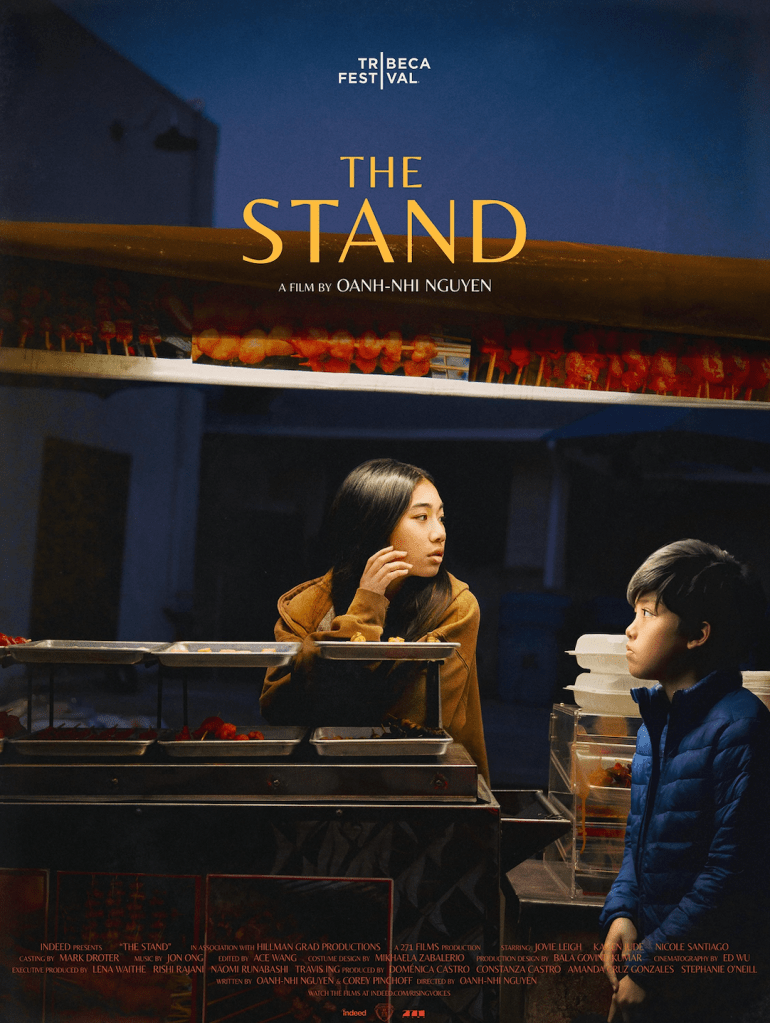
Claiming a dedicated stake in social causes on screen that reflect their real-world beliefs is a powerful driving force for up-and-coming filmmakers. Award-winning writer-director, Oanh-Nhi Nguyen is one such emerging talent, whose commitment to her morals is showcased in her new short film, ‘The Stand.’
The auteur remains steadfast in her dedication to achieving gender and racial justice in her storytelling. Through her lens, Nguyen amplifies Asian women and girls, weaving narratives that explore diaspora, immigrant identity and the complex bonds between generations. The AFI Conservatory MFA graduate is one of just ten filmmakers whose projects were chosen for Hillman Grad and Indeed’s Rising Voices program.
Nguyen co-scribed ‘The Stand’ with Corey Pinchoff, as well as directed the project. The movie stars Jovie Leigh, Kailen Jude and Nicole Santiago.
‘The Stand’ follows a determined immigrant girl who must work with her pesky kid brother in order for them both to survive. When her mother is forced to leave their family’s bustling food stand, the young girl must earn enough money to give their mom a rare night off to attend her choir concert.
‘The Stand’ had its World Premiered at the Tribeca Festival this past June. The movie went on to have its West Coast Premiere this past Wednesday, August 13 at the TCL Chinese 6 Theatre during the HollyShorts Film Festival. In honor of the drama’s West Coast Premiere, Nguyen generously took the time recently to talk about penning and helming the movie during an exclusive interview over Zoom.
Film Factual (FF): You co-wrote the script for the new short film, ‘The Stand,’ with Corey Pinchoff. What was your inspiration in penning the screenplay for the movie?
Oanh-Nhi Nguyen (ONN): So for ‘The stand,’ I applied to the Rising Voices program with Hillman Grad and Indeed. The prompt was, what does the future of work mean to us?
So my stories really center on Southeast Asian women and girls, especially immigrant girls’ stories. I was just having these images of seeing young children walking from home with their parents after working from a food stand. I was also envisioning a youngAsian girl in L.A., working at a stand with her dad.
It was also tied to some documentary research I did through my documentary, ‘Taking Root.’ It shows how in the ’80s in Philadelphia, the only way a lot of Southeast Asian refugees could survive financially and economically, was to create food stamps. They know it’s a family affair for refugees and immigrants to survive.
I’m really passionate about centering stories on young immigrant girls, specifically. I think they’re extremely powerful, but also vulnerable, systematically. So ‘The Stand’ was inspired by all of those experiences. So what we have now is a story that centers around a Southeast Asian girl and her mom and her brother.
FF: Besides scribing the script, you also directed the drama. How did writing the screenplay influence your helming style on the set? What was your overall directorial style throughout the production?
ONN: I feel really grateful for us to get the grant funding from Hillman Grad and Indeed. I really loved my crew and my cast.
I wrote the script in October, and then was selected in December. I did a little bit of development with Hillman Grad and 271 Films for about a month or two. We then shot the film in March. I then had four weeks to edit, and then one week for posts (Nguyen laughs). It was a very quick turnaround. I think it took about six weeks to make it. Then we premiered at Tribeca in June.
So that was the process, but I had an awesome cast and crew. Being on set was really amazing, especially with these young actors. Jovie (Leigh) and Kailen (Jude) are super talented. Also having producers and a crew that really understood, and delivered, the vision was awesome.
FF: And speaking about the actors, what was your approach to the casting process overall?
ONN: I was very lucky to work with an amazing casting director, Mark Droter. He’s amazing.
I originally wrote the script as a Vietnamese story. But then being based in L.A., I wanted to open it to all Southeast Asian communities here. We ended up getting more Filipino casting auditions, which is why I naturally formed a Filipino family for the film.
I wanted to find a young girl who still had some of that innocence, but was still very bold and powerful. I think Jovie really delivered that in her performance, but also really wowed us in her audition.
Then with Kailen, I wanted to find someone who could play both sides of the little brother. He had spirits of being very annoying, but was also a young boy who just wants to be a kid. He really is protective of his sister, even though he acts like he’s not.
So we later auditioned them both. We had a lot of different pairings, and then we had both them together. They were just incredible in their pairing.
Both of them told me they tapped into something different in acting at a different level, which was the best compliment as a director. So they really went all out, both during the audition and in the film. So credit to them, and also (casting director) Mark (Droter) for helping me find them.
FF: Once the actors signed on to star in the film, how did you work with them to building their characters together?
ONN: So the way I like to work, especially with kids, is keeping the conversation going and open. I think as a director, I found that I have a big responsibility to take care of my actors, especially child actors.
There are a lot of dynamics, obviously, between a director and an actor, especially a kid actor. So I wanted them to feel open to try things out, and to improv; they’re both really great improv.
I also had conversations with them separately after we selected them. I wanted them to bring a sense of realness as well as parts of themselves, to the characters. I also wanted them to know that know that whenever they had suggestions, I was open to hearing them.
I think that’s the beauty of working with actors – getting to see and feel who they think the character is, and who they really are in their own skin.
As a director, I think it’s really important for me to create a space for them to be able to try things out. So we created a really strong rapport earlier on, before we went to the set. I just really wanted it to be a collaborative space with them, to allow them to try things that were scary, different and fun. So that’s really important to me when I work with my actors.
FF: Like you mentioned, the food stands are an important element of the story. How did you decide where to shoot, and how did you obtain the locations?
ONN: The location was very hard to find. But in the beginning of the film, there’s B-roll, which was shot on Cesar Chavez Avenue. I felt it was very important to have this film rooted in a working-class community, especially with narratives of what’s currently happening to immigrants all over the U.S.
I really wanted to give an ode to immigrants who are surviving and still working as hard as they can for for their families and communities. So, it was really important that the location was in a working-class community.
I love shooting of Cesar Chavez for the B-roll, which is presented in the beginning section of the film. Then it took us forever to find the locations. Location scouting is very difficult, truthfully.
Finding a location that was safe, but also had the bar element to it and was cinematic, was conducive to production.
So we ended up in a neighborhood around Cypress Park, which we found last minute. It’s a part of a studio, and we made that building into a bar. So it’s actually not a bar, it’s actually a production studio.
It was really the biggest challenge of production – finding a location that fit all of our needs was difficult.
FF: Ace Jing Wang served as the editor on the film. How did you work together to put the final version of the movie?
ONN: Ace is an incredibly talented editor. We kind of leave it to the editors in this program to have their own take of the film. Ace really surprised me with the first cut. I think directors can really resonate with the first cut, which make us want to cry and quit. We think, oh my gosh, what do we do?
But this is the first time in my career where I actually like the work that I did. (Nguyen laughs.) I know that some directors are their worst critics.
So, Ace took the first cut, and it was so good. Then I went in and worked with her for a couple weeks.
But unfortunately, after 10 days working together, Ace’s student visa was revoked by the administration, and she was facing deportation. Thankfully, that got resolved, because the administration re-instituted student visas.
But just to reiterate, this is an immigrant story. One of my amazing members, who works so hard and deserves to be here, was almost threatened with deportation. So that really was awful, and a huge challenge while editing.
But thankfully, they’re here, and they’re okay. Their student visas were reinstated. But I still had to find another editor, Jasmine, who also went to AFI; Ace and I also went to AFI. So I ended up working with Jasmine after Ace had to leave. So, sadly, that happened, but it gave us a reality check of the state where we’re currently in.
 Film Factual