
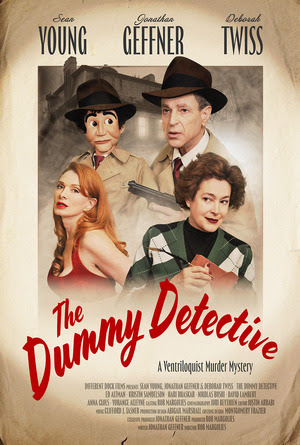
In classic noir storytelling, interior monologues often reveal a character’s deepest truths. That internal dialogue is externalized in the new ventriloquism-driven mystery comedy, ‘The Dummy Detective.’ The film’s detective protagonist articulates his private thoughts through conversations with his wooden partner, transforming a familiar noir device into a distinctive narrative approach.
The crime thriller treats its absurd premise with complete sincerity. The dummy is not a joke but a mirror, reflecting the fragile emotional truths its owner cannot voice alone. Humor emerges quietly, particularly in the spaces between stillness and tension, where what’s ridiculous collides with what’s painfully human.
Rob Margolies directed and produced ‘The Dummy Detective.’ Jonathan Geffner wrote and executive produced the movie. He also starred in the comedy with Sean Young, Deborah Twiss, Ed Altman, Kristin Samuelson, Hari Bhaskar and David Lambert.
‘The Dummy Detective’ follow an alluring actress, Chloe Lake (Twiss), as she’s being stalked by a serial killer. She escapes to a creepy, remote inn in upstate New York. While there, she experiences more eerie encounters with the innkeeper, Harriet Hubbard (Young), who also works as an eccentric British part-time mystery writer.
Chloe is joined by detective Van Trillo (Geffner), who uses his ventriloquist skills to aid in his investigations. Together with his wooden partner, Sam Suede, Trillo soon finds himself stranded with Chloe in the inn as a torrential storm rages outside. To make matters worse, all communication with the outside world is cut off.
They’re also devastate to learn that one of the odd guests at the inn is actually the serial killer. As the night progresses, guests at the inn are murdered one by one as Trillo struggles to identify and apprehend the suspect. Trillo is left to wonder if he and Suede will catch the elusive culprit before it’s too late.
‘The Dummy Detective’ is now playing on Amazon. To help promote the film’s release, Geffner and Young generously took the time recently to talk about penning, producing and starring in the feature during an exclusive interview over Zoom.
Film Factual (FF): Jonathan, you wrote the script for the new ventriloquism noir mystery film, ‘The Dummy Detective.’ What was your inspiration in penning te screenplay for the comedy?
Jonathan Geffner (JG): Well, this was a long journey. It started in about 1995, which was 30 years ago. I created the lead characters of Detective Van Trillo and his wooden partner, Sam Suede. Trillo is a ventriloquist who uses Sam during performances and his investigations.
I have written a number of scripts over he years, for other short films and feature films. I have also produced a number of web series over the years. They can all be seen on our YouTube channel.
So the feature film is part of this long journey. I wrote the first draft of it about 20 years ago. It has gone through many drafts since then, until I finally got to the point that I found a way to produce this. I don’t know what number draft of the script we used – it may have been the 20th draft when we finally shot the film!
FF: You both star in the thriller. Sean, what was it about the character of Harriet Hubbard that convinced you to take on the role? Jonathan, why did you also want to appear in the movie as Detective Van Trillo after you scribed the script?
Sean Young (SY): I thin the genre was the first thing that drew me to this project. I like whodunnits, and I thought this story had a unique idea because of Jonathan being a ventriloquist. I also liked the location, as well as the other actors in the ensemble. I thought it was a really great group, and everyone was so dedicated, which was fun.
I probably should have said the writing first! (Young laughs.) Jonathan, do you recall that at first, you said, “We have to keep every bit of writing the same?” But then you shifted a little bit because I thought my suggestions were good.
A lot of my suggestions were to cut things because I didn’t think we needed certain things. We would then go to making it as tight as possible. You were pretty open to that by the middle somewhere. Do you recall that?
JG: (Geffner pauses.) I remember that a little bit. The reason I hesitate is because I know there were also other suggestions from other people along the way. I was much more reluctant about most suggestions.
SY: Well, that’s because they dealt with plot points. So I think you were very conscious of making sure nothing got cut by accident that we’d need later.
JG: Yes, that’s true. But any suggestions that you made I took very seriously, and I agreed to almost anything you suggested. But the reason why I hesitated when you asked me that question is because I didn’t always agree when other people made the same suggestions.
SY: Oh, I remember you were pretty reluctant to at times! So maybe you agreed to my suggestions because they were reasonable.
FF: Speaking of the other actors, ‘The Dummy Detective’ also stars Deborah Twiss, Ed Altman, Kristin Samuelson, Hari Bhaskar and David Lambert. How did you all work together to build your characters and the overall story – did you rehearse together?
JG: Well, with Sean, I never had any concerns because I knew she’s a terrific actress and would deliver a great performance.
I had some concerns, though, about whether everyone would be on board in the cast. I was happy with the whole cast, but I didn’t know all of their work. Sean has a whole iconic background in films, but the others I wasn’t so sure about.
We did some rehearsing, but we didn’t have time for a lot of it. So it was nerve-racking to roll the cameras without having as much rehearsal time as I would have liked.
SY: You learn how to adapt in independent movie-making. I said to the next director I’m going to work with, Travis Mills, that “When you rehearse on the day you’re going to shoot, you eat up a lot of your shooting time. It’s just not a good idea.”
Somewhere along the way in the moviemaking world, the rehearsal process changed. When I started acting in the 1980s, we always rehearsed before we got to the set and started principal photography.
If you leave rehearsal to the set, you have all your crew there, waiting for the actors to figure things out. That’s just not a good idea because it eats up a lot of your shooting time.
But sometimes people don’t want to be at rehearsal time beforehand because they’re not being paid. But I think rehearsal serves a movie very well.
I remember on this picture, I asked everyone to come over to where I was sitting and just run our dialogue. That way, no one would say while we were filming, “What’s my line?” It’s important that you use the time you have as best you can.
FF: Speaking about working with directors, Rob Margolies served as the director and producer. How did you both work with Rob as the comedy’s helmer on set?
JG: Rob is a very experienced director. He can make micro-budget films look like they have a bigger budget. He’s also able to get them done on time. That’s why I agreed to make this film with Rob. In the past, I’ve explored how to make and produce a film like this one, and there have been too many problems with the budget.
But with Rob, he presented to me a way that we could shoot this film faster and cheaper than any other way I could think of, and he really came through. It was great that he was able to do that.
SY: My experience working with Rob was great. I think he always had in the back of his mind the best way to keep everybody moving along. That’s kind of what you need in a micro-budget film. I think he was very good at that.
We had an 11-day shoot, and by day two, I was like, “We have to go in the other room and rehearse. Our rehearsal in front of the cameras also has to be quicker. We can’t be memorizing lines on set.” I think Rob appreciated that.
I think actors are generally very agreeable. So if we can get all of the actors to agree that we should run our lines together, that’s helpful to the process.
FF: Jonathan, besides writing the screenplay, you also produced the film. Why did you also decide to produce the thriller?
JG: Well, on set it’s pretty stressful, especially as an executive producer, when it’s my money that’s on the line! I wish I had been able to enjoy the process a little more without all the stress…
SY: Next time!
JG: Yes, hopefully I won’t have that worry on the next project. But I love being the writer of these kinds of scripts, and I love performing the role of Trillo and Suede. I wish I could live in that world of just writing and shooting as an actor…but also producing this film made the experience very exciting because I was finally making this dream come true.
 Film Factual