
A single decision made decades earlier can ultimately weave together questions about how modern technology can now impact family and identity in surprisingly intimate and darkly humorous ways. That’s certainly the case for the new documentary, ‘Dad Genes.’ Through an unfiltered lens, the film captures how the titular subject’s quiet, unconventional life is upended when the past suddenly catches up with him.
Craig Downing directed, and also served as a cinematographer and editor on, the movie. Matt Isaac served as the producer on the documentary.
‘Dad Genes’ chronicles how for years, Aaron Long was a happily unmarried man living a single life in Seattle. He lived in a tiny room in a cooperatively-run building alongside fellow artists and bohemians. When not playing ultimate frisbee or performing experimental music, he spent much of his free time caring for his aging mother.
That life changed practically overnight thanks to a 21st-century combination of old-fashioned curiosity and cutting-edge technology. Back in the mid-1990s, Aaron had been a sperm donor as an easy way to make some extra cash. Two decades later, he registers with 23andMe and discovers he has several biological children (with more continuing to be discovered).
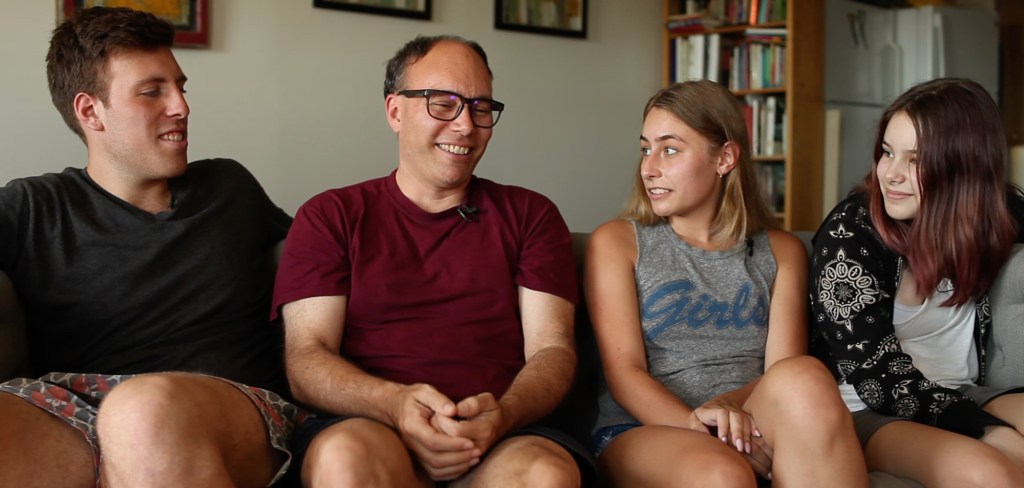
Aaron invites several of his newly discovered children to spend time with him at a “Meet My Kids” party. Not long after, an unusual household forms: two of the children, the mother (Jess) of one, and Aaron’s own mother are all living in the same Seattle co-op. Even more unexpectedly, Aaron and Jess develop a romantic relationship, creating one of the most unconventional blended families imaginable.
Aaron goes on to share his saga in The New York Times Modern Love column. As a result, the unlikely clan experiences worldwide media exposure and grapples with the allure of celebrity.
‘Dad Genes’ had its world premiere on Friday, January 16 in the Docs section of Dances With Films (DWF): NYC 2026. The screening was held at Regal Union Square during the festival’s fourth annual event in New York. To help promote the documentary’s screening at DWF, Downing and Isaac generously took the time to talk about making the movie during an exclusive interview over Zoom the week before its premiere.
Film Factual (FF): Craig, you directed, and Matt, you produced, the new documentary, ‘Dad Genes.’ What interested you both in making the film?
Craig Downing (CD): In the beginning, it was just a unique situation. But now with 23andMe, this opportunity of turning something that was so anonymous into something more public is becoming more popular. There are more and more stories about it. So meeting Aaron, and then him learning that he has children and deciding to have a Meet My Kids party, was a really interesting process.
So we wanted to see how the humanity and dynamics worked out in this situation. There are a lot of players in this situation, as there are moms and donor kids, so we wondered how this was going to go. There’s no playbook for this kind of situation; you can’t go to Amazon and buy a handbook about how to hang out with your donor kids.
So to be able to be there for that journey and see everything that happens, including the funny and human moments, was amazing.
There were some news pieces that were between 30 seconds to two minutes about this subject. But I wanted to make sure we were capturing the fully story that’s on their pace and time.
I thought this entire situation was unique. I had never heard of a Meet My Kids party, so I was like, “Let’s go!”
Then as all documentaries go, I was like, “There’s a bigger story here. We’re just beginning, and this is a long journey. What an opportunity we have to be a part of these relationships, which ultimately form a family, and see where this goes.”
To have their trust to capture all of their moments together was a rare opportunity that I haven’t seen or heard about before. So I felt really lucky to be a part of it.
Matt Isaac (MI): One critical thing about this film is that we were there right from the beginning. I knew Aaron, so I knew that he had connected with some of his kids online. That’s how we knew him.
Initially, it seemed like he was just going to meet some of his kids. So we thought that that was going to be the end of the story.
Then it went into all kinds of different directions. The story developed all these twists and turns as the years went on as we followed them. We had no idea what was going to happen with the story.
But the story evolved over time, so I think we were really fortunate to be there from the beginning. That way, we were able to really show what happened behind the scenes during the lead up to him meeting his kids and Jess, his partner. So we were really fortunate to be in the right place at the right time.
FF: You mentioned your research process for the movie. How did you find more information not only about Aaron and his newly growing family, but also about how families who were once separated are now connecting through such services as 23andMe?
CD: You probably did more research than I did, Matt, since you’re the producer. Do you want to talk about the research a little bit?
MI: Yes. The one thing that happened over the course of making this film that I think is really surprising is the other people who have come to me and said, “I’ve discovered a half-sibling or cousin who I didn’t know existed.”
That’s the real phenomenon here. This is a very specific circumstance that Aaron is in. But it touches on the universal theme of people wanting to find out where they belong and where they’re from.
But it’s also more common that there are these surprises that happen online. So looking into that, we started reading other stories. Not only did we read stories about sperm donors meeting their biological kids, but also about families’ secrets being uncovered over time.
So even though this is a very particular circumstance, it is a little bit universal. It goes into what a lot of people are looking for as they try to find their place in the world.
A lot of things that were possible 20 or 30 years ago, like having a secret family, is now more difficult. So I think that’s the interesting thing about the film – it goes into this larger landscape of how technology has made all of these connections possible.
FF: Speaking of producing, Matt, you served as the producer on ‘Dad Genes.’ How did you approach producing the feature?
MI: I think that this was a really fun project to work on, but it also presented challenges. We never knew what the ending was going to be for the film.
I thought we were going to be done a lot sooner than we were. But there also were so many turns and surprises that it took much longer to tell this story. So that created some unique challenges for me as a producer keeping this together.
I told Craig that I want our next project to be fast, cheap and under control! (Isaac laughs.) Next time, maybe we can shoot something in a week or less, and get it edited in 30 days.
This project also presented so many challenges because we shot so much footage. So much had changed as we followed these folks for so long that we started to wonder, what actually is the story? That presented challenges for our editors, as well, as they looked at the footage.
Luckily, we found Sara Barger, an editor who was incredible at going through all of our footage. She really worked with Craig to form the film’s story. It was a challenge because we have enough footage that we could have done a mini-series! But they found the right mix of clips, and the overall best story, with their editing techniques together.
FF: Craig, you served as the director on the documentary. How did you approach helming the film?
CD: The process was great! As Matt said, we thought it was just going to be a short, little project where we just shot the Meet My Kids party. That would have been great because I normally do short, condensed things, like short films, commercials and music videos.
But then we realized that this project was completely different. Since this is a documentary, I had to keep my mouth shut, which is very hard for me to do as a narrative director. I had to let Aaron and the other participants in the film define the moment and tell the story; I couldn’t tell them how to tell the story, in order for it to be authentic.
I just had to sit with the cameras for 10 hours a day. But on narratives, I tell the actors, “You go here and there, so that I can get this coverage.”
So I had to remember on this film that this is their story. The film chronicles their relationships as donor parents and children, and how they’re going to chronicle that. As a director, I had to respect their story and be quiet. I had to let them honestly tell their part of the story over the course of the three-six years that we followed them to capture their story. That came after I initially thought we were just going to film Aaron and the kids during the Meet My Kids party over the course of one weekend.
FF: Craig, besides directing ‘Dad Genes,’ you also served as one of its cinematographers. How did you approach visually shooting the documentary?
CD: Again, with my music video and commercial background, I was used to telling actors what to say. But I had to remember not to tell Aaron and the other participants what to say or where to go. I really appreciate Aaron trusting me during the shoot.
For example, when his mom was passing, he called me and said, “My mom’s probably not going to make it through the night. Do you want to come over and film my mom and me during our last moments together?”
I said, “Aaron, if that’s okay with you, I would be honored to show that part of your family, with Jess being there for you as you’re with your mom. I would be honored to be there with you.”
So I had to balance the shots and figure out where the best light was, while also letting (the subjects) naturally tell their stories in those heavy moments. That was certainly true while I was there with him while his mom was passing. You could see her last breath and her heart fluctuating.
Aaron then invited us to his mom’s memorial. Seeing him with his friends supporting him was so amazing and helpful.
So the cinematography allowed me to think about the best way to tell this story. I also had to think about how I could ask the audience to watch the film for 62 minutes, and have it still be interesting for them near the end.
I asked myself, How can I use prime lenses and natural light? How can I also position myself so the audience can honestly feel as though they’re in this moment, soaking everything in and feeling this authentic moment? So that was my goal – to be present and authentic in my storytelling.
FF: ‘Dad Genes’ (had) its World Premiere at DWF: NYC. What does it mean to you that the movie premiered at the New York-based festival?
MI: We’re really excited that the movie (premiered) in New York. That was really important to us. Dances With Films has been so great. They’re so incredibly supportive of filmmakers, and that really comes through during the entire festival. They’re very accessible to us.
You can tell that the community that’s created around this festival is really incredible. The dialogue with other filmmakers is also amazing. We (were) really excited to meet everybody.
We were in talks with other festivals about where this documentary was going to play. I think Dances With Films was really the right choice and the perfect fit for this project and the community that comes out for it.
CD: I would agree! We (received) messages from other filmmakers, and we (went) to meet-ups. I feel like Dances With Films is a festival for filmmakers, and I (felt) really excited about this partnership. This festival (was) where I (wanted) to be.
 Film Factual