
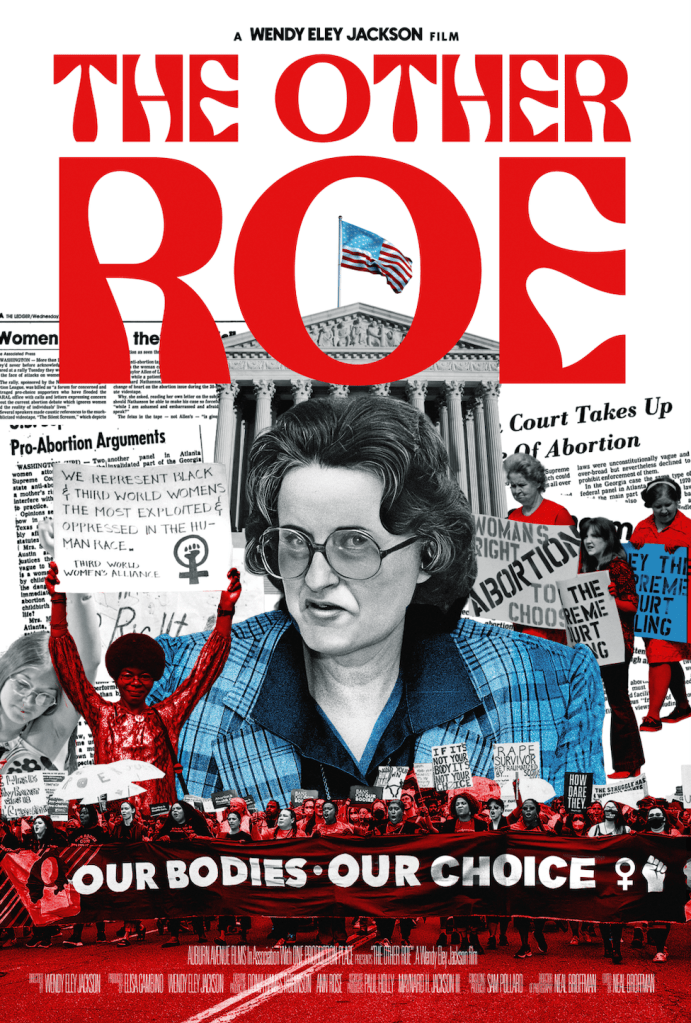
As America moves toward its 250th birthday this summer, it government appears to be regressively taking a step back. The government seems to be more concerned to working for the interests of everyone outside of the average citizen, as seen in the new documentary, ‘The Other Roe.’ The filmmakers of the short determinedly fight back in an attempt to stop officials from denying them the medical treatments they so longingly desire.
Wendy Eley Jackson made her feature film directorial debut on ‘The Other Roe.’ She also produced the movie with executive producers Donia Hames and Ann Rose.
‘The Other Roe’ explores the overlooked history of Atlanta attorney Margie Pitts Hames through the perspective of her daughter Donia Hames Robinson and best friend Ann Rose. It focuses on Margie’s groundbreaking work on Doe v. Bolton, the lesser-known companion Supreme Court case to Roe v. Wade that helped legalize abortion in 1973.
Margie’s tenacious advocacy secured the foundation of women’s reproductive healthcare in the U.S. But after nearly 50 years, both decisions were overturned in Dobbs v. Jackson Women’s Health Organization (June 2022), leading to a fragmented status for the legality of abortion nationwide. The Jackson Clinic was started by Rose in 1995.
Most people are unaware that Roe v. Wade and Doe v. Bolton were argued on the same day before the U.S. Supreme Court. While Roe v. Wade established the constitutional right to abortion, Doe v. Bolton ensured availability and accessibility, granting medical professionals and healthcare facilities the authority to perform medically safe procedures.
Jacksons direction of ‘The Other Roe’ is measured, deliberate and quietly powerful. Rather than leaning into outrage in the wake of Dobbs v. Jackson Women’s Health Organization, the helmer adopted a restrained visual language that mirrors the gravity of the subject matter.
By framing the documentary as an act of recovery, Jackson positions the documentary as corrective history. The result is a work that invites reflection rather than confrontation, trusting audiences to grasp the consequences of erasure without being told what to think.
The research supporting Jackson’s direction of the film is both personal and rigorous. Robinson’s discovery that her mother’s legacy had been largely minimized online becomes the short’s inciting concern. What begins as a daughter’s search evolves into a broader examination of how historical simplification can become political strategy.
By re-centering Margie Pitts Hames’ role in Doe v. Wade, the filmmakers expose how narrowing public memory to the case left abortion access protections vulnerable to dismantling. The short’s merit is embedded organically in its storytelling; legal context is delivered through lived experience, testimony and archival recovery, making complex judicial distinctions accessible without oversimplifying them.
The interview style further strengthens the movie’s integrity. Jackson acknowledges that documentary storytelling is inherently subjective, yet she resists spectacle.
Conversations with legal scholars, healthcare providers and advocates – such as physician Warren Hern – are framed not as soundbites but as thoughtful contributions to a layered narrative. The inclusion of such figures as Andrea Young and Elizabeth Apley expands the legal and historical perspective while maintaining ‘The Other Roe’s emotional core.
Interviews feel conversational yet purposeful, revealing how personal conviction intersects with constitutional law. Even moments of frustration, particularly from Rose, are presented with nuance, highlighting contradictions within public opinion without reducing individuals to caricature.
Editor Neal Broffman complements this restrained approach with a structure that emphasizes cohesion over provocation. Drawing from 17 interviews and extensive footage, the post-production process focused on crafting a cut that honored each voice while blending multiple narratives into a single, comprehensible framework.
The editing rhythm is steady and contemplative, creating space for audiences to absorb the legal stakes and human consequences. Rather than building toward explosive crescendos, the film closes on an intimate reflection from Margie herself, underscoring that the battle over rights is ultimately about future generations. In doing so, ‘The Other Roe’ becomes less a polemic and more a living archive – one that insists remembrance is itself a political act.
Jackson. Hames and Rose generously took the time recently to talk about helming and producing the short during an interview other Zoom. Among other things, the trio discussed what inspired them to make the movie, how they approached researching the history of the cases and how they decided which interview clips to include in the short’s 16-minute runtime.
Film Factual (FF): Together, you produced the new short documentary, ‘The Other Roe.’ What was your inspiration in making the film?
Ann Rose (AR): Donia and I started tis project during the pandemic. We reconnected after being apart for several decades.
I realized that her mother, Margie Pittshames, who argued the case Roe v. Doe, which is the companion case to Roe v. Wade, had pretty much been erased from history. The internet has very little mention of either one of them.
So Donia and I started exploring the possibility of making a documentary that can reverse that. We hoped to tell the story of Margie in this important case.
Donia, you can tell how we found Wendy.
Donia Robinson (DR): Well, it was terrific, because once we got connected, a friend of ours from Atlanta – we’re actually all from Atlanta – connected us. She said, “Did you know that Wendy is out there? She’s not only a professor of Media and Film Studies over at UCSB and Westmont, but she’s doing films. You guys should connect.”
So that’s how we got Wendy in on the project and rediscovered each other. She and I went to middle school together. So it’s definitely an Atlanta-based film, which is great, because it’s an Atlanta story. The case was out of Georgia.
So it was a chance for all of us to get together and really present a story of women’s rights that are quietly being taken away. We’re trying to motivate people to bring them back.
Wendy Eley Jackson (WEJ): Yes. That’s your exposition.
FF: Wendy, you also directed the movie. What was your inspiration in also wanting to helm the documentary? How did you approach directing the film?
WEJ: Well, I have a history of doing what’s considered social impact documentaries. So I make documentaries about anything that’s talking about erasure complexity, political strategy, human and civil rights, and women’s rights. That was a huge appeal for me.
Donia’s other is a very well-known. attorney, and her father was, as well.
Having a really wonderful understanding of the story, but I was still very intrigued. So I did a lot of research. I realized that it was time to do a film that could really expose how the historical simplification of women’s rights can become political strategy. The film can also address all of the erasures and complexities tat come with those issues.
So in cinematic terms, it was an opportunity to do a story about recovery as resistance. But the first thing we need to do is let people know what’s Dolby Bolton. So that’s where it starts with Margie.
FF: Speaking of the research process, how did you find more information and background about the cases?
DR: Well, it was certainly disturbing for me. When we first started trying to do research, it was very difficult to find anything about my mother on the internet.
She was always in front of the camera. We always had dignitaries coming over to ask her opinions about how to get the women’s agenda across in the political sphere.
So I was a little bit shocked. I was like, wait, where is all the information? What’s happening here?
So that started leading to us saying, “Oh, we really need to do this. We really need to document this story. We need to put women’s history into the popular culture in a way to where it can’t be erased as easily as they’re currently trying to erase it.
AR: Roe v. Wade took has taken the spotlight all these years for the legalization of abortion. But people don’t realize that the cases were argued at the same time before the Supreme Court, and the rulings came out at the same time. So it was Roe v. Wade and Doe v. Bolton at the same time.
Roe gave us legalization of abortion. But Doe gave us consideration of the fact that we need to have clinics and access to abortion, But access without legalization and vice versa doesn’t mean anything.
WEJ: What’s been misunderstood for 50 years is that Roe alone doesn’t protect abortion access, and that’s what the public needs to know. Doe operationalizes it.
So, by narrowing the story to one case, the protections of both cases were allowed to be dismantled quietly, clause by clause. So the film asked, what happens when history is simplified for political convenience?
In a post-DOBS landscape, history is no longer academic; it’s more actionable. So, understanding Doe v. Bolton clarifies how and why reproductive rights were even vulnerable, and why today’s rollback was possible.
This is not a then story; it’s very much so a now story with real-world consequences. All four of us that are on this Zoom understand the magnitude of that.
FF: How did you decide who you would include in the short, and what aspects of their stories to include in the project’s story?
WEJ: One of the things about making docs is you always end up interviewing more people than you can include in the final cut. But you’re also are using the information that they provide you as a tool. to discover what the story is for the film. So you have an idea of what you want the story to be, but there weren’t any interviews that we didn’t learn something new from.
Case in point, there’s a doctor named Warren Hern who Ann introduced us to. We interviewed him in Washington, D.C. It turns out, he was at the Supreme Court when both Doe and Roe were being argued.
He owns an abortion clinic. He has been in this business for a long time as a healthcare provider.
Understanding the magnitude of the kinds of patients he would see, and the different reasons why women would need an abortion, was so important. It’s not because people were necessarily promiscuous; there are a lot of health-related reasons why women need this type of autonomy in consultation with their healthcare provider. The doctors can help their patients make a very hard decision for their lives.
So, being able to talk to people like Elizabeth Apley, who’s an attorney and is featured in the documentary, and Andrea Young, who actually happens to be the daughter of U.S. Ambassador, um, Andrew Young, who was one of Martin Luther King’s lieutenants. He’s the only real person left from that era.
So being able to talk to all of these legal minds was amazing. You’re able to get a lot of perspective about the law. You can question, what does the law say? How is it being interpreted?
Those things were essential to be able to truly craft the kind of story that we wanted to tell. But it still took a lot for me to get the film made.
On another end, Ann has a lived experience. She not only was a mentee of Margie, but she’s also a person who has done a documentary on a family member. It’s hard to get people to separate their emotions from the story. But in this case, it all kind of came together.
What we did was really collapse everyone’s story into one case. We unintentionally made the decision to have a framework that allowed us to talk about the protections of Doe as well as Roe. We were able to offer them an understanding that when Doe disappeared from public memory, so did the understanding of how fragile our protections are.
So I believe the film gently but firmly asked us to reckon with the consequences of forgetting. What I really appreciate about both Ann and Donia is they never let. anybody on the crew forget. why this film was urgent.
Initially, we wanted to release the movie by the election in 2024. We did know that we would be living in a much more consequential time less than two years later. So, in the wake of Dobbs, people are searching for answers. How did this happen? How could it have been prevented?
But I think disturbing is why, but we don’t have the answer to that. Why was it erased? Anything I would say would be theoretical. So, I believe that the film doesn’t offer blame, but the film and this team offer everybody pitching in offers it a lot of clarity.
AR: One thing that’s always frustrated me over the years is the number of women coming in to get abortions, from
Republicans to Democrats, and Catholics to Jewish people. everybody from and millions of over the past 50 years.
So I wondered, why didn’t that translate into votes? Why weren’t those women motivated to go out and vote for the people who were pro-choice and going to affect their right to choose? Why didn’t they continue their advocacy and allow other women to have abortions just like they did?
It just seems like there was just a giant disconnect there. We saw picketers come in off the picket line to get abortions in the clinics. Then they go right back on the picket line. Then they’d come in and say things like, “Well, I’m different. I have a good reason, and all these other women in the clinic don’t have a good reason.
I think my frustration in a lot of this was how to make those women and their families, their husbands and their boyfriends. Their families understood that that choice is essential to good, healthy families in this country.
FF: Neal Broffman served as the editor on ‘The Other Roe.’ How did you work together to determine what the final version of the short would be during post-production?
WEJ: The process of going through all 17 interviews and every single piece of footage over and over again until we came up what’s called a paper cut was challenging. But it was a very intentional and respectful approach.
I think that process allows for a peaceful opportunity to bring brilliant minds, some of which are different, together to craft the best story possible. As a director, I told my team I didn’t want to take a sensational pathway to tell people what to think.
I believe people can see the truth. Although we do live in a time where people don’t believe what their eyes tell them.
The subject is already heavy. The film’s tone is quite measured. It’s restrained, but it’s humane, and it really does create a space for reflection rather than confrontation.
So, our goal is to invite the audience in and not push them away. If you come in bombarding people with your thoughts and deas, they don’t listen.
So this documentary has a responsibility far beyond entertainment. We’re grateful for every film festival, but it has a responsibility.
When institutions fail to preserve nuance and truth, film becomes a living archive. So this film bears witness to the law, to the people that pushed to create the law and to the people affected by it.
We owe the future generations. I have two children by birth, two children by heart and my bonus children. Our film concludes with Margie saying, “I have a 19-year-old daughter, and she’s beautiful, and I wanted her to be free.” That resonated with me, as I want my daughters to be free.
FF: Speaking of the film festivals, what does it mean to you all that ‘The Other Roe’ (premiered) at the Santa Barbara International Film Festival?
WEJ: It’s a fun time! For Santa Barbara, this is definitely the crown jewel of the winter.It (was)wonderful to be a participant with a pass!
But what’s even better, I get to do it with my producers. We were able to tell a different story through the lens of women who have a joined past. We’re also very hopeful for what the future can bring, and how it can be changed.
What we really (did) at this festival (was) honor the truth so the future can be navigated with better care and knowledge in humanity.
But I really hope the film opens conversations that are rooted in listening. I’m always saying to students, it’s a listening skill, rather than shouting, because conversations of how rights are built and how they erode can really ring about the change we need.
Editor’s note: ‘The Other Roe’ had its World Premiere at the 2026 Santa Barbara International Film Festival on Wednesday, February 11. It went on to have an encore screening on Friday, February 13. To find more information on the documentary, including future screenings, visit its official website.
 Film Factual