
One of the most endearing kinds of film doesn’t immediately announce its emotional power so much as it gradually and subtly reveals it, scene by scene. The new drama, ‘Dancing on the Elephant,’ does just that by exploring aging with a tenderness and honesty that feels increasingly rare.
What might initially sound like a modest premise – two women forming a friendship inside a retirement home – becomes something far richer. The movie proves to be a meditation on autonomy, memory and the fragile but persistent desire to keep living fully, even as the world begins to shrink.
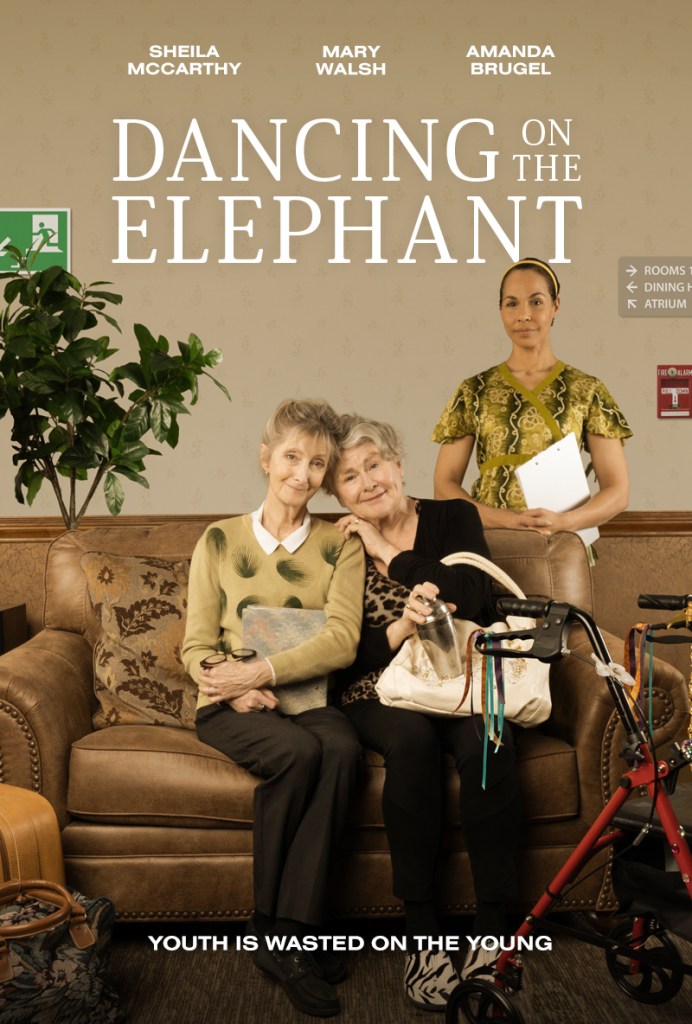
Julia Neill and Jacob Z. Smith directed, and Lisa Hagen penned, ‘Dancing on the Elephant.’ The film stars Mary Walsh, Sheila McCarthy and Amanda Brugel.
In ‘Dancing on the Elephant,’ Nora’s (McCarthy) son drops her off at Shady Rest Retirement Home. Upon her arrival, she’s pretty sure there’s not much left to hope for. That is, until unfiltered firecracker Edna (Walsh) wheels into her life and reminds her it isn’t over until it’s over.
Hagen’s script is the drama’s foundation, as it’s remarkably assured in its restraint. Adapted from her stage play of the same name, the movie’s writing avoids the common pitfalls of theatrical adaptations. It never feels overly confined or dialogue-heavy in a way that limits cinematic expression.
Instead, while she was scribing the screenplay, Hagen leaned into the intimacy of the setting. She used the locations and situations to deepen the character development, rather than restrict the protagonists’ movements.
The scribe’s writing strikes a delicate balance between humor and melancholy, often allowing both to coexist within the same moment. Jokes land not as punchlines but as extensions of personality, particularly in Edna’s sharp, irreverent observations. Meanwhile, the sadness is rarely stressed. It instead lingers in pauses, glances and things left unsaid.
What’s most impressive is how Major emotional beats, including declining memory, unresolved trauma and familial guilt, aren’t spelled out explicitly. Instead, they are layered subtly into the narrative. This approach gives ‘Dancing on the Elephant’ a sense of authenticity.
Neill and Smith’s direction complement Hagen’s writing. The helmers’ style is gentle but deliberate, finding humor without ever undermining the gravity of the subject matter. There’s a warmth to their approach that keeps the film from feeling bleak, even as it confronts difficult realities. The duo understand that their characters belong to a generation that expresses emotion differently, and they lean into that sensibility without making the story feel dated.
Visually, the movie is elevated by the cinematography of Kevin A. Fraser, whose work transforms the retirement home into a surprisingly dynamic space. The hallways, in particular, become a recurring visual motif. Sometimes they feel long and isolating, emphasizing the institutional nature of the environment; other times, they feel almost conspiratorial, as if they’re quietly inviting rebellion. Fraser’s framing often places characters at a distance, observing rather than intruding, which reinforces the movie’s contemplative tone.
Natural light plays a significant role as well. Windows and exterior landscapes are given careful attention, providing moments of visual relief and reminding both the characters and the audience of the world beyond the facility’s walls. These glimpses of the outside world underscore one of the film’s central tensions: the contrast between confinement and the enduring desire for freedom.
Angela Baker’s editing follows suit with a patient, unobtrusive rhythm. Scenes often linger just long enough to capture an unspoken emotional shift. The scenes don’t rush to move the story forward, which mirrors the characters’ lived experiences. By resisting the urge to dramatize or accelerate the story, the editing preserves the authenticity of the characters’ inner lives.
At the heart of ‘Dancing on the Elephant’ are its performances, particularly from McCarthy and Walsh. McCarthy’s Nora begins the film subdued and quietly defeated, carrying the emotional weight of being placed in a retirement home by her own children. The actress captures this with remarkable subtlety – her posture, hesitations and the way she observes her surroundings all convey a woman trying to reconcile herself with a life she didn’t choose.
As the story progresses, Nora’s gradual transformation feels organic and deeply earned. McCarthy never forces the arc; she instead lets it emerge naturally through small, believable shifts.
Walsh, on the other hand, delivers a performance that is both larger-than-life and deeply vulnerable. Edna is a force of nature – funny, abrasive and fiercely resistant to authority – but Walsh ensures that this bravado is also always marked with fear. Her portrayal of cognitive decline is particularly affecting, not because it’s exaggerated, but because it’s understated. That creates a quiet sense of dread beneath her humor.
Together, McCarthy and Walsh create a dynamic that feels entirely genuine. Their chemistry is effortless as their friendship unfolds through small, everyday interactions – complaints about the facility, shared jokes and moments of mutual defiance. Their rebellion is found in reclaiming small pieces of agency, which makes it all the more meaningful.
Amanda Brugel provides excellent support as Nurse Barbara, a character who adds another layer to the drama’s exploration of care and responsibility. The performer avoids turning Barbara into a cliché, instead portraying her as a woman caught between compassion and exhaustion. Her interactions with Nora and Edna reveal her own struggles, which emphasizes that the emotional weight of aging extends beyond those experiencing it directly.
Ultimately, ‘Dancing on the Elephant’ succeeds because of its sincerity. The movie offers a compassionate look at a stage of life that’s too often simplified or ignored. Through thoughtful writing, sensitive direction, evocative cinematography and deeply felt performances, the film is a profound reminder that even in life’s final chapters, there is still room for connection and unexpected joy.
‘Dancing on the Elephant’ had its U.S. International Feature Premiere at this month’s Cinequest Film Festival. The Canadian drama held its first screening on Thursday, March 12 at California Theatre in San Jose. Its second screening was then held on Saturday, March 14 at Alamo Drafthouse Cinema, Mountain View.
 Film Factual