
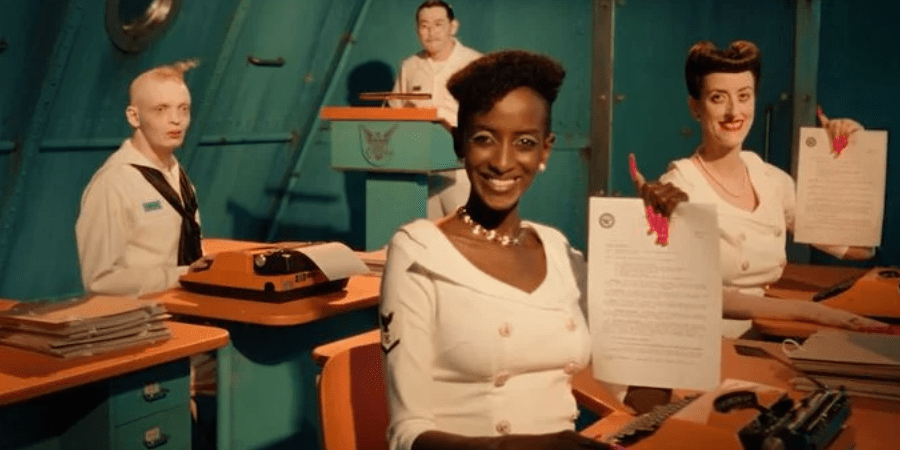
Being constantly suspended in grief and fantasy during an extended period of mourning can often cause a person’s individuality to blur and distort. But during that time of slow change, their instinctive search for selfhood can also lead them toward a new sense of identity. The new short film, ‘Charlie is Not a Boy,’ chronicles such an emotional journey, which the titular character embarks on.
The LGBTQ+ drama is a darkly whimsical, allegorical portrait of identity, repression, and survival. World-class photographer Pol Kurucz made his directorial debut with the film. The filmmaker’s friend, Brooks Ginnan (they/them), stars in the project. The performer’s real-life journey inspired Kurucz to create Charlie’s story.
‘Charlie Is Not a Boy’ is the tale of a hushed soul bound to a crumbling household in an allegorical America. With a perverted butcher for a father (Máté Mészáros) and a mother (Gigi Spelsberg) frozen in a quiet, catatonic spell, Charlie (Ginnan) seeks solace in the whimsical world of his eccentric grandmother (Agnes Bánfalvy). As his safe haven unravels, Charlie navigates the hostile realms of home and the military, caught between his authentic self and the masks he must wear.
‘Charlie is Not a Boy’ had its world premiere at the Slamdance Film Festival on February 22. The drama’s next screening will take place at Wicked Queer in Boston on April 3, where it will have its Boston premiere. To help promote the film’s premiere at Slamdance, Kurucz generously took the time to discuss making the project during an exclusive interview over Zoom.
Film Factual (FF): You wrote the script for the new short film, ‘Charlie is Not a Boy.’ What was your inspiration for penning the screenplay? How did you approach developing the overall story?
Pol Kurucz (PK): Well, I used to be a photographer, and before that, I was a theater director. So I wanted to get back to more sophisticated storytelling, which was film.
While I was doing my lighting tests to go from still to motion, I had a dear friend, Brooks Ginnan. come to my house to do the camera test. I knew the world where I wanted the story to unfold, but didn’t know who would play the main character.
They stepped in the apartment, dressed as a stylish old lady, and I completely fell in love with the character. I immediately told them that in a couple of months, I’d really love to start working on a story together.
With the story itself, I had pieces in my mind. But it was inspired by what was happening in the United States at that time. It was also inspired by Brooks’ own life.
FF: Besides scribing the script, you also made your directorial debut on the drama. How did writing the story influence the way you approached helming the movie?
PK: I used to work in a pretty professional world of photography, so I was used to everything being where it should be, as well as having a lot of prep, tools, equipment, and a staff that knew how to do what they needed to do.
So I had to jump into a completely indie world for the short. We didn’t have the resources that we had in photography.
It was a harrowing process figuring out how I was going to achieve it. But I was very lucky because I secured a group of people from the world of cinema who helped me, including my family and friends.
I’m half Hungarian, as my dad is Hungarian. A lot of my family and friends work in cinema in Hungary, so I had amazing support while making the film.
On the script side, I had a friend, Pablo Larcuen, whom I met at a party here in LA. He was working on a script that would become a film years later, so I asked if he had time to collaborate.
We then talked about the existence—or nonexistence—of God. I found that he was thinking really outside the box. I liked his thinking, so he became the co-writer. He had experience in writing and directing, and that helped me a lot.
FF: Like you mentioned, you worked as a photographer earlier in your career. How did that background help you create the visuals for ‘Charlie Is Not a Boy’ with your cinematographer, Gergely Pohárnok?
PK: On one hand, it was easier for the DP (Director of Photography) and me to work on the visuals because I had a very good idea of camera angles and lighting. I knew what images I wanted and what they could convey.
I also had a good sense of camera positions and blocking, although it’s obviously different from photography. The perspective, and the way you translate emotions and ideas through composition, was very familiar to me.
On the other hand, there was a lot that I didn’t know—and didn’t realize I didn’t know. I thought that a video camera and its lighting were pretty similar to the photo world, but they weren’t completely the same.
Gergely Pohárnok, who’s the DP of the film, is a very seasoned director of photography. He has worked on an incredible number of fantastic feature films and shorts, so he was guiding me throughout the process.
That was the collaboration where I learned the most. It was very atypical, because DPs don’t usually spend a month working so closely with a director, which is what happened in my case. We met every two or three days and went through all the animatics. That’s how I transitioned my eye from still to motion.
FF: Earlier, you mentioned working with Brooks Ginnan on the short. How did you work with them and the rest of the cast to build the characters together? Did you have rehearsal time?
PK: Oh, yes. That was frightening for me, as I’m always intimidated by things I don’t know much about. But I try to prep a lot on all my projects.
This project was much easier and faster than I expected. It’s a short, and it doesn’t have any dialogue, so that helped a lot.
I found that the actors we cast, with casting director Hermina Fátyol, helped tremendously. They already had everything I needed in terms of how the characters would interact with each other.
On set, it was really smooth sailing. I would have never thought that before we began filming, as pre-production was hell. Every second day, we thought, “This is not going to happen.” There wasn’t a set, there weren’t any actors, there wasn’t a studio—there was always something missing. But the five days of the shoot were surprisingly smooth, with very few surprises.
FF: Like you mentioned earlier, the film doesn’t feature any spoken words. How did the lack of dialogue influence the score?
PK: That’s a very good question. I think the music eventually took over the narration.
At first, we didn’t know anything – not even how much narration there would be. I then decided that the narration would stop toward the beginning of the film, so I realized something else would have to carry the emotional storytelling, because the visuals weren’t enough.
So we spent two months with Amanda Cawley, the composer, translating those emotions into music.
FF: Once principal photography on ‘Charlie Is Not a Boy’ was completed, how did you approach the editing process?
PK: You’re the first one to ask this, which I’m happy about. I did something that I later found out not everybody does – it’s more common on larger productions, especially those with a lot of CGI.
I created animatics. I built and edited the entire film in that form.
So when we started shooting, we knew every camera position, timing, and movement. We followed that very closely – there’s barely any difference between the animatic and the final film.
For a feature, that might not be possible, as it takes a lot of time. But it helped a lot on the short.
FF: Besides writing and directing, you also served as an executive producer. How did you approach working with the producers?
PK: We had line producers who were very important. The production was partly self-funded. Basically, we didn’t have much money.
We had support from people who worked for free. I was essentially the main producer, constantly asking people to lend us things and be there without pay. I also brought in family and friends.
Production-wise, the line producers were crucial. It was a new experience for me.
In still photography, it’s somewhat similar. But on a film set, instead of 15-20 people, you can have 80 at times. So I needed help – and I got it.
FF: Charlie Is Not a Boy had its world premiere at the Slamdance Film Festival last month. What does it mean to share the film with audiences in LA?
PK: It’s been a dream—it was wonderful. It was the first time I saw the film in a proper cinema, at Landmark Theatres on Sunset.
I was happy to see that people liked it. We got cheers and applause that I didn’t expect. People came up after the screening, and since then we’ve had many conversations about what they liked and didn’t like.
This is the first festival in the world where the film has been shown, so it’s the start of a journey – discovering the audience and what I’ll take into the feature film.
 Film Factual