
The most atmospheric, striking and surprisingly realistic stories are often times those that focus on the search for human connection in a world driven by societal isolation. The new short film, ‘Bathed in the Night,’ is one such project that thrives on a visually driven, emotionally raw story that blends horror and sci-fi elements together.
Sarah Seeds wrote the script for the existential short, which her husband, Michael Pizzano, directed. The duo served as producers together on the thriller, as well. She also starred in the film with Johnny M Leone.
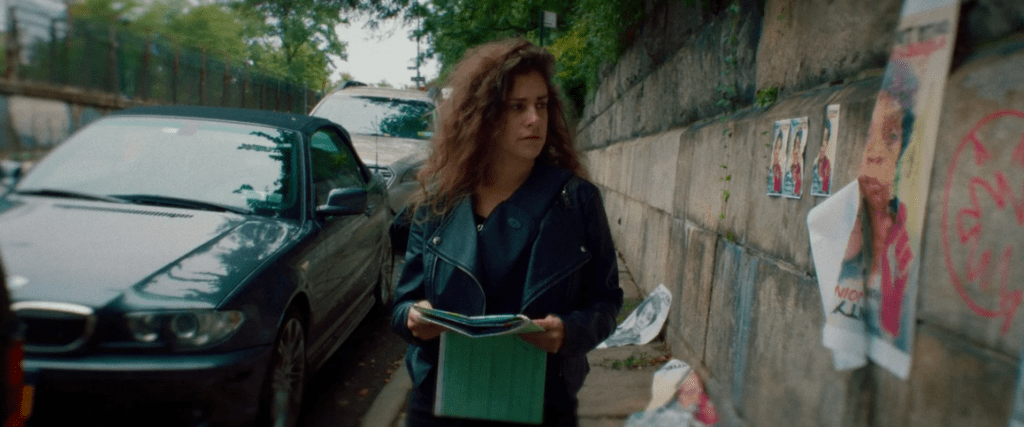
‘Bathed in the Night’ follows a girl, Alyx (Seeds) and a cat as they decide to wait out the apocalypse in a New York City apartment. They decide to venture back into the world when a lone light suddenly appears outside. The light leads her to face the darkest parts of the dystopian city below as she sets out on a journey to face her fears.
Seeds generously took the time to talk about penning, starring in and producing ‘Bathed in the Night’ during an exclusive interview over Zoom. Among other things, she discussed that she created the visually driven horror-sci-fi film as a way to tell the kinds of complex stories she wasn’t being offered as an actress, and how she drew inspiration from pandemic-era isolation as a scribe and performer.
Film Factual (FF): You write the script for the short thriller, ‘Bathed in the Night.’ What was the inspiration in penning the screenplay for the film? How did you craft the story for the drama?
Sarah Seeds (SS): I have a background in acting and have been performing since I was young. I’m on the board of the Screen Actors Guild (SAG). Around 2016–2017, I realized there were roles I wasn’t getting that I really wanted to play – more complex, interesting characters. Instead of complaining, I decided to create those roles myself.
I wrote a web series called ‘Riding the D with Dr. Seeds.’ It’s about a non-licensed psychiatrist riding the D train in New York City, trying to fix people while being a little unhinged herself. It was a way to bring my comedic voice into something meaningful. The series was picked up by Amazon, which helped me join the TV Academy.
From there, I started asking myself what else I could create that I hadn’t done before. When it came to Bathe in the Night,’ I was coming out of lockdown and participating in a Zoom writers’ room where we held each other creatively accountable. I also met my now-husband there.
One exercise was to show a full character arc in the shortest time possible: a character needs something, goes after it, gets it, and is forever changed. I wrote the short quickly with that structure in mind, using a horror lens. I wanted to explore themes we all experienced – loss, isolation and change – through something tangible.
The story follows a woman and her cat waiting out an apocalypse in New York City. When she needs connection or supplies, she ventures out after seeing a light in the distance, and everything spirals from there. It’s not a typical pandemic story – it leans more into sci-fi and darker elements.
The film relies heavily on visual storytelling. It’s been in several festivals and won Best Sci-Fi, which is interesting because it’s often categorized as either horror or sci-fi.
We intentionally used 1970s lenses on a modern camera to create a gritty, New York, John Carpenter-inspired look. This was a big shift from my earlier, dialogue-heavy work – this project focuses much more on visuals.
FF: Like you mentioned, you worked on the movie with your husband, Michael Pizzano, who served as the director. What was your experience like working together while you were making the short?
SS: It was a great experience. Our dynamic is similar to creative partnerships like Gena Rowlands and John Cassavetes. (Pizzano) introduced me to their work, and I loved how they collaborated.
This was my story, and he was immediately drawn to it. The themes of isolation resonated with both of us. In this world, the catastrophe wipes out most of the population, making it an extreme version of what we experienced.
We worked closely in pre-production with our cinematographer, Nick DeLullo. My husband focused on building the crew and visual elements, while I focused on the story, character and casting. The collaboration felt very natural and balanced.
He’s great with actors – he doesn’t dictate performances but works with you to discover them. That was especially important for emotionally intense scenes. Overall, it was a smooth and rewarding process, and our first fully realized production at this scale.
FF: Like you mentioned, ‘Bathed in the Night’ is set in New York City. How did you secure the locations for the thriller, and create the production design?
SS: We shot shortly after lockdown, when parts of New York still felt eerily empty and apocalyptic. We found incredible locations – overgrown streets, graffiti-covered areas and spaces that hadn’t fully recovered yet.
We filmed interiors in two apartments we owned at the time, designing them to reflect different living conditions. One was more controlled and maintained, and the other was more chaotic and deteriorated. One location was lit entirely by candlelight, which created a beautiful effect.
For the cat, we used a trained actor cat instead of mine. My cat looked a little too well-fed for an apocalypse setting.
We had to be resourceful with our budget, focusing on art direction, sound and visuals. Sound was especially challenging in New York, so we relied heavily on post-production.
FF: Speaking about the sound and visuals, how did you balance the two elements during the production?
SS: It required trusting the process. Early cuts didn’t fully reflect the final product because sound design plays such a huge role in horror.
We worked with sound designers to build everything from scratch, including footsteps, ambient noise and subtle environmental sounds. Silence was just as important as sound.
I didn’t want a full orchestral score throughout. Instead, we used minimal music, with one key piece composed by Marcel Dios Herrera. He created a theme that evolves—starting emotional and becoming distorted and unsettling later.
The combination of sound design and visuals was crucial to creating the tension and immersion in the film.
FF: ‘Bathed in the Night’ also stars Johnny Leone. How did you approach the casting process for the film? After the supporting actors were cast, how did you work together to build your characters?
SS: Since I wrote the role for myself, I already understood the character deeply. I used techniques like the Chubbuck Technique, drawing from personal experiences to inform emotional moments.
We had one other key actor, Johnny Leone, who brought a strong, intense presence. The casting process was straightforward because the story is very contained.
There were definitely moments on set where I realized how demanding the role was, especially during physically and emotionally intense scenes. But it was rewarding.
FF: Besides writing and starring in the drama, you also served as an executive producer. How did you balance producing and acting during the production?
SS: I learned early on to separate those roles. During filming, I focused entirely on acting and trusted my team to handle production. Trying to do everything at once isn’t sustainable. In pre- and post-production, I’m much more hands-on.
Right now, I’m writing a feature version of the film. There’s interest from potential collaborators.
FF: Speaking of penning a feature version of the short, what has the adaptation process been like?
SS: It’s going well. I’ve outlined the full story and am working on the script. It expands on the short, following the character beyond the city in search of a possible sanctuary.
It’s a bigger, more expansive story with new characters and locations. Writing it has been exciting. I find myself genuinely wanting to see it come to life.
FF: The short has played at several festivals, including the Richmond International Film Festival and the Chain Film Festival. What has the festival experience been like for you?
SS: It’s been incredibly rewarding. Watching audiences react in real time is special, especially with a film that relies on interpretation and atmosphere.
We screened at the Richmond International Film Festival, which was a full-circle moment for me because I grew up there. Seeing my film in a theater I used to visit as a kid was surreal.
We’ve also won Best Sci-Fi at the Chain Film Festival in New York. That was meaningful since the film blends genres.
We have more festivals coming up and are continuing to build momentum. It’s been an amazing journey so far.
 Film Factual