
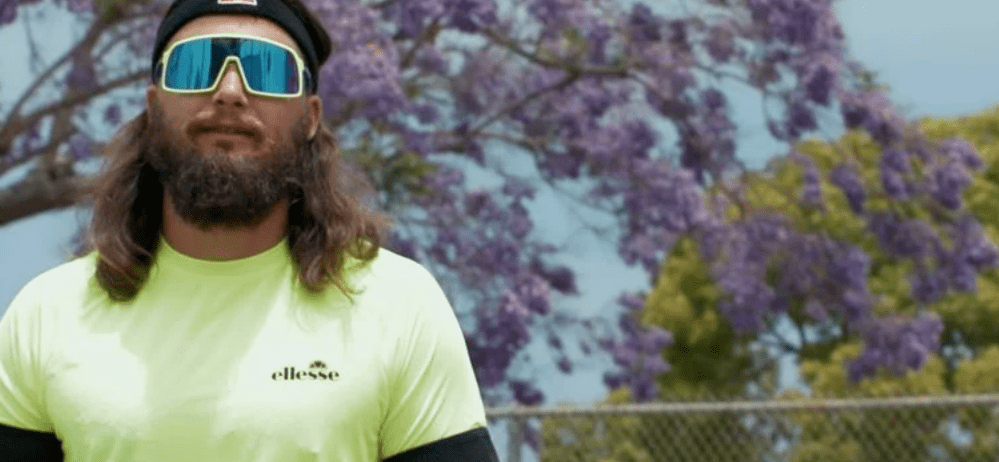
The fight of many communities to maintain their status in society can be a challenge, as they have to continuously prove their worth as modern-day trendsetters. The surprising leading innovators on the streets of Venice Beach are the paddle tennis players, who are determined to prove their value on the California beach. That’s the focus of the new documentary, ‘Kings of Venice.’ The film dives deep into the life of the eccentric and passionate paddle tennis community of Venice Beach, capturing the sport’s colorful players and rich, if obscure, history.
Sveinn Ingimundarson and S.D. Saltarelli wrote, directed, produced the movie. The documentary stars Scotty Freedman, Ernesto Russo, Sonia Ode Lucci, Carl Tabor, Brian Wan and Larry Nagler.
‘Kings of Venice’ held two screenings during this year’s Slamdance Film Festival. The first screening sold out on Saturday, February 21 at the Summer Chastant and David Pierce Theater (DGA Theater 2). After its screenings, the project was honored with the festival’s Audience Award for Documentary Feature.
Set in the cutthroat world of Venice Beach paddle sports, ‘Kings of Venice’ shows that only one paddle can rule!.Once a proud sport, paddle tennis is now kept alive by a collection of oddballs ranging from an Italian male model to an incorrigible gambler and Hollywood’s most accomplished party crasher. But when a horde of pickleballers arrive and threaten their beloved turf, it unites our rag-tag crew and sets off a showdown of hilarious and epic proportions, pitting the two paddle sports against each other. Only one will become the Kings of Venice.
Ingimundarson and Saltarelli generously took the time after the movie’s Slamdance screenings during an exclusive interview over Zoom. Among other things, the filmmakers discussed why they were interested in telling the story of the Venice Beach paddle tennis players in a documentary, how they delved into the community’s history and what their experience was like of screening the feature at Slamdance.
For Saltarelli, the inspiration for the movie came from the world and the people themselves. “It was this combination of an incredibly bright and colorful world down in Venice Beach that encapsulates the sport, along with the people who love it,” he explains. “That combination is what really lit a fire under us – we thought, okay, let’s put this on camera and see if we can do something with this.”
Research for the film was as much about connecting with the characters as it was about understanding the sport. “We were both already members of the paddle tennis community,” Saltarelli noted. “When you’re making a documentary focused on characters, the most important question is: who are the interesting characters? A lot of that groundwork had already been done in our everyday lives.”
The filmmakers also explored paddle tennis history, tracing its roots from New York to LA and uncovering why it didn’t spread more widely. “It became a bit of a detective story,” Saltarelli said. “The New York Times archives were phenomenal, and the community helped us find archival footage and old articles. It was definitely a community effort.”
Meanwhile, Ingimundarson focused on the technical aspects of filming. “We had to figure out gear, cameras, microphones, and how to make everything work well. There was both a creative and a practical side to the preparation.”
Working with cinematographer Michael Cannova, the directors found that Venice Beach itself did much of the visual work. “It could be taxing to be on the courts for hours waiting for one or two usable moments,” Ingimundarson recalled. “But Venice is such a visually beautiful place, with the colors, palm trees, and sky, that you don’t need much cinematography magic to make it look good. The production design is already there.”
Helming the project was a learning process for both filmmakers. “This was our first documentary features, so we were figuring things out one step at a time,” Saltarelli says. “It was very much like: This person is interesting, so let’s go talk to them, or This event is happening, so let’s go there. We built the movie piece by piece.”
While ‘Kings of Venice’ features a diverse cast, Ingimundarson said the real selection happened in the editing room. “We had way more footage than what ended up in the film, so the storylines and the most compelling personalities naturally rose to the surface,” he revealed.
Saltarelli added that representing Venice Beach’s diversity was a priority. “We wanted the film to reflect the different types of people and perspectives. If we had certain voices, we looked for others to balance that out. That was part of the puzzle.”
Locations, too, were dictated by the characters’ lives. “We mostly followed them, including where they lived, where they spent their time. A lot of the film takes place on or near the courts,” Ingimundarson explained.
Both directors agree that editing was the hardest and most revealing part of the process. “That’s where you find the story,” Saltarelli said. “It took several iterations. Showing cuts to others, including people in the film, was really helpful. Even after filming ended, we were still collaborating with our subjects in a way.”
Most of the time, filming was intimate, with just two or three people on set. Tournament day, however, was a different story. “It definitely felt overwhelming,” Saltarelli laughrf. “We brought in a larger camera team who worked on Netflix’s ‘Last Chance U,’ with a temporary court, bleachers and a lot more moving parts. It was a big departure from the rest of the shoot.”
The competition itself was tense and nerve-wracking. “We were probably more nervous than the competitors,” Saltarelli admitted. “As the day went on, with the pickleball team beating Venice teams, tension rose. People were getting a little upset with us. But we wouldn’t change anything if we could go back.”
After filming ended and ‘Kings of Venice’ screened at the Slamdance Film Festival, the filmmakers enjoyed being able to share the movie at Slamdance. “It was a real treat,” Ingimundarson said. “Seeing it with strangers and watching them enjoy it made everything feel worthwhile.”
Saltarelli recalled the joy of hearing the audience laugh at moments they had watched countless times during editing. “You can tell when someone truly connects with a film beyond just saying, ‘It’s great.’ That makes all the work worth it.”
With ‘Kings of Venice,’ Saltarelli and Ingimundarson have not only documented a sport and a community – they’ve captured the heart and soul of Venice Beach itself, one paddle swing at a time.
 Film Factual