
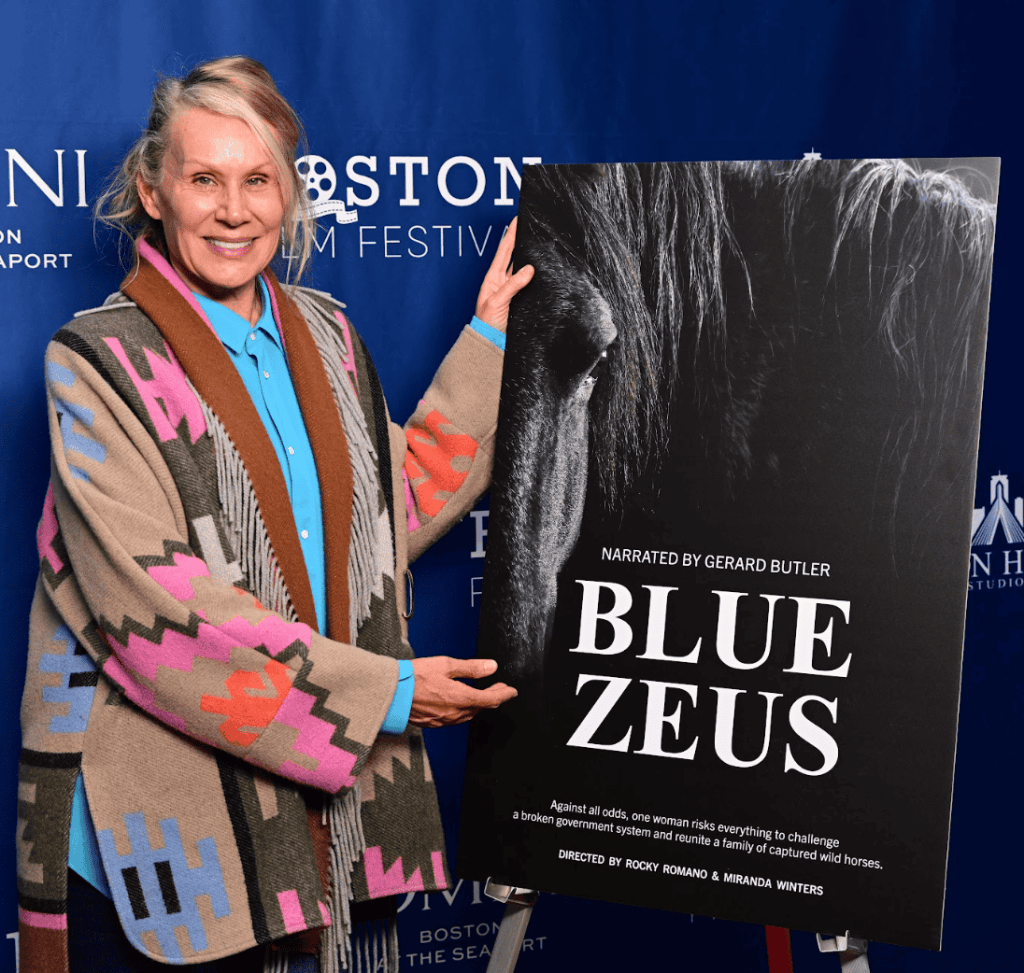
Photo credit: Stephen Ryerson
Exposing a flawed and corrupt government system rampant with abuse and paralyzing bureaucracy is a powerful narrative driving force in many documentaries. The new documentary, ‘Blue Zeus,’ is a prime example of doing just ha by exposing the plight of America’s wild horses. The movie chronicles how wild horse advocate Clare Staples attempted to rescue the titular animal after the U.S. government captures him and his family.
Rocky Romano and Miranda Winters served as directors on the film. Daryl Hannah, Robert Martin, Michael Holster, Janet Russell and Mathew Rhys served as executive producers on the movie. Jamie Baldanza, Analís Martin and Nicholas McCarthy served as producers on the documentary. Besides Staples, the movie also features Gerard Butler and Arielle Kebbel.
‘Blue Zeus’ features the heartfelt story of the rescue of the eponymous wild mustang. After 9 months, Staples was finally able to rescue him. But she then had to beat all odds to find his family, who were lost in an overcrowded system. With unparalleled access to government employees, their helicopter contractors and a whistleblower, the film delivers jaw-dropping journalism through an emotional and visually stunning story.
‘Blue Zeus’ had its New England Premiere, and served as the Centerpiece Film at the 41st Boston Film Festival last fall. The screening was held on Saturday, September 20, 2025 at 5:30pm EST at Emerson Paramount Theater (Bright Family Screening Room)
A post-screening Q&A was held with Staples, Kebbel, Baldanza, Kuhn, Romano and McPhee. Journalist Peggy Keyser moderated the Q&A.
Staples generously took the time to participate in an exclusive interview over Zoom after ‘Blue Zeus’ screening at the Boston Film Festival. The filmmaker discussed her experiences of making the feature during the interview, including how her lifelong love of horses led her to start Skydog Sanctuary and advocate for wild mustangs, culminating in the rescue of Blue Zeus. She also noted that through the documentary, she highlights the deep familial bonds of wild horses, giving voice to all sides of the issue and reflecting on the powerful audience response at the Boston Film Festival.
Film Festival (FF): You’re the founder of Skydog Sanctuary, and are known for your extraordinary dedication and tireless efforts to rescue and protect America’s wild mustangs and burros. Why are you so interested in serving as an advocate for the horses?
Clare Staples (CS): Well, I‘ve loved horses all my life. All my happiness came from seeing horses, touching horses and smelling horses. I used to get dropped off at a riding stable near my house every day after school, and it was everything I looked forward to everyday. I think it did me an enormous amount of good, in terms of teaching me responsibility and hard work.
So I’d always loved them, and they’d come in and out of my life. When I turned 50, I had an amazing opportunity to really rethink my life and what I wanted to do with the second half of it. I just realized that everything about horses had been my passion and my happy place.
So I started looking into rescuing some horses, which then turned into mustangs. My passion then turned into me really doing a deep dive and looking into the plight of the wild horses in the west. That eventually led to me starting Skydog Sanctuary and buying a 9,000 acre property in Oregon for them to be rewilded on.
FF: Speaking of launching and working at Skydog Sanctuary, what has your experience in that aspect of working with the horses been like for you?
CS: It’s been an extraordinary experience because I don’t think there are more sentient beings that are more emotionally connected to humans than horses. The wild horses have taught me so much about everything in life, including about staying in the moment and not dwelling on things from the past, as well as having patience.
It’s been a beautiful journey because I know all these horses individually. We have 350 animals at the moment, and we get to know them all really well before they get turned out on the land.
But the day-to-day work at the beginning of setting up the sanctuary is just the sort of boots on the ground hard work that I love. I’m kind of in the middle of doing it again now because we’ve just bought another ranch.
It’s funny, in a way. I’ve been sober most of my life and in AA, which is a big part of my story. The whole premise of AA is being of service, and I feel like I am every day to these horses. Its purpose is also to have a passion and a purpose.
I know someone in AA who always used to say that no matter what was going on, people should do the next right thing, and say, “Chop wood, carry water.” It was just a kind of metaphor for putting one foot in front to the other. It’ encourages people to just work hard.
That couldn’t have been truer than when I started working with these horses because I really was chopping wood and carrying water. So I made that metaphor into my reality, and I still do.
In the morning I’ll go out alongside the ranch hands and I’ll muck the horses that are here. I just like to have a management style where I never ask anyone to do something I wouldn’t do myself.
I like being shoulder-to-shoulder with the people who are working here, even though I have a lot of other things now that make me busy. I’m promoting the movie and setting up the new ranch.
There’s a lot of admin and paperwork to do with running a nonprofit. But I always make sure I touch a horse every day. My whole thing is touch a horse every day. I always want that to be a part of my life because that’s where my love lies and all the work that I do for them. It always has to come back to them.
FF: Speaking about the documentary, how did you become involved in the project?
TT: Well, The Doddo, which is a hugely popular kind of animal social media site, usually does very short form videos. They had done a couple of stories with us about horses that we had rescued.
So they approached us asking if they could make a long form video about Blue Zeus and his story. They had made a short video about Goliath and Red Lady being reunited.
They saw all the footage that there was of Blue Zeus in the wild being rounded up. They also saw the footage of him being brought to the corrals being reunited with his family. They thought that it would make a really amazing longer form.
So they made a seven-minute video, which is really unheard of for the Dodo. They put it out on Christmas day, which was beautiful.
There was a lot of interest that came from that because it was so widely seen. They have millions and millions of followers.
I think the director of the current film saw that piece and thought, this needs to be a movie. Originally, he approached me to make a short film about it. But I persuaded him that it could instead be a full-length feature documentary.
I explained all the different characters that are involved behind the scenes of why Blue Zeus got rounded up. I noted that we could explore why this is happening and what happens to them. I also thought we could explore the thinking behind it, and what the process is now.
I knew a lot of people in the wild horse advocacy world and asked them if they would do interviews. They helped on that side of it to bring people into the film.
Rocky also did a really good job with getting interviews from the other side of things. He spoke to people from the Bureau of Land Management (BLM) group to the helicopter people and the ranchers.
So, I think all in all this was a really well-rounded film in that it let both sides speak. But unfortunately, the bad side seemed to do a really good job of making themselves look terrible without us even having to say that.
Q: When you decided to capture Blue Zeus, what was the experience of bringing him in?
TT: It was extraordinary, but also incredibly difficult because it all happened during the COVID-19 pandemic. Blue Zeus and his family had been taken to a BLM facility located inside a high-security men’s prison, which meant there was no access. The prison was on lockdown, and there were no adoption events happening at the time. I spent months calling, writing and emailing; I was constantly reaching out to express my interest in adopting these horses.
Eventually, there was a brief break in restrictions one summer, and the BLM held an adoption event where they brought 64 older horses to a park. That’s where I finally saw Blue Zeus. I adopted him for $25, and that same day we transported him, along with three other older horses, to our sanctuary in Oregon.
Once Blue Zeus arrived, I noticed a deep sadness in him. He often stood alone, gazing off into the distance as if searching for his family, and didn’t engage much with the other horses. It really felt like an ache in his heart.
That’s when I began to wonder if I could find any of his family members. Using photographs and videos taken in the wild by photographers like Chad and Lynn Hansen, I tried to match markings and track them down.
In the end, I found eight members of his family, which was incredible. What started as a rescue turned into a powerful family reunion, and ultimately, into the film itself. I wanted the story of Blue Zeus to be woven throughout the movie, giving audiences an emotional thread to follow while also exposing them to the broader, more difficult realities facing wild horses in the American West.
Q: How did you decide who to interview for the film, and what was that experience like?
TT: We wanted to give a voice to all stakeholders involved in the wild horse issue. That included interviews with people from the BLM, as well as the helicopter company contracted to carry out the roundups – this was actually the first interview they had ever given. We also spoke with a whistleblower who had worked at the BLM for 28 years and left feeling disillusioned and frustrated by how the horses were being treated.
It was also very important to include people who had firsthand experience with the horses in the wild. My work really begins after the roundups. I don’t attend them, so we brought in individuals who had witnessed those events and could speak to their experiences. We also featured scientists who discussed the idea that horses may be native to North America, as well as the science behind their familial bonds and social structures.
That idea of strong family bonds between horses was central to the film. The BLM does not recognize horse families as something that needs to be preserved or managed, and in some cases, they don’t acknowledge those bonds at all.
But from what we’ve observed, these connections are real and incredibly strong. We’ve documented reunions where horses find each other again and never leave one another’s side.
Some critics argue that this perspective anthropomorphizes the animals. But while their emotions aren’t human, they are clearly deep and meaningful. Anyone who spends time observing these horses can see that.
We also included footage from organizations like American Wild Horse Conservation, who attend roundups and document what happens. Overall, we interviewed a wide range of people to ensure every perspective was represented, though not all arguments presented felt like viable solutions. Still, it was important to let everyone speak for themselves.
Q: Blue Zeus had its New England premiere at the Boston Film Festival last September. What was it like to present the documentary at the estival?
TT: It was an incredible experience; honestly, it was the best festival experience I’ve had. We had screened at a few smaller festivals before, which were enjoyable, but Boston was on another level. It was exceptionally well organized, and everything ran smoothly.
What made it even more special was the audience. Many people who follow SkyDog Sanctuary on social media came out to support the film, so it felt like being surrounded by a community. There were people wearing SkyDog shirts and hats, and the energy in the room was amazing.
The Q&A session lasted about 45 minutes, which is much longer than usual. That allowed for a deeper, more meaningful conversation with the audience. Our moderator, Peggy Kaiser – a former news anchor and an excellent journalist – guided the discussion beautifully. She also had a personal connection to the work, having collaborated with us on a horse rescue effort, which made the conversation even more engaging.
We had several people from the film on the panel, and the entire experience was very emotional. I was especially surprised when actor Matthew Rhys, a longtime friend, introduced me for an award I didn’t even know I was receiving. The audience gave a standing ovation, and I was completely overwhelmed – I couldn’t stop crying throughout the evening.
Seeing the film on the big screen, especially the stunning cinematography and close-up shots of the horses, was incredibly moving. Watching Blue Zeus’s story unfold in that setting made it all feel worthwhile. It was truly a beautiful and unforgettable experience.
 Film Factual