
Crime thrillers have long been fascinated with the gap between appearance and desire, particularly the roles people perform and the truths they conceal. The latest entry, ‘Body Blow,’ reimagines the genre through a distinctly queer lens, using the conventions of noir to explore identity, repression, masculinity and the cost of living according to expectations that conflict with individual’s deepest instincts.
Drawing on the seductive danger of classic noir and erotic thrillers while subverting their traditional gender and sexual dynamics, the movie asks timeless questions about power, identity and the personas people construct to survive. Blending erotic tension, darkly comic twists, and a knowing nod to queer history, the feature reimagines classic film noir as a neon-soaked descent into Sydney’s underworld.
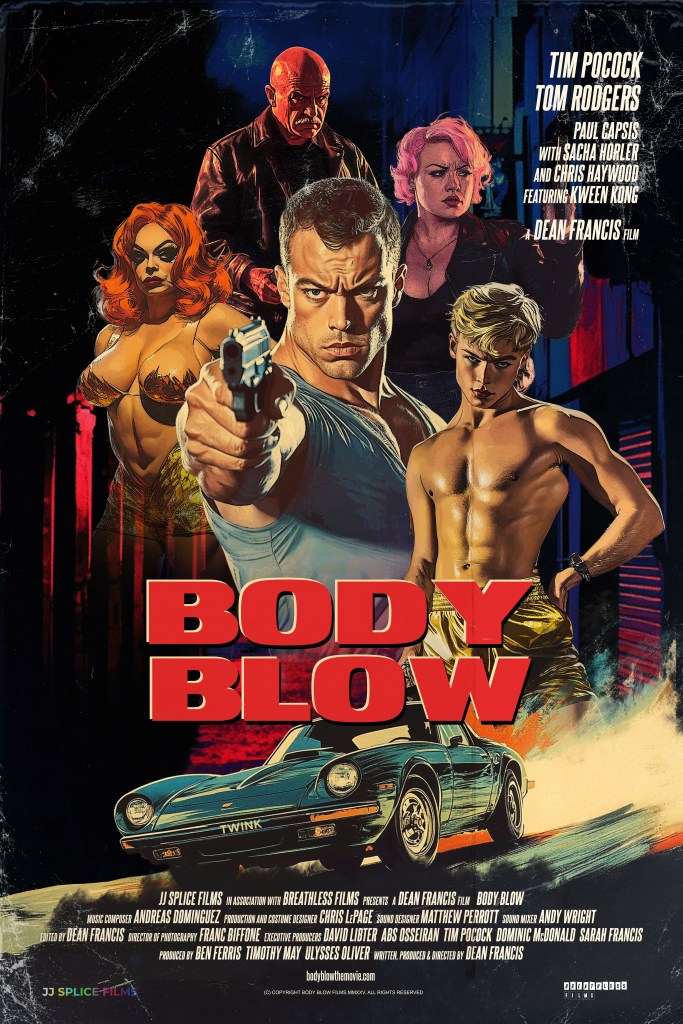
Dean Francis wrote, directed and produced ‘Body Blow.’ The drama stars Tim Pocock, Tom Rodgers, Paul Capsis, Sacha Horler and Chris Haywood.
‘Body Blow’ follows disgraced cop Aiden (Pocock) as he’s thrust into Sydney’s neon-soaked gay district. While there, a chance encounter with Cody (Rodgers), a seductive bartender and sex worker, sparks a dangerous spiral. Blackmailed into working for Fat Frankie, a murderous drag queen mob boss, Aiden is drawn into a deadly heist and a twisted game of survival. As he battles desire, betrayal and his own demons, Aiden must decide if redemption is worth the price of betrayal.
‘Body Blow’ is set to have its World Premiere at Fantastic Fest tonight, September 19 at 8:30pm CT in Theater 6 at the Alamo Drafthouse Cinema South Lamar in Austin. The movie will then have its second screening next Wednesday, September 24 at 2:40pm in Theater 5. Dark Star Pictures has acquired North American rights to the thriller and is currently planning a 2026 theatrical release.
In honor of the film’s premiere, Francis generously took the time earlier today to talk about scribing, helming and producing the feature during an exclusive interview over Zoom. Among other things, the filmmaker discussed how he used the framework of a queer crime thriller to explore the tensions between identity, desire and societal expectations, particularly through the lens of masculinity and repression. He also noted how the drama examines what happens when personal longing collides with duty, control, and the personas we create to navigate the world.
Film Factual (FF): You wrote the script for the new crime thriller, ‘Body Blow.’ What inspired you to develop the screenplay, and how did you approach creating the story?
Dean Francis (DF): The film was really inspired by my passion for the erotic thrillers of the late 1980s and 1990s – films that explored sexuality and sexual tension in a visceral, plot-driven way. Growing up watching those movies, I was always conscious that they were very heterocentric. As a queer filmmaker, I thought it would be an interesting challenge to explore that form through a queer lens.
We built the story from a combination of real events that have happened in Sydney over the years, along with some of my own experiences. Ultimately, we wanted to immerse audiences in a strange, otherworldly version of underground Sydney.
FF: Besides penning the script, you also directed the drama. How did scribing the screenplay influence the way you helmed the movie? What was your oval approach to directing the thriller?
DF: Once we had the idea, it felt very potent and urgent to get it made. We decided to take a very independent route because we didn’t want to spend years in development, which often happens in Australia. We also didn’t feel we needed to ask for permission to tell this story.
We were fortunate to attract incredibly supportive private investors, and then we moved into casting. I couldn’t have been happier with the enthusiasm from the actors. Tim Pocock, whose work I’d admired for years, had never played a queer character before and had only recently come out publicly. He brought a lot of himself to the role and connected deeply with the character’s internal conflicts.
Sasha Haller joined the project and brought a strong analytical approach to the material, which was enormously beneficial. We also cast Paul Capsis, an Australian legend whose personal experience within Sydney’s queer community gave him a deep understanding of the film’s world and characters. It became a fascinating collaboration, and we shot the film over six weeks on location throughout Sydney.
FF: Speaking of shooting ‘Body Blow’ on location throughout Sydney, how did you choose the places where you would film?
DF: We wanted to create a distinctive world while working within the realities of a lower-budget production. Sydney offers an incredible amount of production value if you know where to look, so we often wrote scenes around locations we already knew we could access.
Stonewall, a famous gay bar in Sydney, became a central location. It’s full of history and legend, and we incorporated much of that into the production design. Our approach was always to embrace what already existed and highlight the truth of the city. The setting is incredibly important to the film’s tone and immersive atmosphere.
We wanted to showcase Sydney’s beauty while also giving it a darker edge – something closer to a Gotham City sensibility. Whether it was alleyways, rooftops or nightlife spaces, we focused on enhancing what was already there.
FF: Franc Biffone served as the drama’s cinematographer. How did you work together to create the drama’s visual look?
DF: Our major inspirations were classic erotic thrillers. ‘Body Heat’ was a huge influence, as was Ken Russell’s ‘Crimes of Passion,’ particularly in terms of lighting and bold, saturated colors.
I worked closely with Frank Buffone, who was fearless. The schedule was challenging, but he was willing to take significant visual risks. We also leaned into some Brian De Palma influences, particularly the use of moving camera work.
We built a lightweight 6K camera rig with small anamorphic lenses, which allowed us to create dynamic shots using a simple jib arm. Height became an important visual motif throughout the film, especially in relation to the characters and their relationships.
FF: You mentioned earlier the actors who appear in the drama. The movie stars Starring Tim Pocock, Tom Rodgers, Sacha Horler and Paul Capsis. What was your collaboration process like with the actors? Did you have rehearsal time?
DF: Rehearsal was very important to me. Even though the film embraces a heightened noir and thriller style, it still needed emotional truth. If the performances didn’t feel authentic, audiences wouldn’t connect with the story.
So we spent time exploring backstories and the broader world of the film. The cast were incredibly collaborative and brought their own life experiences into their performances. Paul Capsis had firsthand familiarity with the drag and queer worlds reflected in the story. Sasha Horler grew up in the same neighborhood depicted in the film and contributed lived-in texture. Tim Pocock brought a great deal of himself to the role as well.
The cast were proactive, creative, and deeply committed to finding the nuances the story required.
FF: Chris Le Page served as the movie’s costume designer. How did you develop the costumes and overall look for the characters?
DF: We wanted the characters to feel distinctive while still nodding to the films that inspired us. Our costume and production design team focused on showcasing beautiful local fashion designers and shaping the visual identity from there.
Tim Pocock also contributed a lot of ideas and creative energy to Cody’s look. Marissa Sekhov’s makeup design became a real feature of the film. It helped transform Cody into an almost alien-like figure and reinforced themes of being an outsider or a stranger in an unfamiliar world. That collaborative process was central to creating the film’s visual identity.
FF: Andreas Dominguez served as the thriller’s composer. How did you work together to create the film’s score?
DF: We worked with Andreas Dominguez, who’s an incredibly talented young composer. His previous work included ‘Bird Eater.’ We were also fortunate to have Oscar-winning sound mixer Andy Wright on board.
From the beginning, we knew we wanted a sonic world built around saxophones, synthesizers and sounds that evoked the 1980s and 1990s. Andreas did an excellent job translating that vision.
One particularly interesting development was that Tim Pocock actually composed several key instrumental pieces in the score. It happened very organically. Since the film is largely experienced through Aiden’s perspective, it felt fitting to have some of the music literally emerge from the actor portraying him. Tim’s contributions were a wonderful surprise and added another layer of authenticity to the film.
FF: You were also supportive as a producer on ‘Body Blow.’ What was your collaboration like with the producers and production team while making the drama?
DF: My company, JJ Splice Films, collaborated with Breathless Films. We’d worked together previously on ‘Lonesome,’ which I produced and shot as cinematographer while Craig Boreham directed. That previous collaboration gave us a shared language and familiarity.
Breathless Films has a very independent spirit, which was perfect for this project. They’re focused on getting out there and making films regardless of budget limitations. Timothy May, from JJ Splice Films, was also an enormous support throughout the process.
Making independent films is always challenging, but we’re fortunate in Australia to have a producer offset system that helps filmmakers package and finance projects. That support has become an essential lifeline for independent productions.
FF: ‘Body Blow’ is having is World Premiere tonight at Fantastic Fest. What does having the film premiere at the Austin-based festival mean to you?
DF: The world premiere is incredibly exciting and a little daunting. As a filmmaker, you spend so much time inside your own creative bubble, and then suddenly you’re presenting the work to audiences halfway around the world. So far, the enthusiasm surrounding the film has been tremendous, and I’m excited to see how audiences respond. There’s always an element of uncertainty, but that’s part of the thrill of sharing a film with the world for the first time.
 Film Factual