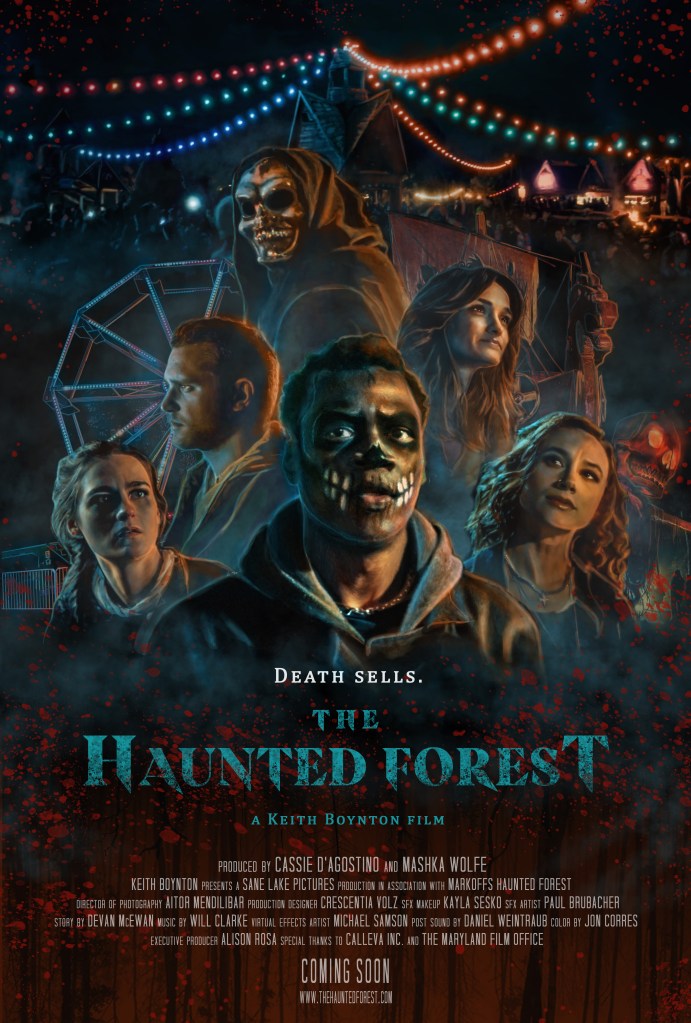
The natural intertwining of fear and curiosity offers a deep contemplation on humanity’s desire to explore terror and the unknown. The new horror film, ‘The Haunted Forest,’ embraces that reflection.
Beneath the drama’s blood-soaked thrills and practical effects lies a blurred line between staged horror and genuine danger. By combining the playful energy of a carnival haunt with the psychological tension of survival horror, the movie questions what horror reveals about people’s collective fascination with fear and the thrill of being scared.
Keith Boynton wrote and directed ‘The Haunted Forest,’ which marks his first entry in the horror genre. Grayson Gwaze, Cedric Gegel, Kaitlyn Lunardi, Meghan Reed and Jamie Bernadette star in the drama. The film is now available on Digital and VOD, courtesy of Quiver Distribution.
‘The Haunted Forest’ follows Zach (Gwaze), a horror-movie obsessive who’d rather draw gruesome comic books in class than concentrate on his studies. So when his cousin Mark (Gegel) invites him to work at the legendary titular Haunted Forest, Zach is thrilled beyond belief.
On his first night, Zach meets Sarah (Lunardi), a beautiful and intriguing makeup artist, as well as Jacko (Boynton), a veteran employee who takes the protagonist under his wing. Zach is living his best life, indulging his passion for all things morbid.
But when Jacko is found dead, the magical world of the Forest begins to seem sinister. Zach can’t help but wonder where the killer will strike next.
Boynton generously took the time recently to talk about penning, helming and starring in ‘The Haunted Forest’ during an exclusive interview over Zoom. Among other things, the filmmaker-actor discussed how the real-life Markoff’s Haunted Forest inspired the decade-long journey of creating the feature, from developing the screenplay with his brother to shooting within the legendary attraction using practical effects.
FF (FF): You wrote the script for the new horror film, ‘The Haunted Forest.’ What was your inspiration in penning the screenplay?
Keith Boynton (KB): So in this case, the answer is really easy. We were inspired by the location. It’s a real place – it’s a real haunted forest in Maryland. They’ve been running it there for more than 30 years.
Some cousins of mine actually started it up and still operate the location. So I went down there for the first time about 10 years ago with my brother. He was the one who turned to me and said, “You got to make a movie here. It’s just such a special place. It’s so rich and beautiful, and it’s such an occasion. I mean, thousands of people go there every night.”
Then he and I started batting around ideas for the story. We really developed the whole script together over the course of a couple years. So it’s been a dream project for about a decade now, and now it’s finally coming out.
FF: Speaking of the location, Crescentia Volz served as the production designer on the drama. Once you began filming in the forest, what was the experience like working within that environment and bringing the space to life on screen?
KB: Most of those design elements were sort of there already for the shooting. We did rearrange things a little bit – we could add a fireball here if we needed it, rearrange the geography of the forest. We had our own imaginary geography, and what we show in the film is a tiny percentage of what’s actually out there. Plus, there’s more new stuff every year.
Crescentia Volz did a beautiful job for our production design. It was largely about capturing the beauty and the magic of those actual locations.
FF: Besides scribing the script, you also directed ‘The Haunted Forest.’ How did penning the screenplay influence the way you approached helming the movie?
KB: It was amazing. It was really one of the best experiences I’ve ever had. That occurred because of the community that we built around the film and that we were able to embed ourselves into.
We were this little film community operating within the larger Markoff’s Haunted Forest community. We really merged those two communities to an amazing extent over the course of a few weeks.
So it was a blast. We were there all night in the woods, in the cold, in November. The physical conditions were pretty miserable, but the vibe was so good and the enthusiasm was so high.
When something happens, like a geyser of blood goes off, you just feel like you could go forever. Everybody feels that excitement.
That’s something I didn’t really count on – how different making a slasher film is from most other films because of those real physical effects, and how they get everyone to be like a kid again. It’s really an amazing feeling.
FF: Speaking about the physical effects, how did you make the overall special effects for the film?
KB: It’s pretty much all practical effects. We did some CGI just to clean things up, but really all the effects on screen are real.
That was very new for me. Most of the movies I’ve made are character and dialogue-driven dramas. So I got to play around with practical effects for the first time, and there was definitely a learning curve.
There’s a discipline and planning that practical effects require. We as a team had to learn a lot as we went along.
Sometimes the effect doesn’t quite go the way you think and you have to adjust. Other times it’s more spectacular than anything you could imagine. I feel like I learned a lot in that process. The next time I make an effects-heavy movie, I’ll do an even better job.
FF: ‘The Haunted Forest’ stars Grayson Gwaze, Cedric Gegel, Kaitlyn Lunardi, Meghan Reed and Jamie Bernadette. How did you approach casting the drama?
KB: It was a multi-tiered process because a lot of the people you see in the movie are the real staff. A lot of them are playing versions of themselves or variations on themselves.
The lead actors were brought in – some were from New York, and some were local. That was more of a traditional casting process, with some virtual auditions and some in person auditions.
But a lot of the supporting cast are real people: non-actors, staff members, community members and family members. There are about 38 speaking roles in this movie, so we really had an opportunity to showcase a lot of different faces, personalities and backgrounds.
That was incredibly gratifying. The three Markoff brothers who created the forest are all in the movie. They all have little cameos. I got to be in the movie, and my brother, Devin McEwan – who developed the story with me – is in the movie playing Fly the Freak Nasty. So it was a little bit of everything.
FF: Once the actors were cast, how did you work with them to develop their characters?
KB: It was a great cast. They didn’t need a lot of help. They showed up ready to work and play.
They knew the lines and understood the characters. A lot of it was just positioning them and giving them the basic physical pattern of the scene. I’d throw in a note here or there, but there wasn’t a lot of me needing to interpret a character for someone. They all had a really good intuitive sense of who they were playing.
There was one actor whose character operates on multiple levels, and that was something we had to stay in contact about during the shoot. Those scenes needed to work on more than one level. I’m sorry to be vague, but I have to avoid spoilers. But I think we pulled it off beautifully.
FF: How did you work with the actors to specifically create the stunt work and physical action scenes?
KB: That process was great fun. We had a stunt coordinator (Duncan McAdam), who unfortunately got injured partway through the shoot, so he wasn’t able to be as active as we hoped.
A lot of the fight choreography came about through working directly with the actors. They brought amazing physical abilities and an incredible willingness to just go for it.
I was really nervous and intimidated because that’s not really my skill set. So it amazed me how easily those scenes came together once we got on set and started talking through what needed to happen. It was really fun.
FF: Aitor Mendilibar served as the cinematographer on ‘The Haunted Forest.’ How did you work together to determine how you would visually shoot the movie?
KB: Well, Aitor Mendilibar wasan amazing DP to work with on this film. He’s an incredible DP and such a positive presence on set.
It was our third feature together, so we already had a good shorthand and working relationship. We actually flew him in from Spain to shoot the movie because that’s how strongly I felt about working with him. We were able to short-circuit a lot of the usual conversations because we’ve worked together so often.
The most important decision we made was to shoot the whole film handheld. We needed that flexibility because we were shooting run-and-gun in these locations and needed to move quickly.
Once we made that decision, a lot of it flowed organically. I shudder to think what would’ve happened if we hadn’t committed to that handheld aesthetic – I don’t know if we could have gotten the movie done.
FF: Besides the visuals, the score is just as important for a genre film like ‘The Haunted Forest.’ How did you create the score for the film?
KB: The music was all written by my oldest friend in the world, Will Clark. We’ve known each other since we were little kids. He’s an incredible musician.
This was his first film score, so we had to work really closely together. He did both the score and the songs in the movie, with one exception – one song was written by my mother.
There’s just an incredible amount of original music in this film that he wrote and performed in wildly different genres.
Since we were living in the same town, we were able to work closely together in person on each cue, getting the tone and timing right.
Since this was his first film, it had to be really collaborative. I’d edit his track and move it around where I wanted it, then he’d do another pass, then I’d do another pass. I’m incredibly pleased with how it all came together.
FF: How did you approach editing the final version of the drama together?
KB: I do my own editing, and I try to stick pretty tightly to the intention of the script and what was shot. I don’t really try to reinvent a film in the edit because I usually have a pretty clear idea of what I’m trying to achieve.
There are always interesting moments, especially with something like a decapitation. You’re trying to make it as credible as possible without actually decapitating an actor.
So there were unique challenges related to the slasher genre. But at the end of the day, I try to edit faithfully to my intention, and let the actors’ performances guide the story. It’s such a joy to work with actors of this caliber because every take has something interesting.
FF: How did you collaborate with the producers to get the movie made?
KB: I can’t say enough about my producers. It was my first time working with Cassie D’Agostino and Mashka Wolff.
It was a learning process getting to know and trust each other, but it happened amazingly quickly. They were working with very limited resources, a limited budget and limited time. It was the first feature for both of them, so it was a real heavy lift and a real challenge.
There were last-minute problems every week. There were roles not cast when we started shooting, effects we hadn’t figured out how to do yet. So a lot of this stuff happened on the fly.
I don’t think they slept at all for about four weeks, but you see it on screen. They pulled it off to an amazing extent.
We’ve since made another movie together, so that relationship is still strong.
FF: ‘The Haunted Forest’ is now available on Digital and VOD, courtesy of Quiver Distribution. What was the process of securing distribution for the film?
KB: It took some time. We started out going to festivals and figuring out what our premiere would be. We premiered at FrightFest in London last August.
That’s when we really started courting distributors in earnest in collaboration with our sales agent, Bill Strauss. It takes time to find the right partner, and we didn’t want to rush it or just go with the first offer.
We’re really happy to be working with Quiver. The film (is now) available on Amazon, Apple and all the various platforms.
So far it’s been a great collaboration with Quiver, and we’re also just starting our international sales effort. Hopefully, we’ll be available all over the world in a few months!