
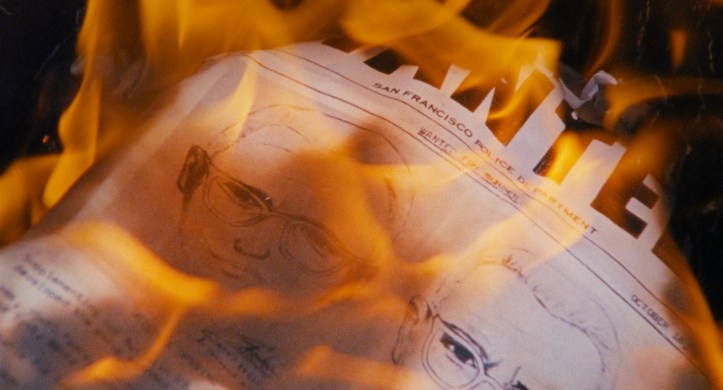
Winner of the NEXT Innovator Award at the 2025 Sundance Film Festival, Zodiac Killer Project is a long-form cinematic essay that tells two stories in parallel — one being a wistful reflection upon a movie about a Zodiac Killer suspect that unraveled before it could come to fruition, the other a ruminative documentary interrogation of the gravitational pull of the true crime genre upon (particularly up-and-coming) filmmakers.
Directed, edited and narrated by Charlie Shackleton, a nonfiction filmmaker who works across multiple mediums and is also one-third of the London-based production outfit Loop, this meta offering isn’t for everyone, and the woozy intrigue of its merits may feel stretched a bit thin in its 92-minute feature form here. Still, for those interested in formal explorations of form, there’s some fascinating material here.
Not so much fascinated by the unsolved serial murders of 1969 and the early 1970s as driven by an economic siren song, Shackleton came to explore the Zodiac Killer by way of the work of Lyndon Lafferty, a retired California Highway Patrol officer with special knowledge of the cases who claimed, in a 2012 book, that attempts to bring a suspect to justice in the case were stymied by higher-ups. When Lafferty’s family pulls out and withdraws their book-rights consent deep into pre-production on his project, it leaves Shackleton in an arrested state, unable to move forward not only with the story itself, but also all the building blocks he had envisioned as integral to its telling.
Most of Zodiac Killer Project, then, unfolds as a wry contemplation of what its director wanted to do — both why and how. This means Shackleton, with narration that unfolds in a unique tone that could best be described as dry yet mischievously removed, talking about scenes he’d never get to shoot, mysteries he’d never have a chance to unravel. Time is spent ducking in and out of various genre trope cul-de-sacs (shell casings falling in slow motion and close-ups of playing tape recorders, for instance), with our guide often waxing about the value and layers of meaning present in this filmic language. He talks about three-dimensionalizing crime scene photos and the like.
While Shackleton does edge into a little more information of substance as it relates to the Zodiac case (“I’m trying to keep all of these quotes brief, because I have to justify each one to a lawyer,” he says), this isn’t really the type of film to which crime-hounds will flock, as even its maker acknowledges. (It spoils nothing to note that, as part of its ending, Shackleton wonders how many people will actually ever see his film.) Definitely not second-screen entertainment, Zodiac Killer Project in large measure connects for those openminded enough to submit to its premise, but requires full buy-in, and not half-lidded attention.
Zodiac Killer Project comes to Blu-ray by way of Music Box Films, in a standard clear case with a 1.85:1 widescreen transfer and English language 5.1 DTS-HD master audio track, plus optional English SDH subtitles. There’s a softness to some of the imagery herein, but this seems an aesthetic choice as much as anything else, dependent on the particulars of captured footage.
In addition to its theatrical trailer, a decent complement of supplemental features is anchored by a 24-minute Q&A session between Shackleton and film critic Zachary Lee from the movie’s Chicago premiere. This is an informative chat in which Shackleton discusses both the inspiration and stop-and-start timeline of the project, and it’s by far the meatiest and most straightforward element in the bonus material.
Fifty-six minutes of evocative B-roll expands upon the visuals of the film, but its presentation feels neither revelatory nor much like alternative-sketch exploration; rather, these extended outtakes mainly just present additional footage devoid of context. Some of it will connect and spark thought for those who have just viewed the film, but other bits won’t linger long.
Running five-minutes-plus, there’s a rejected Sundance “Meet the Artist” video in which Shackleton walks around London and talks about the guidance given to him to introduce himself and his project, in brief. There’s also an “uncommentary” track — so-called because it removes Shackleton’s voiceover narration from the movie. This is a joke bit that, in tandem with the aforementioned rejected Sundance video, underscores the movie’s deconstructionist sensibilities.
There’s also a seven-minute short film camera test in which Shackleton discusses an old candy commercial, and a two-and-a-half-minute short in which he discusses Paint Drying, a 10-hour experimental protest film Shackleton made in 2016 in response to his battles with the UK Censor Board — as well as some Letterboxd videos about said project. These playful bits, if nothing else, reaffirm their maker’s impish spirit, and underscore that short-form is a realm in which he really can shine.

