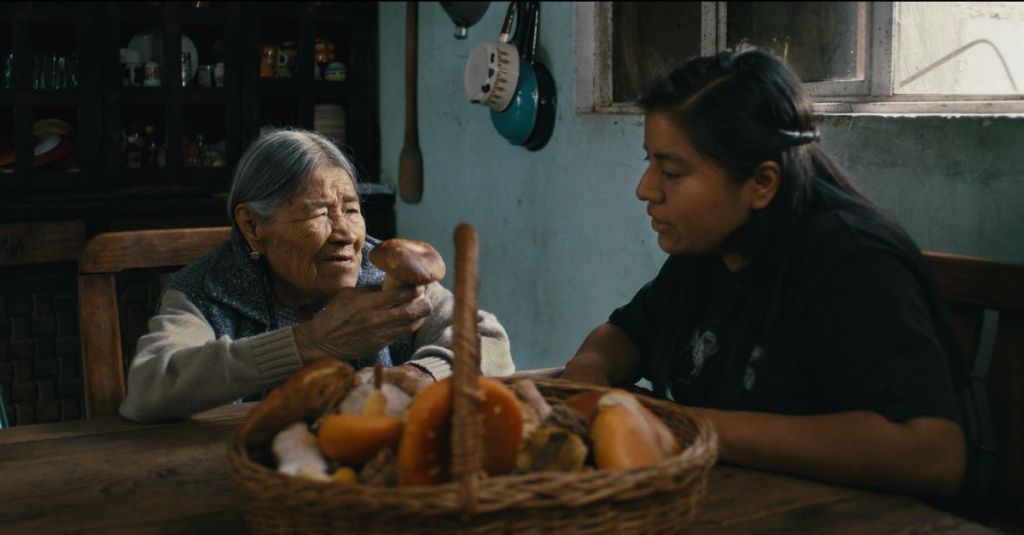
The sci-fi genre is morphing into a realistic, immersive world, where humanity’s previously unattainable goals are proving to be soon within reach. The new documentary, ‘Daughters of the Forest,’ is a speculative exploration of the realities of those aspirations, as it explores two Indigenous communities and the fungi in the forests of Mexico. Their growing entanglements are encouraging people to reconsider the perceptions and experiences of Earth’s human and non-human inhabitants.
Otilia Portillo Padua wrote, directed and produced the film. Paula Arroio Sandoval also serve as a producer on ‘Daughters of the Forest.’ Eliseete Ramirez Carbajal, Julieta Serafina Amaya, Julia Dolores Raimundo, Zenaida Perez, Magdalena Martínez and Olivia Ayala appear in the movie.
Ursula K. Le Guin’s essay ‘Carrier Bag Theory of Fiction’ and the principles of Radical Mycology inspired ‘Daughters of the Forest.’ The documentary follows Ramirez Carbajal and Serafina Amaya, two scientifically-trained young women. They come from communities that have long lived in symbiosis with the diverse mushrooms in their distinct regions of Oaxaca and Mexico State in Mexico. They strive to further collective understanding of the fungi with which human existence is entwined.
But the world they know is changing, and their pursuits are threatened by deforestation, lack of opportunity and loss. Along their parallel paths, they share their knowledge. They also reveal how mushrooms show different possibilities of coexistence, helping them overcome obstacles and reshape their lives and futures.
‘Daughters of the Forest’ had its North American Premiere in the Visions section at SXSW Film Festival 2026 on March 13 at the Violet Crown Cinema in Austin. Following its screenings at the festival, the movie won the Visions Audience Award. After playing at SXSW, the project will have its New York premiere at the Margaret Mead Film Festival this Sunday, May 3 at 2pm ET at the LeFrak Theater.
Ahead of the documentary’s North American Premiere last month, Portillo Padua, Arroio Sandoval and Ramirez Carbajal generously took the time to talk about helming, producing and appearing in the feature during an exclusive interview over Zoom. Among other things, the trio discussed how the film was created through a long, collaborative process over several years, and shaped by close relationships with the participants.
Film Factual (FF): Together, you made the new documentary, ‘Daughters of the Forest.’ What inspired you all to work on the film?
Otilia Portillo Padua (OPP): The project began around the start of the pandemic in 2020. After meeting through a mutual friend, we started discussing whether it was possible to tell stories that weren’t centered solely on a human perspective.
At first, it was just a casual conversation over coffee. We briefly mentioned foraging, though we didn’t know much about mushrooms at the time. We then came across Ursula K. Le Guin’s ‘Carrier Bag Theory of Fiction.’ That idea really opened things up for us – we started imagining what a story shaped like a bag could look like.
As we explored that concept, we realized that inside this bag were mushrooms. Around that time, there was a lot of attention on mushrooms in the media, but mostly in terms of how they could benefit humans. We became more interested in what we could learn from them instead.
So we started researching mushrooms from a scientific perspective. We were fortunate to meet an incredible scientist whose knowledge – and generational connection to mushrooms – was a revelation to us.
That became the foundation of the film: the idea of the bag, then mushrooms and then the people who carry that knowledge.
FF: The movie features an ensemble group of on-screen participants including people who voiced the mushrooms. How did you decide who you would cast in the documentary?
Paula Arroio Sandoval (PAS): Once we began working on the film, finding participants was a gradual process. During the pandemic, we conducted interviews over Zoom.
The collaboration with the participants was very respectful and generous. They trusted us with their knowledge while also helping ensure accuracy in the science and cultural elements. Over time, those relationships became very close – we really became like a family.
We eventually connected with a postgraduate college in Mexico where students from different communities study mushrooms. Through them, we met key contributors who became both collaborators and participants in the film.
FF: Eliseete, what was your experience like in appearing in ‘Daughters of the Forest?’
Eliseete Ramírez Carbajal (ERC): Filming the documentary was very a completely new experience for me. While I have spoken about mushrooms before, this was the first time I had the opportunity to share my cultural knowledge with a wider audience. It was meaningful, but also challenging, since I wasn’t always sure how my stories would be presented.
FF: Paula, you served as a producer on the film. How did you approach your producing duties during the production?
PAS: Well, it was it’s a very independent film. So we could only really film during the rainy season. We filmed during the summer over the course of four or five years because of the nature of the story – mushrooms only in the rainy season.
We also gradually securing funding from organizations like the Sundance Institute, Sandbox Films, the Redford Center and others. We also had a Mexican government grant and incentive taxes. Having the long timeline as we secured the funds allowed the ideas behind the film to mature.
FF: Otilia, you directed ‘Daughters of the Forest.’ How did you approach your helming duties throughout the production?
OPP: It was one of the most rewarding experiences I’ve had. The process was highly collaborative, with a team that was open to experimentation and discovery. Everyone contributed creatively, and I learned a lot from working with such a diverse group of people.
FF: Martin Boege served as the movie’s cinematographer. How did you work together to create the documentary’s visual style?
OPP: Well, it was very process driven. So once we decided that there was going to be a subjective camera that was going to take on this non-human perspective, we tested out what this subjective camera would be like.
Later on, we started incorporating other elements, such as having a projection artist creating time lapses, but they’re all real materials. So all of the materials that we layer on the movie as composites are footage. They’re things that we filmed, but we sort of collaged them together. Finding that took a little bit of time. But this visual language did come together.
I also thought the sound was just as important as the visuals. We questioned not only what the film was going to sound like, but also how it was going to make the audience feel. We always wanted to be incredibly immersive.
So, we hope that people get the chance to experience the movie on a big screen, which is very challenging now. But we want our films to be viewed as a collective experience.
FF: Lorenzo Mora served as the editor on ‘Daughters of the Forest.’ How did you approach putting the final version of the film together?
OPP: The editing process was challenging and took about 18 months. We aimed to create something more like an ecosystem than a traditional linear narrative. The film weaves together two storylines – one more individual and one more collective – which made finding the right structure complex.
FF: ‘Daughters of the Forest’ is having its North American premiere at the SXSW Film Festival. What does it mean to you to share the movie with audiences at the festival?
ERC: It’s exciting to finally present the film to audiences, especially those interested in mushrooms and mycology. Festivals are an opportunity to connect with viewers and hear their responses.
FF: After ‘Daughters of the Forest’s SXW screenings, how will you share the feature with audiences?
OPP: Beyond festivals, we’re planning outreach efforts to bring the film to communities in Mexico, particularly those connected to this knowledge. It’s important to us that the film reaches the people it represents, not just festival audiences.