
Award-winning documentary filmmaker Anabelle Marshall believes stories about refugees don’t always have to begin with tragedy. Sometimes, she says, they can begin with a sewing machine.
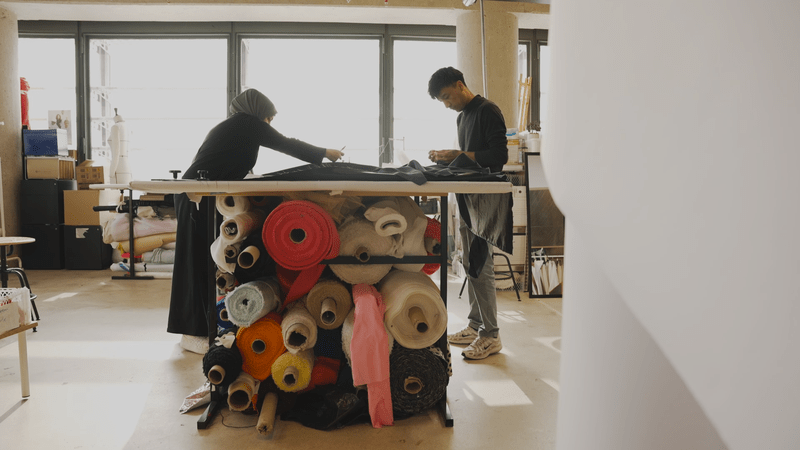
Marshall’s latest documentary short, ‘Fabric,’ offers an intimate look inside Espero Atelier. The Paris-based social enterprise trains refugees in haute couture tailoring while helping them build new lives in France.
The movie had its World Premiere at the 34th Raindance Film Festival, where it is nominated for Best Documentary Short. Its June 19 premiere coincided with Refugee Week, underscoring the film’s timely exploration of migration, identity, integration and opportunity.
Produced by Tiny Circus Productions and Hemeroscope Studios, the UK-France co-production follows refugee artisans as they prepare an original couture collection for presentation at the Musée d’Orsay on the eve of Haute Couture Week. With exclusive access to Espero Atelier, the documentary introduces audiences to Ibrahim, Suad, Haider, Sumaiya and Cynthia – artisans from Guinea, Eritrea, Afghanistan and Congo – as they refine their craft while rebuilding their futures.
Rather than focusing solely on displacement, ‘Fabric’ examines resilience through creativity, revealing how fashion education, mentorship and meaningful employment can become powerful tools for integration. For Marshall, that perspective was exactly what drew her to the project.
The film originated when producer Sanam Hasan introduced Marshall to Espero Atelier. The director was immediately fascinated by the unlikely intersection between luxury fashion and refugee resettlement.
“The fashion world has a reputation for being very wealthy and very elitist,” Marshall said. “Then you have refugees, who often arrive in France with absolutely nothing except the clothes on their backs.”
That contrast became the film’s emotional foundation. Rather than making another movie centered on war or displacement, the helmer wanted to tell a story about possibility.
“If you want to change the world, sometimes you need to inspire as well as shock,” Marshall explained. “There are plenty of shocking documentaries about refugees and the countries they come from. I thought it would be good to inspire people about what can be done with a bit of humanity and compassion.”
Armed with little more than a Sony FX3 camera and a pair of wireless microphones, the filmmaker traveled to Paris for an exploratory day of shooting. Much of that footage ultimately found its way into the finished documentary.
Marshall quickly became captivated not only by the atelier itself, but also by its co-founder, Maya Persaud, a former fashion model who has spent decades in Paris and now helps refugees and marginalized communities develop careers in couture.
“She’s an inspiring American in Paris who’s clearly adored by all the refugees who train there,” Marshall said as she praised Persaud.
Marshall intentionally avoided making a policy documentary. Instead, she wanted audiences to meet individuals rather than statistics.
“So often, refugees are talked about as people invading countries or crossing borders,” the director pointed out. “I wanted to humanize refugees.”
The filmmakers initially hoped to follow participants from the beginning of their training through eventual placement at major French fashion houses – a process that often takes several years.
Budget and scheduling realities prompted a different approach. So the documentary chronicles the four months leading up to Espero Atelier’s annual fashion show at the Musée d’Orsay, creating a clear narrative arc while capturing the participants’ remarkable personal journeys.
The resulting film captures not only technical craftsmanship but also emotional resilience as the artisans prepare for one of the most significant moments of their professional lives.
Alongside Persaud and the refugee artisans, ‘Fabric’ also features fashion mentor Catherine Brickhill, a former designer for Alexander McQueen and Givenchy. She’s joined on screen by Sylvain Amic, the then-President of the Musée d’Orsay and Musée de l’Orangerie.
Marshall, who regularly shoots her own broadcast documentaries, knew intimacy would be essential to ‘Fabrics’ success. “I wanted it to be a very small crew because these are sensitive stories,” she said. “You get much more authentic reactions.”
The documentarian partnered with Paris-based cinematographer Louise Gholam, whose personality proved just as important as her filmmaking experience.
“It was very important to me that the person filming was kind, sensitive and approachable.”
For much of production, the crew consisted solely of Marshall and Gholam. During the fashion show itself, they added one additional camera operator – a Ukrainian refugee already connected with Espero Atelier.
The modest production also allowed them to adapt naturally to the rhythms of the nonprofit. “It’s not an organization where everything is super structured,” Marshall explained. “Sometimes things just happen, and we had to roll with the punches.”
Although Marshall doesn’t view the process as casting, selecting the documentary’s central participants became one of the project’s most important creative decisions. When she first visited Espero Atelier, she quickly noticed who naturally connected with the camera.
“Some people just light up the screen,” the helmer said. The filmmakers sought a diverse group representing different countries and experiences, but personality ultimately guided the final choices.
TThe central Paris atelier serves only about 10 to 15 trainees, which allowed Marshall to spend meaningful time getting to know each participant before deciding whose stories to follow. “We ended up with some amazing people,” she noted.
Marshall deliberately resisted conventional talking-head interviews. While the filmmakers initially recorded a formal interview with Persaud, much of it was eventually removed from the final cut or used as voiceover. Conversations also unfold naturally inside the atelier or during visits to participants’ homes.
“I wanted everything to feel observational,” Marshall revealed. “It keeps you in the moment.”
The editing process reflected that philosophy. Working alongside French-speaking editors was essential to the helmer because roughly three-quarters of the documentary is in French. So the team decided early to open with the fashion show before moving backward through the preceding months. The structure, Marshall noted, ultimately made the film stronger.
Although ‘Fabric’ explores timely issues surrounding migration and integration, the filmmaker intentionally resisted filling the project with facts and figures. As a result, viewers have described the finished movie as “quiet,” a characterization Marshall embraces.
Rather than attempting to speak for every refugee experience, ‘Fabric’ focuses on one remarkable community and the relationships built within it. “It became a very observational, character-based film,” Marshall said.
By emphasizing universal themes, including hope, perseverance, belonging and triumph over adversity, the documentary invites audiences to connect emotionally rather than politically.
The director believes short documentaries are entering an exciting period, noting that audiences increasingly embrace concise storytelling.
Still, Marshall views ‘Fabric’ as only the beginning. “I definitely think this is a proof-of-concept film,” she divulged.
The filmmaker hopes one day to expand the short into a feature documentary that follows refugee trainees from their arrival in Paris through their education at Espero Atelier and eventual placement in leading fashion houses.
For now, however, Marshall’s eager to introduce audiences to the remarkable people already at the center of ‘Fabric.’
With its Raindance premiere arriving during Refugee Week, the filmmaker hopes viewers leave with a different perspective – not simply on refugees, but on the transformative power of opportunity.
“It’s about showing what can happen when people are welcomed with humanity and compassion,” Marshall concluded.
 Film Factual