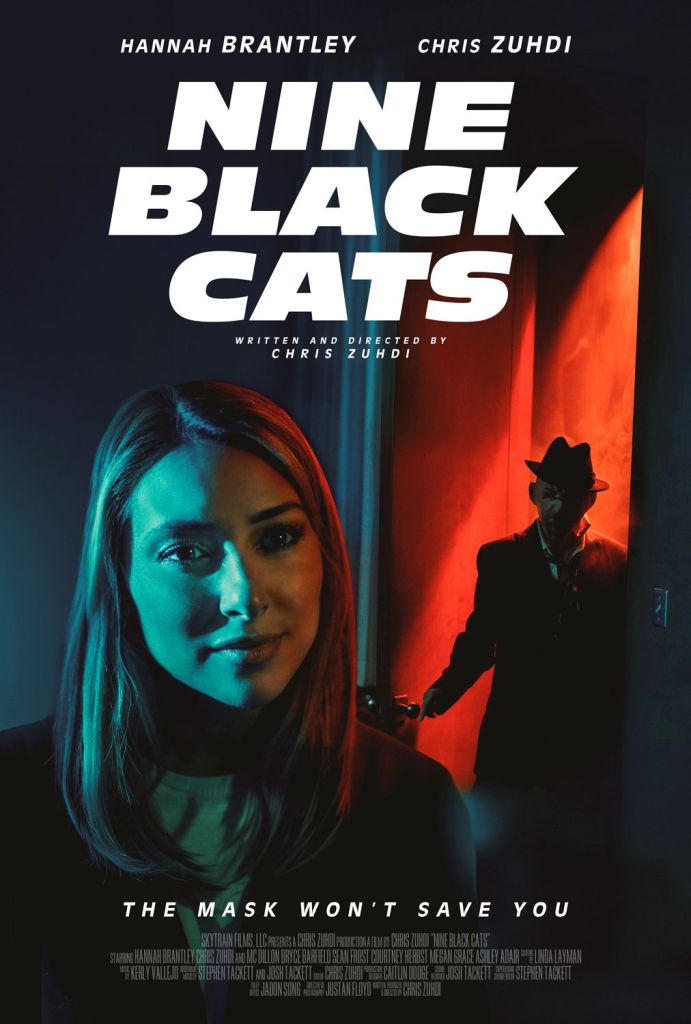
The boundaries between past and present, artistic ambition, and personal obsession shape the mysterious world of the new neo-noir conspiracy thriller, ‘Nine Black Cats.’ Blending noir influences, French New Wave sensibilities and psychological tension, the movie explores how seemingly ordinary environments can conceal something far more dangerous. Its atmospheric storytelling is further enhanced by neon imagery, timeless music and the distinctive character of its Oklahoma setting.
Filmmaker Chris Zuhdi wrote, directed, produced, edited and stars in the project. The drama also stars Hannah Brantley, MC Dillon, Sean Frost, Megan Grace, Bryce Barfield, Ashley Adair and Courtney Herbst.
‘Nine Black Cats’ follows a suspended police officer and a lonely waitress whose investigation into a brutal nightclub murder uncovers a mysterious glowing blue powder. Their search ultimately leads them to a masked conspiracy operating deep beneath the city’s streets.
‘Nine Black Cats’ is set to have its theatrical premiere this Friday, August 21 at New York City’s Cinema Village. In honor of the movie’s debut, Zuhdi generously took the time to talk about making the feature during an exclusive interview. Among other things, he spoke about developing the screenplay, embracing improvisation and creating the movie’s visual language while filming on location in Shawnee, Oklahoma.
Film Factual (FF): You wrote the script for the new thriller, What was your inspiration in penning the screenplay? How did you approach scribing the script?
Chris Zuhdi (CZ): About a year and a half ago, I started working on the script, and I sort of got stuck with it. It didn’t really feel like the story was working, and I wasn’t sure what the problem was.
I have the famous book, ‘Hitchcock/Truffaut,’ by François Truffaut. Truffaut interviewed Hitchcock for it, and they went through all of his films one by one.
I came across this section where Hitchcock discussed the MacGuffin, the plot device that you have to have to help a movie work. I realized that’s what the script was missing, so I had this idea for a glowing blue powder that has some kind of dangerous properties.
Once I plugged that into the script I was laboring over, all the pieces fit together. I was able to build everything out around that motif, and then I was off to the races.
FF: Besides writing the screenplay, you also directed the film. How did penning the script influence the way you approach helming the drama?
CZ: The approach was really getting the right team in place. A lot of different filmmakers have noted that if you get the right team, then you’re just a captain at a wheel. You can make minor adjustments at the steering wheel, but if you have everyone in the right position, and you can trust your team.
That was the approach. My first goal was to get the right team, which I did. I had a great cinematographer, Justan Floyd, and Tim Katz was the gaffer. I had a great cast.
I was able to relax once I got on set – well, as much as you can on a film set – and trust my team.
FF: ‘Nine Black Cats’ stars Hannah Brantley, Chris Zuhdi, Mc Dillon, Sean Frost, Megan Grace, Bryce Barfield, Ashley Adair and Courtney Herbst. How did you approach casting the movie?
CZ: I was looking for people who had a European art house aesthetic. I love French New Wave and classic cinema from that era, so I was looking for people who not only had that aesthetic, but were also solid actors.
It just worked out. I was able to get a great cast together that had the aesthetic I was going for, but were very strong actors as well.
FF: Once the actors signed on to star in the thriller, how did you work together to build the characters and overall story?
CZ: That’s a great question. To be honest with you, we didn’t do a table read for this film. The cast, of course, had their scripts. I oftentimes discussed the characters with them one-on-one. But once we actually arrived on set, we would do a fairly minimal amount of takes.
I like to try to keep things, at least for this particular film, somewhat spontaneous. If they had a question, I would answer. But actors really care very much about the work and the character, and they do a lot of off-camera work before they even come to set.
I trusted their process and let them work it out. Then we could make fine adjustments when we were filming, but there wasn’t a whole lot of rehearsals or anything like that. I let them each find the character.
FF: Speaking about being spontaneous on set, did you encourage the actors to improvise?
CZ: Yes, I definitely encouraged improvisation. There are many examples where the actors were able to come up with some pretty brilliant things on the spot.
The script that I wrote is not Shakespeare. So I always tell my actors that if they have a better idea or way of saying sometthing, do it. When you’re sitting at your computer and writing a screenplay, you can’t possibly imagine what it’s going to be like on set in the moment.
When you’re filming a scene and it’s lit, and you’re with your actors, there are all kinds of angles that are going to present themselves. You couldn’t possibly foresee those angles when you’re writing te script.
The actors are professional artists, so I just let them try new things. If they have a better way to do something, or add some texture, I always support them.
FF: Like you mentioned earlier, Justan Floyd served as ‘Nine Black Cats’s Director of Photography, and Tim Katz served as the gaffer. How did you collaborate together to determine how you would visually shoot the film?
CZ: Yes, Justin and Tim have worked together for many years, long before I had met either one of them.
They actually started lighting on film. They were lighting 16- and 35-millimeter film negative a long time ago. I think a lot of the approach they brought to lighting this film had DNA from shooting film back in the day.
I think a lot of the aesthetic they brought to the film was from that old school discipline, particularly in the way they were setting the lights. Tim used a lot of tungsten bulbs when he was lighting talent because the tungsten filament has a nice warmth on skin tones.
A lot of the visuals are a credit to them. The basic note I was giving them was that I love color, particularly those bright neon colors, as well as playing with hard light and that noir aesthetic.
That was my basic note. But they built the look together for the most part.
FF: You shot ‘Nine Black Cats’ in Shawnee, Oklahoma. How did filming on location help build the thriller?
CZ: I had a great production designer, Caitlin Dodge, and she was a miracle worker. She could just go into a space and transform it.
We shot in downtown Shawnee, which has moved like most cities north. You have all the modern strip malls and outlets and all that sort of thing. There’s also this old-fashioned part of Shawnee that’s the main street and is the old heart of the town.
You have all these old hotels, movie theaters, buildings and banks, and I absolutely love it. It’s like a time capsule. So I shot most of the movie in that forgotten part of Shawnee, around those mid-century buildings.
We got one particular location that served as our office and headquarters. We shot about 80% of the locations in this one late-’70s building.
A lot of the look was already in. The curtains, the vintage staircase, the wood paneling and a lot of similar things were already in that practical location. Then Caitlin was able to accentuate that look and bring it out more.
FF: Besides the visuals, the music also helps build a film’s emotions. Stephen Tackett and Josh Tackett created the score for ‘Nine Black Cats.’ How did you work with them to create the music for the drama?
CZ: Creating the music was a very large part of my anchor points. I used classical music consistently throughout the story, as I wanted to give it a timeless feel.
Then I did add one contemporary indie rock track that plays at the beginning and the end. So I was using sort of that juxtaposition of the new and the old to build this world out.
It’s very much in the non-discernible past, so it’s not necessarily the ’50s, the ’60s or the ’90s. It’s a hodgepodge of all of them, so I used the music selection to sort of reflect that.
FF: You also served as an editor on the film. Why did you decide to also edit the movie? How did you approach putting the final version of the drama together?
CZ: Editing is, of course, the third stage of filmmaking. Francis Ford Coppola said a movie is made three times: when you write it, when you shoot it and when you edit it, and it’s so true.
When you get into the editing bay and start cutting the footage together, you’re building the movie all over again. I like the auteur theory. The filmmaker is the auteur, so whatever choices they make in the edit are essential to the finished film.
I love editing. It’s tedious, with hours and hours of work. But the shots don’t have meaning until you connect them with other shots in juxtaposition.
I love finding the meaning in the movie. I also love discovering how to cut those shots together.
FF: You also play Joe Pacifico in the drama. As a filmmaker, did you enjoy working with the actors while also starring in the film? How did you balance directing with your performance?
CZ: It’s very hard to be objective in any part of the process, either as a director, a writer or an actor. It’s very hard to be objective because we all have our filter that we’re looking at the project through.
When you’re acting in a movie you’re also directing, it’s even more difficult to be objective. You’re trying to act, and you also want to be available for the other actors to help answer their questions as the director. You also have to technical questions about the lighting and everything else.
It is a challenge, but I do enjoy the auteur way. If the director can also star in their film, or just do cameos like Hitchcock would do, it’s a cool fingerprint for the filmmaker.
FF: You also served as the movie’s producer. How did you also balance your producing duties while the drama was in production?
CZ: What you have to do is hyper-compartmentalize, because every single job is so incredibly draining and intense in its own way.
When you’re doing multiple jobs, you have to just really compartmentalize. When you’re producing, you have to focus on that. When you’re directing, you have to focus on that. It’s easier said than done, but that’s one thing that helped me. Once I knew the edit was locked, I was then able to switch into producer mode and start making calls and sdoing the producer thing.
FF: ‘Nine Black Cats’ will premiere on August 21 at Cinema Village in New York City. What does it mean to you to have the opportunity to share the film with audiences in a theatrical release?
CZ: It’s a huge blessing, and it’s one I didn’t really expect. It sort of compounded at the last minute in a good way.
Landing the Cinema Village, which is, of course, famous for launching ‘Eraserhead’ with David Lynch, is a blessing. It’s an absolutely iconic venue, and I’m very grateful to get a track to run there.
The doors that this theatrical run has opened up, including speaking with you and a lot of outlets, is amazing. I wouldn’t have had access to this opportunity otherwise. So this experience has been very exciting.
FF: Following the film’s theatrical release in New York, what’s next for the project? Are there plans to bring the film to theaters in other cities as well?
CZ: We’re still working on that. But we’re hoping to do a regional theatrical push here in Oklahoma, especially in my hometown in Shawnee. Maybe we can secure other theaters in other areas from there. So we’re still working out how to roll the movie out from here.