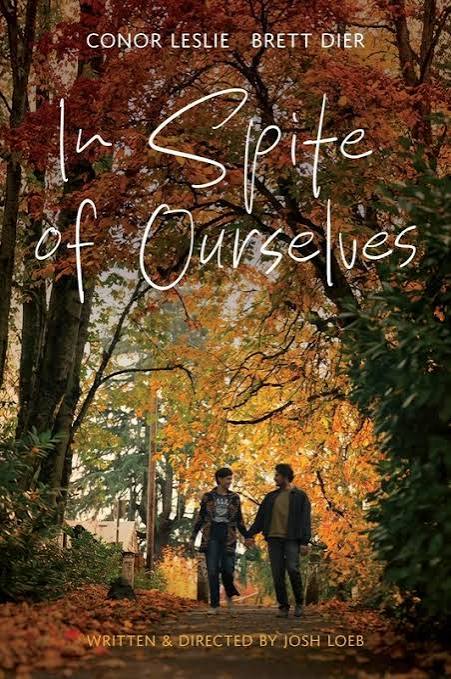
Love comes easy, but relationships often don’t. That’s certainly true for the protagonists of Hannah and Archie in the new romantic comedy, ‘In Spite of Ourselves.’ The characters’ honest love story shows that the optimism and joy of falling in love plays against the challenges and messiness that come with being in a real relationship.
Josh Loeb wrote and directed the film. He also served as a producer, along with cinematographer Gabe Mayhan and Tim Harms.
The movie stars Brett Dier and Conor Leslie as Archie and Hannah. They’re joined on screen by Mo Mandel, Alyssa Limperis, Britian Seibert, Zora Casebere, Ethan Ingle and Glenn Morshower.
‘In Spite of Ourselves’ is opening today in Portland at the Living Room Theatres. The romcom will then open next Friday, October 16 in L.A. at the Landmark Nuart Theatre. The film’s theatrical expansion comes after it opened in New York at the Quad Cinema last Friday, October 2.
‘In Spite of Ourselves’ follows Hannah, a warm and determined Portland baker, as she crosses paths with Archie, an up-and-coming L.A. comedian with a habit of dodging commitment. Upon meeting, their instant chemistry sparks a whirlwind romance neither expected.
But after two blissful weeks together, real life pulls them back to separate cities, forcing them to confront distance, doubts and their own hilariously messy insecurities. They must figure out whether they can move past their fears to give love a real chance.
Loeb generously took the time recently to talk about scribing, helming and producing ‘In Spite of Ourselves’ during an exclusive interview over Zoom. Among other things, the filmmaker discussed
Film Factual (FF): You wrote the script for the new romantic comedy, ‘In Spite of Ourselves.’ What initially inspired you to pen the screenplay for the film? How did the movie develop from its original concept into the finished project?
Josh Loeb (JL): I was writing a script, and the first character I developed was Archie. At the time, I was watching a lot of stand-up comedy and these really funny male comedians, and I felt there was a lot of sadness and strife beneath the humor. I thought, what an interesting exploration: this person who goes out and has to make everyone laugh but is also struggling. Where does that come from?
Then it started to feel like, okay, what happens if that person falls in love, and who would that person fall in love with? I feel like often in love, you find the opposite kind of person. Thinking about what the opposite would be, I’ve known a lot of bakers. My previous careers were in restaurants, and we have bakeries. I’ve been married to a baker for many years, and I’ve known a lot of bakers.
The ones I’ve known tend to be very strong, creative women. They have the ability to manage a lot, take on a lot, and don’t often take great care of themselves in the process. That happens to a lot of people who take care of other people.
Often, I would find that they would date people who made me think, “You’re just taking care of someone else again.” That happens after they spend 12 hours a day taking care of other people.
I thought that was an interesting juxtaposition: those two characters meeting and falling in love. He has to learn to care about someone other than himself, or more than his own neuroses, and she has to learn to let somebody in and help take care of her. That became the inspiration for the film, along with a lot of personal life experiences.
FF: How did you find the balance between the humor and the more serious elements of the story as a filmmaker?
JL: My favorite films are the ones where it can be a sad film that has funny moments, a funny film that has sad moments or a little bit of both. I think life is both, so I wanted the film to have all of that.
They both have very serious things they’re going through, but even within those serious things, there are funny moments. There are moments, just like in life, when you have to laugh because something is absurd or it’s too much to handle. You just kind of laugh, and that helps make things better.
It’s also vice versa sometimes in this film, as you can see the seriousness comes in while you’re making people laugh. I wanted those two things playing against each other throughout the film because that felt interesting to me about life in general.
FF: Besides scribing the script, you also directed ‘In Spite of Ourselves’ How did you approach helming the film, and how did writing the screenplay help you as a director on set?
JL: I never envisioned myself as a director. I was a writer many years ago before I started opening restaurants, and then I took many years off to pursue my other passion. I felt like I needed more life experiences to write the characters I wanted to write.
When I came back, I was like, “Okay, I’m ready to write.” I wrote a few scripts, including this one, and I got an agent. I thought, “Okay, now I’m going to sell the script and someone’s going to make it.” That was the fantasy.
In all the meetings I had, everyone said, “This is a really good film. It’s a very personal, smaller film, and it’s the kind of thing that generally someone would direct themselves.” I was like, “Well, I’m not a director.”
I was fortunate to become really good friends with Gabe Mayhan, a really talented director of photography. He had read the script, really loved it, and said, “Hey, if you ever want to make it, I’ll go make it with you.” Finally, after getting a bunch of rejections, I said, “Okay, let’s go make this.”
I thought he would direct it, and he said, “No, you’re going to direct it.” I was like, “What?” He told me he had watched what I did in the restaurants. My favorite part of opening restaurants was putting the team together, curating the vision, keeping everything aligned with the values and on track for what we were trying to accomplish, and communicating.
He was right. I fell in love with directing, and I really enjoyed it. I can’t wait to do it again. Now that I’ve edited a film, I feel like everything you do for the first time, you can go back and do better. I write better now that I’ve made, directed and edited a film because you think with a different lens. I’m really looking forward to directing again at some point soon.
FF: Speaking about working with Gabe as the cinematographer on the movie, how did you collaborate on set and figure out how you wanted to visually shoot the project?
JL: Gabe held my hand so much. I’m very grateful for him. I’m a narrative thinker, not a visual thinker, and he is 100 percent a visual thinker.
We walked through things together, thinking about how things were going to look. The first time we shot-listed and went through that process, a lot of it was me saying, “Here’s what I want to communicate. Here’s the feeling I want to have. I want her to feel scared or far away. I want them to feel really close. I want it to feel like something is bubbling up.”
Then I trusted him to create that, and I trusted myself to say, “That feels right,” or “It doesn’t feel right.” A lot of directors approach things from a visual standpoint, where they can see the image before they know the story. For me, I’m trying to tell the story, but I want it to be visually interesting while doing that.
FF: ‘In Spite of Ourselves’ stars Brett Dier and Conor Leslie as the protagonists, Archie and Hannah. How did you cast the romcom, particularly the lead roles of Archie and Connor?
JL: It was super lucky. One of the first people who started working on the film was Michelle Lewitt, a casting director who was really helpful from the beginning. I asked her to be a producer, so she was actively involved in a lot of the early process.
We talked about what I wanted for Hannah. We started with Hannah, and she found Conor. She knew Conor from before, but Conor was going through a major life transition. She had just cut off all her hair, changed her representatives and was looking to move away from a certain kind of acting toward more independent storytelling. She was just perfect. When I met her, I thought, there’s no doubt in my mind that you are Hannah.
We met a few people for Archie, some great people. Then Michelle said, “I have someone for Archie. It’s not exactly who you wrote, but I feel like it could really work.” The character changed a lot when Brett came on board, but Brett was perfect.
Michelle connected Brett and Connor and said, “Hey, you guys have to have coffee. You’re going to fall in love over the next several months.” They went out for coffee, and they both came back saying, “I don’t know about this person. I don’t know if they’re the right fit.” It was just that typical first meeting.
Then we all took a trip to Portland for a location-scouting trip. I was showing them why I loved Portland and why I felt it would be a good romantic backdrop for the film. Then they started to fall in love in real life. By the time we went up to shoot, they were together, and they still are. They’re life partners.
It was very lucky, and it really shifted the film. Initially, the script was a little more about some of the other things happening in their lives than about each other. Once we had them on screen, with their chemistry and real-life relationship, it felt like that was the focus of the film. In the editing, we really shifted things to focus on that.
FF: Speaking of shooting the movie in Portland, how did the city help build the story, and what was the experience of filming there like?
JL: Portland was really a character in the film. When I was raising money for the film, someone said, “It would be a lot cheaper if you just shot it all in L.A. You don’t need to go up to Portland.” I said, “No, Portland isn’t just a backdrop for this story. It’s a character in this film.”
It was really important to me. Portland in the fall is a city very dear to my heart, and it’s one of the most beautiful, romantic cities anywhere. I’d just never seen it shown that way. I’ve seen it shown in films as dark, edgy, independent and funky.
It certainly has that independent, funky side, but it’s also beautiful in the fall, with the leaves changing and falling to the ground. It’s almost like wallpaper on the ground, with all these different colors. It’s really beautiful, with great restaurants and great people. I wanted to showcase that in the film.
FF: You mentioned working with your fellow producers on ‘In Spite of Ourselves’ earlier. How did you collaborate with them to get the romcom made?
JL: There are a lot of parallels between film and restaurants. One is that it takes a lot of people to do it. Everybody’s working really hard, and there’s a lot of coordination and a lot of conversations.
I feel really lucky. It was Gabe, Michelle, and me as producers, and our fourth producer was our line producer, Tim Harms, who ended up wearing many hats. He handled the budget and arranged a lot of the logistics.
We had really good people, and I felt like I could lean on them throughout the whole process. For someone like me, doing this for the first time, it was really important to have good people around me.
FF: Once filming was completed, how did you put the final version of the movie together? How did you approach the editing process?
JL: Editing was a big learning experience. I started with one editor, and we got pretty far, but it wasn’t clicking yet. We had to change editors halfway through. It wasn’t any fault of his; we just couldn’t find what I knew the film needed to be.
We brought in a second editor, and we were able to take what had been created initially and shape and shift it into what it became. She made some really big changes. To me, the story needed to be a little less linear.
The opening sequence you see in the film was really all her. It starts with the knowledge that they’ve been in a relationship, talks about some of the challenges, and then we meet them and go through their meet-cute. That shift was huge. It felt like it really pulled the film together.
The music was also a really important part of post-production, including the original music, which my friend Jim Fairchild did. He’s really talented and was in Modest Mouse and Grandaddy. Modest Mouse was based in Portland, where Jim lived for a while and spent a lot of time. So he was familiar with the feel of the city.
Then Brittany (Douziech), our music supervisor, found 31 songs to use in the film. The music played a really important part in it.
FF: ‘In Spite of Ourselves’ is playing in theaters in Portland, New York and L.A. What does it mean to you to share the movie with audiences in theaters across the U.S.?
JL: It’s the best feeling. I’m so excited. I (left) for New York on Thursday (October 1), and we (opened) on Friday (October 2). It’s really exciting to play at the Quad Theater. I (couldn’t) wait to see it there.
But I’m also nervous about going to the theaters. I hope the theaters are full, and I hope people laugh at the right parts. (Preparing to go) to New York (was) great because it’s New York. Where better to open a film? The art-house culture and being at the Quad make me feel so lucky.
Then we (went) to Portland and (will) have a totally different experience. So many of the people who worked on the film, particularly the crew, live in Portland, so it’s almost like a hometown film. I’m really excited about that.
I’m from L.A., and I grew up going to the New Art Theater, which is a legendary theater. So I’m also looking forward to opening the film in L.A.
I’m excited about every single one of those stops. I’m still learning this game, but basically, if the film does well in theaters (throughout October), other theaters around the country will start to notice, and we’ll have opportunities to play in more theaters.
I encourage everybody to come out and see it. Bring your friends. If you like it, come again and write a good review. Help us get it out into the world because I love going to movie theaters, and the more independent films out there, the better.