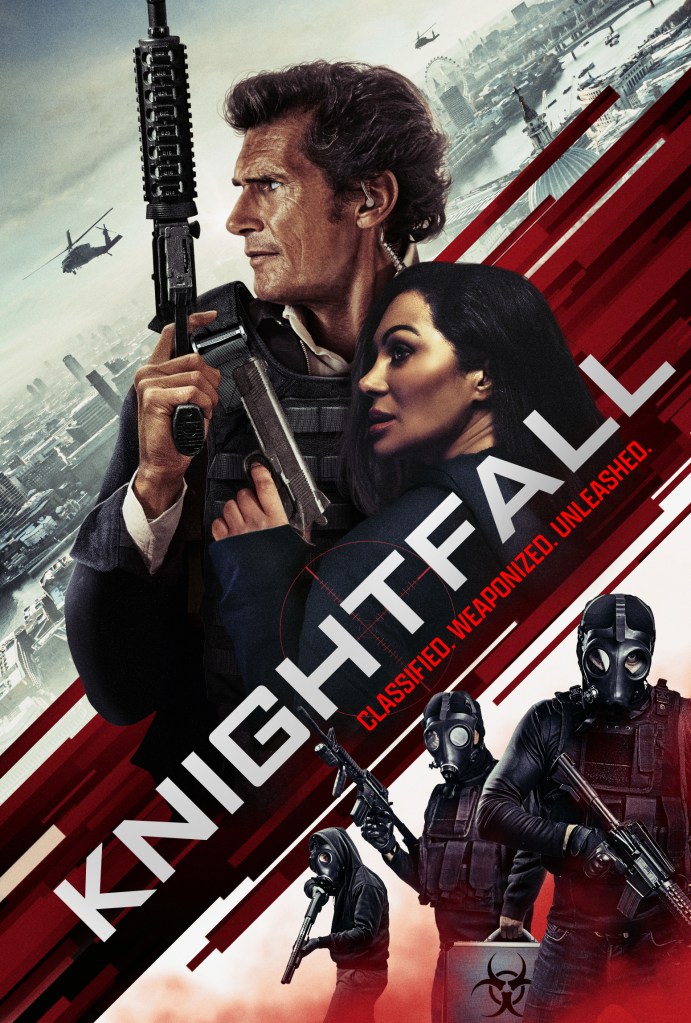
Contending with the bonds of family, the burden of trust and the devastating consequences of biological warfare are powerful motivators in the thriller genre. The new espionage movie, ‘Knightfall,’ is one such entry that thrives on that challenge.
The feature is now available on VOD and Digital, courtesy of Saban Films. Ben Fortune directed ‘Knightfall,’ which was produced by Jonathan Sothcott. The drama’s cast is led by Sothcott’s wife, Jeanine Nerissa Sothcott, as well as Ian Ogilvy, Geoffrey Moore, Robert Cavanah, Rupert Holliday Evans, Nick Moran and Michael Paré. The actors all portray characters who are caught in the escalating race to secure a weapon before it falls into the wrong hands.
In ‘Knightfall,’ Charles Knight (Ogilvy), an infamous spy catcher, is forced back into the dangerous world of espionage when his daughter, Ros (Sothcott), becomes the target of ruthless assassins. A scientist, Ros possesses the only key capable of unlocking a stolen briefcase containing a man-made biological weapon. As deadly enemies close in from every direction, father and daughter must rebuild their fractured trust while preventing a homeland security catastrophe.
Nerissa Sothcott generously took the time recently to talk about starring in ‘Knightfall.’ Among other things, the actress revealed how she helped shape the character of Ros into a strong, resourceful woman with the help of her personal experiences. She also reflected on the movie’s realistic stunts, and emphasized the importance of offering actresses more opportunities in the action genre.
Film Factual (FF): You play Ros Knight in the new dra,a, ‘Knightfall.’ When you first read the script, what drew you to the story and to your character?
Jeanine Nerissa Sothcott (JNS): Well, the script was actually written as a vehicle for myself and Ian. We were looking for something to do with Jonathan. Someone had put a script in and said, “Look, how about what about this script?”
I read it, and I looked to see if there are there any fight scenes for me. also, do I drive any cars? The answer was yes. So I just immediately loved it, as there are a lot of fight scenes and a lot of driving. So I thought, “Wow, that’s quite a nice little script.”
It was a lot different than what I first expected. I didn’t realize that Ian was actually going to be playing my dad because I thought he was going to be my love interest. I’m in my 50s – I’m 55, and he’s 80. So I just thought, well, I’ve done a movie before where I was in my late 40s and my husband was almost in it. So I just assumed that would also be the case for this movie.
So when they said, “Oh, actually, he’s going to be playing your father,” I thought, oh, wow. That’s okay. I had to reread the script then, and I think, okay, this is my dad in this. Fine.
Then Jonathan (Sothcott) had been wanting to do a project with Jeffrey Moore for many years. Jeffrey wanted to do some acting and be in a movie that Jonathan was making. Jonathan was like, “Hang on a minute. We need to get the right script for him.”
This actually lends itself to a role for Jeffrey because we were doing a spy movie. With his background, Jonathan felt this was perfect for Jeffrey.
So Jonathan had the script rewritten a bit, making Jeffrey part of the film, and it really did work. So it was really exciting, seeing it go from scratch and being built upon. But I think it really does work as a great little spy movie.
FF: Speaking of working with Ian, how did you collaborate once you signed onto the film to build your on-screen relationship?
JNS: It was actually quite easy because I’ve been friends with Ian for many years. He’s been in lots of Jonathan’s movies over the years, so we’ve known him for a long time. When we’re in L.A., we always meet up, and when he’s in England working, we’ll get together for dinner or brunch. He still has family in England – I think one of his sons is here. So it was really easy to work with someone you already know, respect and love outside of the screen.
The Moores have also been a big part of our lives for many years. They’re very close friends of ours. I’m very friendly with Jeffrey’s wife, Lulu, and their daughter Amber played my daughter in a movie in 2020. We’ve shared so many experiences over the years, so it was a natural relationship to bring to the film.
FF: ‘Knightfall’ is an action-driven thriller. How did you approach the physicality and stunt work?
JNS: I think we played it quite differently from how it was originally intended. There’s a scene toward the end where we were supposed to be more upbeat, but we make these films very quickly – this one was shot in 10 days – and by the end, we were exhausted.
I remember sitting on the stairs during the penultimate scene with Ian. We were supposed to be elated, but we played it as we actually felt: almost deflated because we were so tired.
I think it worked beautifully. Ian has such charm; he’s an absolute darling and incredibly giving as an actor. He’s so easy to work with.
Our scenes together, including the one around the fireplace, involved quite a lot of dialogue about gene editing. It’s very technical, so we practiced together and worked on how we could naturally overlap and cut into each other’s lines.
We actually did that huge monologue in one take. It was eventually split into two scenes in the film for pacing. There was so much technical information that the filmmakers thought audiences might start falling asleep!
We shot a close-up of Ian, a close-up of me, and then a long shot, and that was it. It was around 4:30 in the morning, and I think the crew were wondering whether we’d be there all night. We just sat together and said, “Right, let’s make the crew happy and get this in the bag.”
When we finished, everyone was thrilled because they could go home. Ian is so professional and easy to work with that creating that chemistry was a pleasure. We were able to find a genuine father-daughter dynamic.
It was also a difficult time for me personally because my dad was dying while we were filming. He’d been given three months to live, so I was going back and forth between the shoot and driving two and a half hours to see him.
I would show him the rushes every day. My dad had been in the military for 15 years in the RAM, so he was very interested in the film. Unfortunately, he didn’t get to see it, but I tried to share as much of it with him as I could.
So those father-daughter scenes were particularly emotional for me. In a way, I felt as though I was speaking to my own dad. We ultimately dedicated the film to him in the credits.
FF: Do you feel your personal experiences influence your performances? Did that connection help you honor your father through this role?
JNS: Absolutely. I think all of our experiences in life help us create a character.
Ros was a wonderful character to play because she’s vulnerable, but she’s also strong, independent and very capable. I think those qualities exist in all women.
I wanted to bring a sense of realism to the character. I didn’t want this to be just another testosterone-fueled action movie. I wanted Ros to kick ass without looking like a gymnast performing elaborate high kicks.
I wanted to show how women might actually respond in those situations. In fight-or-flight mode, you grab whatever is around you and do whatever you can to get free. We don’t necessarily know all the moves, and we’re probably not going to overpower a man physically. So I wanted to show how resourceful women can be.
For example, when I’m fighting Michael Paré in this film, I’m cooking and there’s a knife nearby. Of course I’m going to grab it. I wanted to think about what the environment could realistically offer her.
Those experiences of simply being a woman can inform the way you approach a character and bring that resourcefulness into a script.
The script originally made Ros much more vulnerable, but I didn’t want to play her that way. I wanted her to be considerably stronger.
FF: Did the locations and real-world environments were you shot ‘Knightfall’ also help inform the action sequences and your performance?
JNS: The locations really did help build the stunts and performances. There was pouring rain during the first scene we shot at the marina. We were doing night shoots from 7 pm to 7 am, and it was cold, windy and raining the entire time.
You’re naturally in a heightened state when you’re standing there soaked and freezing. You’re not relaxed – you’re constantly on edge. It really added to the grit of the movie.
There was one scene where I had to walk in for the interview where the mission is explained, and that was when I first met Jeffrey’s character. The rain stopped for literally the five minutes we needed to shoot it, so they brought out a huge hose and sprayed me with freezing-cold water as I walked in.
I remember standing there completely soaked, with my hair scraped back, while all the men looked as though they’d just arrived. I always think, if people only knew that I was standing there having freezing water sprayed over me!
But it was fun. All the locations were fantastic. We had a marina and several other great settings. I think we made a film on a budget of under $200,000 that looks like it cost a million dollars.
FF: Do you think Ros demonstrates why the action genre needs more strong female protagonists?
JNS: Absolutely. It’s wonderful to see women become more than just the decoration in an action movie. So often, the wife, girlfriend or daughter is relegated to the sidelines.
Women can be integral to these stories. Half the population is female, after all. I have four children – two boys and two girls – and I’ve never treated my daughters differently from my sons. They deserve the same rights and opportunities.
The world needs to move beyond the idea that women belong in the corner cooking. We’re strong.
Even as an older actress, you can sometimes feel invisible. But women remain strong as they get older. We can still do things; we don’t have to become the grandmother sitting in the corner.
I think things are changing. With ‘Shogun,’ for example, we’re also trying to showcase what older actors and actresses can bring to a production.
I’ve worked with Stephanie Beacham, who’s in her 70s, and Patsy Kensit, who’s 58. I’ve also just done a movie with Caroline Ford, who’s 85. She was the first ‘Doctor Who’ girl – the first female companion in the original ‘Doctor Who.’
It’s wonderful to bring these actresses back. They have so much to offer. They look fantastic, they’re still acting brilliantly, and there’s so much we can learn from them. I just hope things continue moving in that direction.
FF: ‘Knightfall’ is now streaming on VOD and Digital. What does it mean to share it with audiences, particularly women, and highlight the need for greater inclusivity in the action genre?
JNS: I’m so excited for people to see this movie. I think it’s a really enjoyable film. There isn’t relentless swearing throughout – there’s swearing when it’s necessary.
It’s also something you can watch with the family. It has a feel-good quality that takes us back to those old-school movies of the ’80s, where the good guy wins and you don’t leave feeling depressed.
You come away thinking, hey, the good guy wins sometimes. It has that feel-good, old-fashioned quality.
I love that the women don’t get the short end of the stick. They’re strong, they can fight, and they can fight for themselves. You don’t always need a man to come and rescue you.