Focusing on one child’s unique life experience can restore a sense of urgency to a time period often reduced to statistics. The titular protagonist’s narrative in the documentary, ‘Hidden: The Kati Preston Story,’ serves as a powerful reminder of the need to confront hatred. The film also helps inform the next generation about the resurgence of misinformation in modern society’s divided media landscape.
The movie is based on the 2023 award-winning graphic memoir ‘Hidden: A True Story of the Holocaust,’ which was written by Preston and illustrated by Dilleen Marsh. Daniel Matmor co-wrote the screen adaptation with Jodi Glover. Matmor also directed the documentary.
Besides Preston, the film also stars Franky Glover, Viktoria Imre, Chase Lawless, Bridget Gillie, Cara Mahoney, Karina Krepps-Bette and Laszlo Jankovich. The movie also features Matt Grant, Kamila Khamatdinova, Annelise Hawrylak, Tom White, Dr. Martin Rumscheidt, Annette Tilleman Lantos and Rabbi Buruch Overlander.
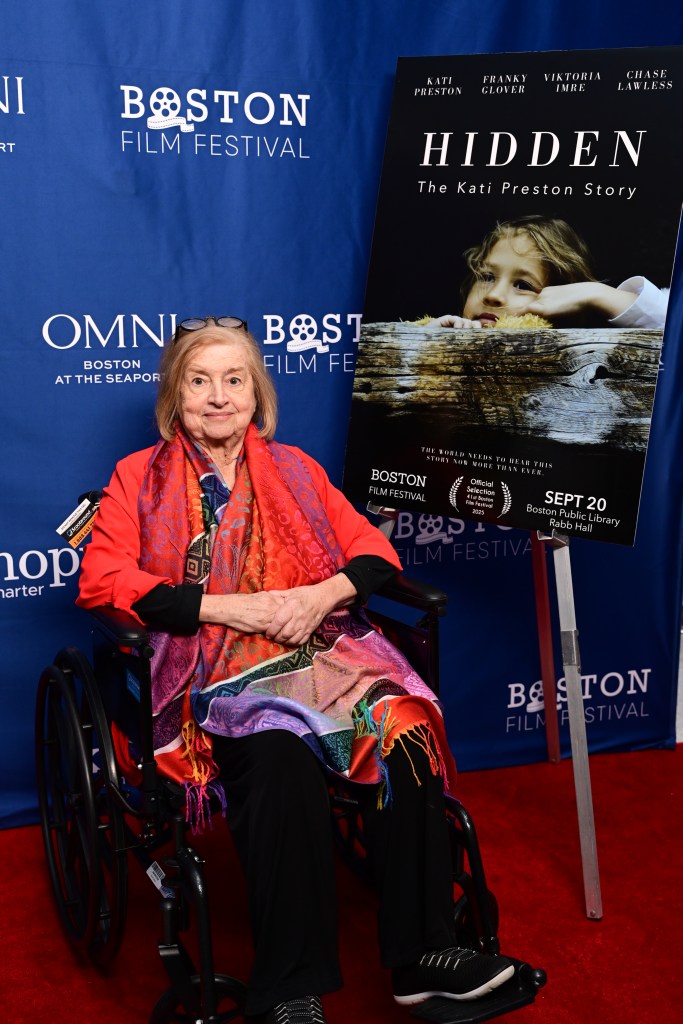
‘Hidden: The Kati Preston Story’ had its World Premiere at the 41st Boston Film Festival last fall. The screening was held on Saturday, September 20, 2025 at 1:30 p.m. at Boston Public Library.
‘Hidden: The Kati Preston Story’ is a firsthand account of a society’s slow and insidious descent into authoritarianism, dictatorship and tyranny. Preston’s joyful childhood in Hungary came to an end in 1944 during an era of antisemitism, fascism and of the communist dictatorship that followed, as told by the 85-year-old survivor remembering the world through the eyes of her five-year-old self.
Preston generously took the time to talk about appearing in ‘Hidden: The Kati Preston Story’ during an exclusive interview over Zoom the week after its World Premiere at the Boston Film Festival. Among other things she talked about how she was driven to share her story through the movie to educate young people about the dangers of hatred and the importance of remembering history. She also explores the deeply personal process of turning her life into a book and its screen adaptation, which serves as a memorial to her lost family.
Film Factual (FF): You appear in the documentary, ‘Hidden: The Kati Preston Story,’ which chronicles your childhood during the 1944 Hungarian Holocaust. What interested you in recounting your life journey in the film?
Kati Preston (KP): Well, I don’t know if you know about my history, but I was a hidden child. After the war, when you survive, you tend to have a lot of guilt. As a result of that guilt, I became overly ambitious and was very successful in several careers. Now that I’m 86, I finally know what I want to do when I grow up.
I want to speak to young people, starting around when they’re in 8th grade, and warn them against hatred. There’s so much of it in the world, especially today. I also don’t want them to forget what happened, because if you forget history, it tends to repeat itself.
I’m very worried about what’s going on in our country today. I see many parallels in the way Hitler started – cutting education, cutting information and attacking journalists. The news is now considered the enemy, and that bothers me terribly.
I’ve been speaking for about 15 years. Kids used to ask me, “Could it happen in our country?” I always said no. I don’t say that anymore. These children are worried. They don’t care about success and money as much – they just don’t want to be stuck in their parents’ basement at 55. They’re not prejudiced. They care about the environment and their futures. They’re much more mature.
FF: The documentary is based on your 2023 book, ‘Hidden: A True Story of the Holocaust.’ What was your experience like when you writing about your life? How did the book help shape the film?
KP: I wrote the book for my granddaughters. I met a woman (Dilleen Marsh) at my house for coffee, and she noticed my accent. She asked about my life, and after I told her, she said I should write a book. I told her I already had, and I gave it to her.
She went back to Utah and later called me saying she wanted to illustrate it. I was hesitant at first, but when she sent me two pages, I was blown away.
Then COVID happened, so for two years we worked together on the phone daily. We collaborated on every page and every word. She became a very close friend. The book comes from the soul.
FF: You served as the narrator on the documentary. What was it like telling your story on screen as the storyteller?
KP: My son made the film to memorialize our family. They weren’t just killed – they were wiped off the face of the earth. There’s no memorial, no grave and nothing to hold onto. We had 38 members in my Jewish family, and I’m the only survivor.
When I’m gone, no one will remember them. So for me, this was a labor of love – for both of us.
FF: Like you mentioned, your son, Daniel Matmor, directed ‘Hidden: A True Story of the Holocaust.’
What was it like working with him?
KP: He was the boss. We didn’t argue, but he wanted me to go back to my old town, and I didn’t want to. I prefer to remember my childhood as a golden time, and forget the horrors. I’m glad I didn’t go, especially with how much is being covered up now.
FF: What was your experience like going through your archival footage and deciding what to include in the film?
KP: I was very emotional throughout the process. We worked closely together and saw each other often. When I first saw the little girl playing me, I was blown away—it felt like being there again. They recreated my home perfectly. For a moment, I was almost scared, until I reminded myself it was a film.
You don’t get over experiences like that, but you learn to live with them. It’s like grief – you go through stages, and eventually you live with the pain, but it never goes away.
FF: ‘Hidden: The Kati Preston Story’ is told in your own voice, as you recount her childhood before, during and after the war. With poignant reenactments and interviews woven throughout the movie, how did you create those elements?
KP: We wanted to tell a coherent story for people who may not fully understand what happened. The film works well for middle and high school students because it isn’t boring – it moves between narration, acting, expert interviews and archival footage.
If something is only sad, people tune it out. That’s why I include humor in my speeches. People ask how I can joke about such a subject, but if everything is sad, people stop listening. You can tell a meaningful story without making people cry.
FF: ‘Hidden: The Kati Preston Story’ screened during (last fall’s) 41st Boston Film Festival. What did it mean to you that the movie played at the festival
KP: It was amazing. I was so excited I didn’t sleep the night before. I was energized for days. I saw people I hadn’t seen in 25 years. At my age, everyone is younger than me, so it’s wonderful to reconnect.
I’m not a filmmaker. But my son did a great job telling the story without trying to steal the spotlight.