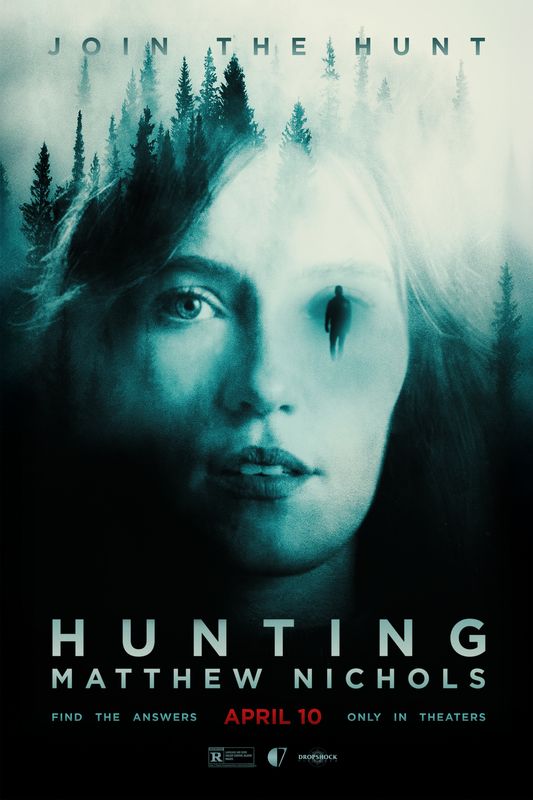
Hunting Matthew Nichols
Moon7 Films
Director: Markian Tarasiuk
Writer: Tarasiuk and Sean Harris Oliver
Cast: Miranda MacDougall, Tarasiuk and Ryan Alexander McDonald
Opened: April 10, 2026
Screened at: Critics Screening Link, 4/15/25
Establishing an emotionally driven sense of unease and a tension-heavy mystery that prioritize atmosphere and dread can make the most unsettling horror stories. The new found-footage film, ‘Hunting of Matthew Nichols,’ is the perfect reminder that the subgenre still has untapped potential to continue making disturbing tales.
The independent feature doesn’t only revisit the origins of ‘The Blair Witch Project,’ it also actively engages with it and builds something unique out of its legacy. The result is a psychologically driven mystery that prioritizes atmosphere and dread over spectacle. In doing so, the new movie becomes far more unsettling than many of its higher-budget peers.
Mark Tarasiuk and Sean Harris Oliver wrote and produced the drama. Tarasiuk also made his feature film directorial debut on the project.
The duo launched ‘Hunting of Matthew Nichols’ through a self-distribution strategy that involves partnering directly with independent exhibitors for the initial rollout. The movie debuted in 901 theaters across the US and Canada on April 10. It recouped its entire production budget back in its first weekend.
‘Hunting of Matthew Nichols’ follows a documentary crew investigating the disappearance of a reclusive figure, with the narrative structured like a scavenger hunt. Each clue leads to deeper layers of unease.
The story folds in a meta element: the original disappearance involves two aspiring filmmaker – the titular teenage boy (James Ross) and his best friend, Jordan (Issiah Bullbear). The two friends, who are obsessed with ‘The Blair Witch Project,’ may have attempted to recreate that movie’s premise before vanishing in the forests of Vancouver Island.
Decades later, the search is reignited by a surviving sibling, Tara (Miranda MacDougall), who’s determined to uncover the truth. This framing device allows the drama to explore themes of obsession, myth-making and the blurred line between documentation and manipulation, all while maintaining a gripping central mystery.
What immediately stands out in ‘Hunting Matthew Nichols’ is its cinematography from Director of Photography, Justin Sebastian. Found-footage films often lean on chaotic visuals to sell realism, but the genre’s latest entry takes a more disciplined approach.
The camera work is organic but never careless. The shots are composed with intention, often lingering just long enough to make the viewer question what might be hiding in the frame. Darkness isn’t just a setting in the drama; it’s a tool, used to obscure, misdirect and amplify tension. The movie understands that what viewers think they can see can be far more disturbing than anything explicitly shown.
‘Hunting of Matthew Nichols’ editing is equally impressive, striking a careful balance between narrative clarity and disorientation. Editor Jonathan Mathew built tension through rhythm rather than shock. Transitions feel natural, as though the footage is genuinely being assembled from recovered material. By the time the drama reaches its final act, the pacing becomes almost suffocating, which is driven by a relentless spiral of dread.
The score also deserves special recognition for how effectively it enhances the film’s atmosphere without ever overpowering it. Instead of relying on traditional horror cues, the movie uses low, ambient textures and subtle sonic distortions that creep into the background. It’s the kind of sound design that makes silence feel ominous and amplifies even the smallest auditory detail. The result is a constant sense of unease that lingers long after scenes have ended.
Performance-wise, the drama is anchored by a cast that fully commits to the realism of the premise. MacDougall delivers a standout performance as Tara, bringing emotional depth and authenticity to the movie’s investigative core. Her portrayal captures a nuanced mix of determination, vulnerability and growing fear, making the mystery feel deeply personal rather than purely procedural. It’s a performance that grounds the feature, giving significance to every discovery and every moment of doubt.
Supporting performances, including Tarasiuk and Ryan Alexander McDonald as versions of themselves as the filmmakers capturing Tara’s journey, further reinforce the documentary-style realism. Their acting styles blur the line between fiction and reality in a way that enhances immersion.
Beyond its artistic achievements, ‘Hunting of Matthew Nichols’ is also remarkable for how it’s reaching audiences. Eschewing traditional distribution channels, the filmmakers opted for a direct-to-exhibitor strategy, partnering with independent theaters across the U.S. and Canada. The drama debuted in 901 theaters on April 10, an unusually wide release for an indie project. It generated over $600K in its opening weekend, fully recouping its production budget almost immediately. In an era where independent films often struggle to secure theatrical space, this project’s rollout is both bold and refreshingly effective.
The movie’s DIY ethos extends beyond production and distribution into its marketing approach. Through The Moon7, the team developed an immersive online component that mirrors the drama’s narrative structure. An ARG-style puzzle trail and dedicated website invite audiences to engage with the story beyond the screen, uncovering clues and piecing together elements of the mystery themselves. This transmedia approach doesn’t just promote the film, it also deepens the experience, turning passive viewers into active participants.
What’s perhaps most impressive is how all of this was achieved with a deliberately scrappy mindset. From its minimalist production techniques to its grassroots marketing campaign, which was executed by a small crew, ‘Hunting Matthew Nichols’ embodies a new model for independent cinema. It demonstrates that with creativity, strategic thinking and a strong understanding of audience engagement, filmmakers can bypass traditional gatekeepers and still find meaningful success.
At a time when the found-footage genre can feel oversaturated, ‘Hunting Matthew Nichols’ stands out by returning to the fundamentals that made it effective when ‘The Blair Witch Project’ debuted in theaters in 1999: strong atmosphere, believable performances and a commitment to psychological tension over visual excess. But it doesn’t stop at homage – it evolves those ideas, integrating them into a modern context, both narratively and industrially.
Ultimately, ‘Hunting Matthew Nichols’ is more than just a compelling horror movie. It’s a proof of concept—for storytelling, for distribution and for the enduring power of indie filmmaking. Smart, unsettling and impressively crafted, it not only honors the legacy of ‘The Blair Witch Project,’ but also points toward a new path forward for the genre.