
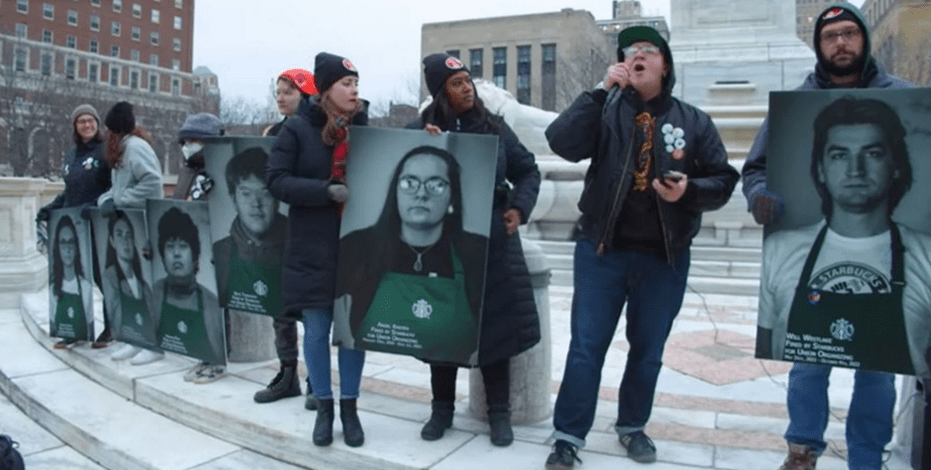
Americans are shifting from lining up at one of the country’s most beloved institutions for calming relaxation to assembling to start a call to action. The new documentary, ‘Baristas vs Billionaires,’ is emphasizing the perspective of Starbucks employees. The titular workers are now fearlessly organizing at the long-beloved chain coffeehouse to fight for dignity, fair treatment and a voice on the job.
Academy Award-nominated filmmaker Mark Mori directed the feature. Bob Judson served as the editor on the movie. The duo also produced ‘Baristas vs Billionaires,’ alongside Dennis LA White. Susan Sarandon served as the narrator on the documentary.
Set primarily in Buffalo, New York, ‘Baristas vs Billionaires’ follows workers at the first Starbucks to unionize, along with the Memphis 7 employees fired during union organizing efforts. The iconic coffee brand publicly champions progressive values, but secretly waging an aggressive, illegal campaign to crush union efforts.
Leaked videos from whistleblowers reveal the company’s playbook: deploying a “SWAT team” of out-of-town managers to intimidate and dismantle organizing efforts. The team also retaliates against pro-union workers through harassment, surveillance and termination.
Through exclusive interviews with front-line baristas like Michelle Eisen and Gianna Reeve, and veteran labor organizer Richard Bensinger, the film exposes a stark contradiction between Starbucks’ public image and its behind-the-scenes union busting. Bensinger, with five decades of experience, calls Starbucks one of the most ruthless companies he’s ever faced.
Featuring firsthand accounts and original footage, the doc exposes Starbucks’ anti-union tactics while highlighting a new wave of labor activism. The fight has captured national attention, with congressional hearings and a Senate subpoena forcing CEO Howard Schultz to testify under oath. Even the U.S. Supreme Court has weighed in on a related case, underscoring the movement’s far-reaching implications for American labor.
‘Baristas vs. Billionaires’ will have its Georgia premiere as a Special Presentation of the 50th Annual Atlanta Film Festival (ATLFF 50). The screening will take place this Tuesday, April 28, 2026 at 9:00pm E at the Tara Theatre’s Eddie Auditorium.
The documentary’s selection for ATLFF 50 marks a full-circle moment for Mori, whose first movie, ‘Building Bombs,’ opened the 1989 Atlanta Film and Video Festival (as ATLFF was then known). The documentary, which is narrated by Jane Alexander, later earned an Oscar nomination.
A recent 4K restoration of the filmmaker’s debut feature will play as an ATLFF 50 Legacy Screening directly before ‘Baristas vs. Billionaires.’ ‘Building Bombs’ will screen on Tuesday, April 28 at 7:00pm E at the Tara Theatre’s Eddie Auditorium.
In honor of ‘Baristas vs. Billionaires’ Georgia premiere on Tuesday, Mori, Judson and LA White generously took the time last week to talk about making the feature during an exclusive interview over Zoom. Among other things, the filmmakers discussed why they were compelled to document the Starbucks labor movement in, and how their collaboration shaped, the project.
Film Factual (FF): Dennis, you served as a producer on the new documentary, ‘Baristas vs Billionaires.’ Why were you interested in helping produce the film?
Dennis LA White (DLAW): Well, Roberta Bryant, a co-producer, and I had worked together when I was a host at Fuse Television in New York. She reached out and said, “Dennis, I know you have a lot of industry contacts and do a lot of things. I’d love to have you come on and help with this project.”
That was my introduction to Mark. As we built a relationship, I also became aware of the movement involving Starbucks workers. In many service industry jobs, people don’t have anyone to speak for them. This film gives them a voice and helps get their story out, so I was fully on board.
FF: Speaking of working with Mark, he served as the director on the movie. How did you collaborate with him as the helmer during the production?
DLAW: Mark is a visionary with an incredible work ethic. The team contributes ideas, but his vision is so clear that we mainly support and help refine it. The story tells itself because it’s real, and our job is to bring it to a wider audience.
(Mori joins the Zoom call.)
Markk Mori (MM): Hi Karen. Sorry I’m late.
FF: No problem at all. Thank you for taking the time to join the call. Dennis was just discussing the origin of ‘Baristas vs Billionaires,’ and what interested you all in making it. You served as the director on the documentary. Why did you decide to helm the film?
MM: I worked at Atlantic Steel in the 1970s and gained firsthand experience with unions. I was even fired for political activity and got my job back through the union, so I learned how they function. I’ve always made films that engage with political issues and inspire action. When I saw union drives happening at companies like Amazon, Starbucks, and Apple, I realized this could be a major movement, similar to the labor movement of the 1930s. I wanted to document it from the beginning.
FF: What kind of research did you do on the Starbucks labor movement before, and during, the movie’s production?
MM: We read everything we could find, mostly on social media, and started interviewing baristas. We traveled to places like South Carolina and eventually Buffalo, where the movement began. I believe shooting is part of the research—you discover the story by documenting it.
FF: You all served as producers on ‘Baristas vs Billionaires.’ How did you approach that process together?
DLAW: I see it like a sports team. Mark is the quarterback, and the rest of us fall into place to support his vision. We collaborate to make sure the story is told in the best possible way.
MM: Our producers contributed in different ways. Dennis brought in music and talent, Bob handled much of the cinematography, and others supported development and PR. It was a collective effort.
FF: Speaking of the music, the movie’s score helped amplify the Starbucks employees’ emotions. How did you decide which music to incorporate into the documentary?
MM: Dennis introduced us to artists like Pete Rock, who contributed music. We also worked with composer Wendy Blackstone for the score and licensed a few songs. The mix of styles helps reach a broader audience.
FF: Dennis, like Mark just mentioned, you introduced the rest of the crew to musicians you felt would be a good fit for ‘Baristas vs Billionaires.’ How did you decide what kind of music you thought would be a good fit for the film?
DLAW: Well, when I saw the film, there were certain spots that Mark wanted music for, and so I sent him a lot of music from friends who are in the business. We couldn’t end up using some of their work, so I developed other ideas. We were back and forth about what songs we could get clearance for to include in the film.
Pete Rock, who’s a Grammy-nominated producer and has produced for everybody from Jay-Z to Kanye West, is a real close friend of mine. He just gave us a catalog of music and said, “Have it and use it as you will because I believe in the project.”
I think a lot of people have donated their time, energy and talent to this project because we believe in the movement. That’s what this is really all about.
MM: Like Dennis said, including all these different types of songs is allowing us to reach a broader demographic with the documentary. Besides the hip-hop artists who are really well known, we also worked with Tom Petty
We crossed over into different genres with the music because it’s such an important part of this story. Audio is often forgotten in filmmaking because people become so enamored with visuals, they forget how important the sound is in films.
FF: Besides the score, the visuals in ‘Baristas vs Billionaires’ also helped emphasize the baristas’ determination to unionize. Howd did you work with the movie’s cinematographer, Bob Judson, to determine how you would shoot the documentary?
MM: It was a low-budget project, so we kept it simple. Most of the film was shot by a two-person crew. We focused on interviews and supplemented them with footage and photos from baristas and other sources.
(Judson joins the Zoom call.)
Bob Judson (BJ): Hey there. Sorry I’m late. I had to take care of something.
FF: No problem at all. Thank you for taking the time to join the call. We were just discussing how ‘Baristas vs Billionaires’ visuals helped emphasize the baristas’ determination to unionize. You worked as the film’s cinematographer. During production, how did you decide how you would shoot the movie?
Bob Judson (BJ): It was a scramble. We had to get there. Then the baristas only had a limited amount of time, as some of had to get back to work, or had other things to do.
So we had to scramble to get the lighting and audio done; we had to make sure we recorded good sound and images. Ninety percent of it came out good. But we had a couple of things that went array, mostly because we were scurrying around and didn’t have a full crew.
We shot everything with a film look. We tried to stay away from flat television type lighting because of the subject matter.
We also shot everything in in 4K, to future proof it. Most deliverables now are standard high definition, but we wanted to make sure that when 4K becomes more of the standard that we would be able to repurpose the film.
FF: Bob, you all also served as producers on ‘Baristas vs Billionaires.’ How did you approach producing the documentary together?
BJ: Everyone comes from a very professional discipline, and we all have different backgrounds. So we all brought different expertise and points of view, which strengthened the project. With a small crew, experience and intuition were key to keeping things moving efficiently.
Dennis gave us a lot of great input on the sound and the music, as well as the story lines. Mark and I have worked together in the past, which was a benefit to this experience.
FF: The film features a diverse group of subjects, including Susan Sarandon, Omari Hardwick and Yolanda Whitaker. How did you decide who you would interview?
MM: Well, I just cut Dennis loose and told him to go to work. He’s got some good friends in the business, like Omari Hardwick and Yolanda Whitaker. He got them to step up and make their voice contribution.
With Bob and Mark’s histories and connections in the entertainment business, for them to be able to get Susan Sarandon to narrate for us was a major triumph. With her credits and soothing, calming voice, she was the perfect match for the film. She came in and just helped us out basically for free. That’s what this is all about.
FF: Mark and Bob, you both also served as editors on
‘Baristas vs Billionaires.’ How did you approach producing the documentary together?
MM: I always say, the story is made in the edit. No matter how much time you give yourself, you’re working up to the last minute, especially in a story like this, where change happens every day.
It’s not like a Ken Burns Civil War documentary where things aren’t going to change. This was a very fluid story.
It was edited in several locations over a long period of time, so juggling the media and working within that kind of proximity factor was challenging. It always is, but it came together.
FF: ‘Baristas vs. Billionaires’ is set to screen in the Special Presentation section at the Atlanta Film Festival. What does it mean to you all that the movie is playing at the festival?
MM: Well, it means a lot to me. My first film, ‘Building Bombs,’ was launched at the Atlanta Film Festival in 1989. It went on to win a lot of awards, and eventually received Academy Award nominations. So you could say the Atlanta Film Festival launched my career.
Bob worked with me on that film, which is also showing at the festival along with ‘Baristas vs. Billionaires,’ as a new restoration. So it’s a homecoming for me—my first film premiered at the festival. Now, after about 40 years, my most recent film is also playing there.
FF: After ‘Baristas vs. Billionaires’ plays at ATLFF, how else will you screen the feature?
MM: Well, we will be at the Real Work Labor Film Festival in Santa Cruz, California on April 29, and at the Museum of Contemporary Art in Jacksonville, Florida on June 20. There are more things in the works that we’ll announce as details are confirmed.
BJ: I also want to say the film is available now to libraries, including university and public libraries. We’re also doing grassroots distribution to community groups, churches and local unions. Anyone around the country can get in touch with us and organize a local screening.
We also encourage people to check our website for updates on screenings and how to support the film.

