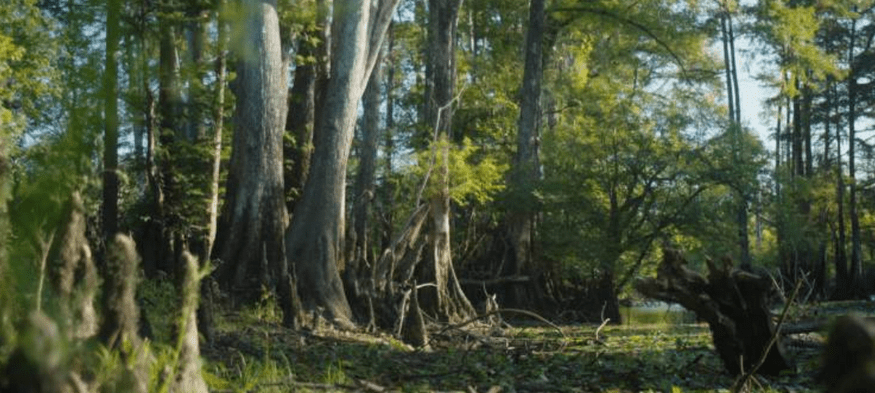
Society often tells people they need to grow up, but the media is now encouraging them not to let go of their childhoods. The new political documentary, ‘Frogtown,’ balances that wholesome absurdity with a gentle undercurrent of melancholy. The movie showcases how the titular town’s eccentric residents possess a genuine depth and humanity.
Atlanta-based filmmaker Costa Karalis made his feature film directorial debut on the project. He also wrote and edited the documentary. Laurel Collins, Serra Naiman and Ruby Bailey appear in the movie.
‘Frogtown’ follows a woman’s obsessive drive to prove the existence of a magical swamp creature she befriended as a child. Set in a small Florida town, home to 5,000 dreamers, and told from the POV of an Atlanta-based documentary crew, the film blends truth and fiction like no other. The movie encourages viewers to question what’s real and what’s not, and wonder when they let go of their own childlike imagination.
‘Frogtown’ will have its Georgia Premiere in the Georgia Film section at the 50th Atlanta Film Festival today, Saturday, April 25 at 3:15pm ET. The screening will be held at the Tara Theatre’s Jack Auditorium. In honor of the movie’s Georgia premiere this afternoon, Karalis generously took the time earlier this week to talk about scribing, helming and editing the feature during an exclusive interview over Zoom.
Film Factual (FF): You wrote the new political documentary, ‘Frogtown.’ Why were you inspired to make the film?
Costa Karalis (CK): What started this whole process was watching videos of myself when I was younger. My mom found home videos of me as a little kid, around seven-years-old. I noticed I ran around the house with this energy, imagination and creativity that I still have today in some ways, but not as much. I started to wonder where that feeling went.
I was jumping off couches and engaging with this imaginary world that we don’t really see as adults. That led me down a path of questioning where that wonder goes, talking to people about imagination and childhood belief.
The movie was born from that feeling. I decided the best way to answer that question was to talk to as many people as possible. In the film, you see around 10 to 12 people, but we actually talked to about 60 people in the town. You’re seeing my favorite interviews.
I learned that a lot of people have let that wonder go, and a lot have kept it. It was a great process exploring that.
FF: Speaking of the people you interviewed, Laurel Collins, Serra Naiman and Ruby Bailey are amongst the who appear in the movie. How did you decide who to speak with and what questions to ask them?
CK: My producer, Evan Barber, is from Frogtown. When we went there, it was easy to find our first subjects because he knew everyone. He’d say, “You have to talk to this person down the street.”
A lot of people who ended up in the movie weren’t the first ones we met. We’d spend hours with someone, and the last question I’d always ask was, “Do you know anyone else we should talk to?” In a small town, that cascades until you’ve talked to everyone.
We had a plan, but it changed every day. One person would lead to another. Making the film was an adventure. Our philosophy was that if anyone wanted to sit down with us, we would make it happen.
Choosing who ended up in the film was difficult. It took over two years to edit because so many people had meaningful things to say. We had to be meticulous about what made it into the final cut.
FF: Speaking about the editing process, you also served as the documentary’s editor. How did you approach shaping the final story during post-production?
CK: We had over 100 hours of footage for a 90-minute film, which is about one percent of what we shot. That’s more typical for documentaries, but I had never edited a feature-length documentary before. I initially thought it would take six months, which was naive.
I was working other jobs while editing, so I couldn’t focus on it full-time. We would put together cuts that felt strange, then bring in friends to watch it and give feedback. I’d study their reactions and take notes. We repeated this process many times over two years.
Eventually, we felt comfortable showing it to an audience. We had our world premiere at Florida Film Festival (last weekend, April 18-19). It was a full house, and people enjoyed it. We only got there because of years of small test screenings and iterations.
FF: Speaking of the Florida Film Festival, ‘Frogtown’ had its World Premiere at the festival (last Saturday, April 18). What was the experience like of filming and debuting the movie in Florida?
CK: We premiered in Orlando at the Florida Film Fest after we shot the documentary in Marianna, which is about 30–40 minutes from the Florida-Georgia border. Since we shot and premiered the movie in Florida, it has a regional identity.
The premiere was special because people connected with it on a personal level. Many said the sounds and people reminded them of home. That’s exactly what we wanted – to bring people back to their childhood selves. For those who grew up in the Southeast, I think the film really resonates.
FF: You and the most of the crew are based in Atlanta. With ‘Frogtown’ having its Georgia premiere at the Atlanta Film Festival, what does it mean to you all that the documentary is playing at your hometown festival?
CK: It’s the festival’s 50th year, which makes it a huge honor. I’ve attended the festival for five years since moving to Atlanta. It’s a place where the independent film community comes together.
This is my first time bringing my own feature to the festival. The team was so excited when we got in. I love these spaces and what they represent. My hope is that people discover the film, maybe stumble into it, and give it a chance. My dream is to have a line out the door and run out of seats!
KB: Besides penning and editing the movie, you also served as the director. How did you approach helming each other?
CK: Most people in the film aren’t actors – they’re real people. My goal was to be a good listener. When meeting someone for the first time, I had about 20 minutes to make them feel comfortable on camera.
Once they relaxed, I could guide them. I would ask them to rephrase something or clarify a thought. I was always thinking about the edit, trying to capture strong sound bites. That’s challenging with non-actors.
FF: Like you, most of the crew who worked on ‘Frogtown’ are based in Atlanta. What was your experience like of working with them, especially the documentary’s producer, Evan Barber?
CK: Working with this team was truly the backbone of the film. As our producer, Evan was essential in every sense. Because he grew up in the town, he brought an authenticity that shaped every decision we made—nothing moved forward without his perspective.
We kept the crew very small, never more than seven people, which made the process feel intimate and collaborative. Evan’s deep knowledge of the area guided us constantly, from finding locations to connecting with people. That kind of insight is something you can’t replicate.
It really reinforced something I believe strongly: when you can, make films in places that you or your collaborators know deeply. That connection shows up on screen, and for ‘Frogtown,’ it made all the difference.