
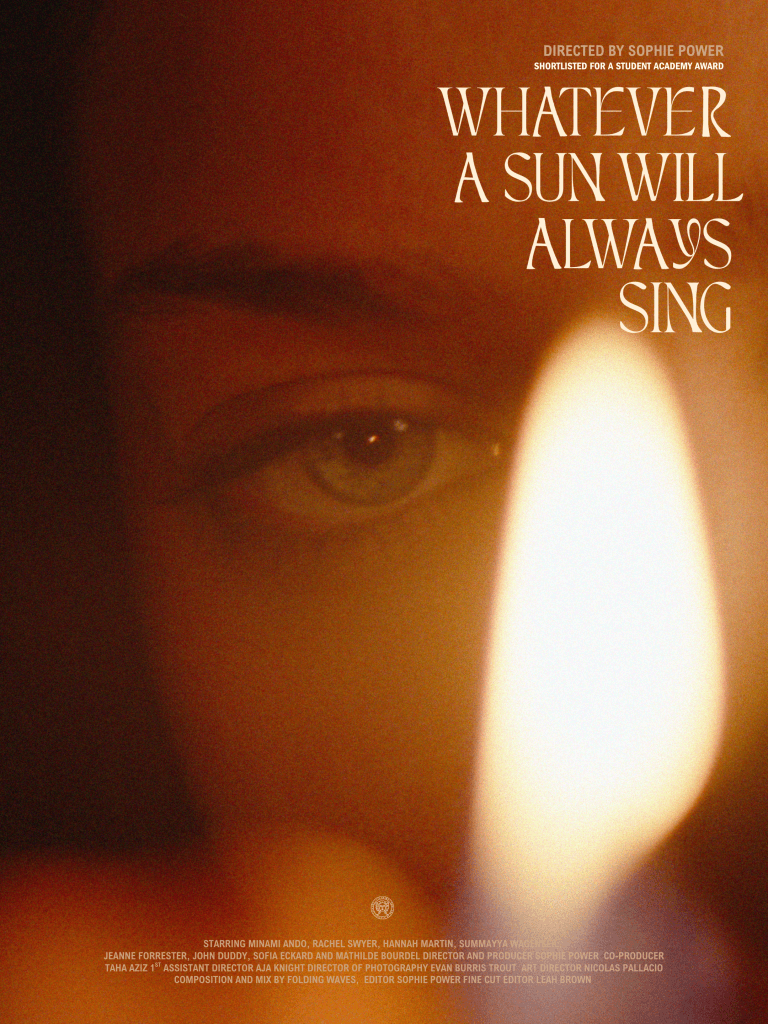
The most experimental movies often offer an emotionally layered meditation on the tenderness, grief, shame, love and resilience that shape young women’s journeys into adulthood. The new short film, ‘Whatever A Sun Will Always Sing,’ is a perfect example, as it blends anonymous confessional storytelling with immersive visual and sonic landscapes.
The 11-minute project reimagines pivotal moments of growth through a series of raw, cathartic performances. Those portrayals reflect the importance of amplifying underrepresented voices through emotionally resonant cinema.
Sophie Power directed, produced and edited the movie, which is presented in English and Japanese. The Irish filmmaker is currently based in New York City. She was recently shortlisted by the Academy for the Student Academy Awards for helming the project.
‘Whatever A Sun Will Always Sing’ will screen next Wednesday, May 20 in Palais F at the Palace of Festivals and Congresses of Cannes during the Cannes Film Festival. The project will play at the estival as part of the Short Film Corner / Cinéma de Demain program.
Following four stories, ‘Whatever A Sun Will Always Sing’ is an experimental hybrid film that follows the tenderness of young women’s journeys into adulthood. Cathartic in nature, the film’s narrative is drawn from four anonymous confessions to the question: What was the pivotal moment where you were forced to grow up? The formative moments are reimagined through actors who bring these memories to life. Each tale serves as a thread, which creates a tapestry of powerful expressions of personal truth.
Power generously took the time recently to talk about helming, producing and editing ‘Whatever A Sun Will Always Sing’ during a Zoom interview. Among other things, she explained that the project was inspired by her desire to ethically and intimately tell women’s stories through anonymous confessional interviews about pivotal moments of growing up. She also discussed the collaborative filmmaking process, including casting actors to embody real experiences, one of which was her own story.
Film Factual (FF): You created the new experimental hybrid film, ‘Whatever A Sun Will Always Sing.’ What was your inspiration in making the shorts during the project’s development?
Sophie Power (SP): Well, I always really knew I wanted to tell women’s stories. I was very focused on that from the very beginning.
One thing I was very drawn to in my inspirations is the tenderness that comes with creating intimate films with confessional pieces.
So I had a couple of different films I was watching at the time and felt very strongly drawn to. One of them is by a director duo called Luna, an Irish directing duo (composed of Luke Daly and Nathan Fagan). I’m also Irish – I don’t know if you can tell by my accent!
Luna created a beautiful experimental piece, ‘Skin to Skin,‘ which explores something a little hidden: hookup culture on dating apps in the LGBTQ+ community. But it was their honest portrayal of connection through confessional pieces that really moved me. Honestly, every time I see it, I’m almost moved to tears because it’s just so beautiful.
I knew I wanted to do something similar, and make a film about women’s stories, especially growing up as a woman. I wanted to unpack the complex emotions and experiences we have growing up.
But I wasn’t really sure how to do it. Then it came to me: why don’t I just ask one simple question and see where that takes me?
So I took to the streets and decided to interview a cross-section of society – women of every age and background. I wanted to meet as many women as I possibly could and ask them the same question: What was the pivotal moment you were forced to grow up?
This is a challenging question. I’m sure if someone asked you this, you’d probably feel the same way – you definitely need to think on it for a moment.
What I found was that I was having a myriad of experiences come forward. There were really special moments, as well as some moments that were a bit traumatic. But there were also a lot of joyous moments. I really wanted to capture that complexity – the myriad of emotions.
So in the film, one story deals with grief, another with shame. There are also stories of love and coming into oneself. I really wanted to capture the whole variety of what it is to grow up as a woman.
It was such an honor to be trusted with these women’s stories. They were completely anonymous, but they were very aware that their stories would be visualized.
The best thing I found was allowing them complete anonymity in retelling what they went through. That process allowed them to open up completely without fear or judgment.
I think women often find that their stories can be silenced or shrouded in shame. So it was just such an amazing experience to be gifted these stories and tell them ethically.
FF: The project features an ensemble cast, including Minami Ando and Sofia Eckard. How did you decide who to cast in the shorts?
SP: I obviously had all the stories, which were anonymous, and then I had to reimagine those memories with actors. That was challenging because I’m primarily a documentary director.
But it turned out to be super fun. I really had to tap into my imagination and think deeply about who would resonate best with each role and who would be the best person to tell it.
In the first story, we have Minami Ando as the actress. She’s from Japan herself and also lives in New York. The story came from a Japanese immigrant living in New York, and I felt like she could really do the story justice because she had a similar background.
Minami is also incredibly talented with emotional delivery. She’s primarily a dancer, but she uses her body and expressions in a way that gives a lot of emotion and depth. So I thought she was the perfect match for that role.
So the process was mainly thinking about who could be a good fit and reaching out to actresses that way. They were all super excited.
Actually, one of the big stars of the film was the baby at the very end. We had such a big age range in the cast, but Sofia Eckard plays the little girl, and she was so great on set.
That story is really special to me because it’s actually my story. I decided to put myself into the film and tell the tale of the moment I grew up – when I became the caretaker instead of the person being cared for.
It felt very cathartic to tell. Casting it was challenging, though, because I had to cast myself, essentially. But I had a good connection with every girl at the different ages portrayed. Sophia’s parents were so lovely to work with, and she kept laughing the whole way through the shoot, so it felt like a good omen.
FF: What does it mean to see your own story on screen through an actress portraying elements of your life?
SP:I wasn’t expecting to put my own story in the film. I realized about 90 percent of the way through making the film that it probably made sense for me to include it.
At first, I didn’t fully understand why I was making the film. It was something that was just pouring out of me. Then when I finally thought about my own response to the question, I realized: Okay, this is why I’m making this.
I went to my friend Jeanne Forrester, who’s one of the actresses in the film. We’re from the same part of Ireland – our family homes are very close to each other – and I asked if she’d play me. I was really grateful that she accepted.
It was a strange feeling seeing it on screen, but it’s probably the part of the film I get most emotional about. It was definitely cathartic.
FF: You served as the director on ‘Whatever A Sun Will Always Sing.’ How did you approach helming he film?
SP: It was my first time directing a set that big. We had approximately 40 people, a really short time frame and a lot of location changes.
But directing felt really natural. Honestly, the collaboration process was amazing. Everyone had such an important role, and I really felt like everybody was working in unison. Seeing the vision come to life on screen felt like a little miracle.
My DoP (Director of Photography), Evan Burris Trout, is just incredible – he could point the camera anywhere and make magic happen. We had this kind of symbiosis where we were working in a flow state together. This was the first time I’d really experienced that on set.
Usually I produce, so it was so cool to be creatively directing. It was an amazing experience and I was really grateful.
FF: Speaking about working with Evan Burris Trout as your DP, how did you collaborate on set to determine how you visually shoot the project?
SP:A lot of the time we would sit down at the start of the day and map out the lighting and camera direction. We worked quite intuitively.
It wasn’t heavily planned in the sense that I had a very strong vision for how I wanted it to feel, but a lot of decisions were made in the moment together. Before each scene we’d huddle for 15 or 20 minutes and really get into the emotional depth of what we were trying to say.
We also had a huge lighting team, grip team and production design team. So it was a massive collaborative effort.
Evan primarily works as a commercial videographer, so the aesthetic was definitely different from traditional documentary work. I was really keen to do something experimental and cross-disciplinary because I felt like a traditional talking-head documentary wouldn’t do the stories justice.
FF: How did the locations and production design also help tell the stories?
SP: We got really lucky because we found this retro house from the ’60s or ’70s in New York. It had so many different rooms that served different parts of the film.
We also filmed in this beautiful gothic-style school location for one of the darker stories. I felt that environment really matched the anxiety and tension in the story.
We were very mindful of making sure the spaces aligned emotionally with each story – whether that was warmth and comfort in a bright ’70s-style room, or anxiety and pressure in a dark gothic room.
Our art director, Nicholas Palacio, was really helpful in sourcing these locations. The spaces really helped amplify the emotional tone of the stories.
FF: Besides directing ‘Whatever A Sun Will Always Sing,’ you also served as the producer. How did you balance helming and producing the movie during the shoot?
SP: I’ve been producing for about six or seven years, primarily with brands like Carhartt and Converse. A lot of that work involved logistics, organization and booking crews, so those skills really helped get this project off the ground.
The biggest advantage was being familiar with pitching, including creating pitch decks. I knew how to cohesively present the story I wanted to tell, and that helped me secure collaborators like Evan.
My co-producer, Taha Aziz, was also incredible. He mainly handled producing on set so I could focus more on directing creatively, which was really great.
FF: How did you approach putting all the stories together during the film’s editing process?
SP: I actually ended up editing it myself. I also worked with a great editor named Leah R. Brown for the fine cut.
The process was emotional. I was really trying to cut on moments where the expressions felt the most personal and intimate.
It’s a huge responsibility to be entrusted with these women’s stories, so I wanted to do them justice. I was very meticulous about the editing and trying to tap into how the women truly felt emotionally.
The process flowed pretty naturally overall. I think the hardest part was color grading because I did that myself too. It was definitely a learning curve, but it was fun to learn. My co-producer Taha gave me a lot of helpful input.
FF: Whatever A Sun Will Always Sing’ will screen during this year’s Cannes Film Festival. What does it mean to you to share the project at the festival?
SP:I’m super excited. We’re screening as part of the Short Film Corner, which is a curated catalog by Cannes. We’ll be screening on Wednesday the 20th in the Palace of Festivals and Congresses of Cannes.
It’s my first time attending the Cannes Film Festival, so I’m really excited to network and meet different filmmakers, especially emerging filmmakers.
It’s such a great feeling to have made something and have people watching it. Getting other eyes on the film makes all the hard work feel worthwhile.
 Film Factual