
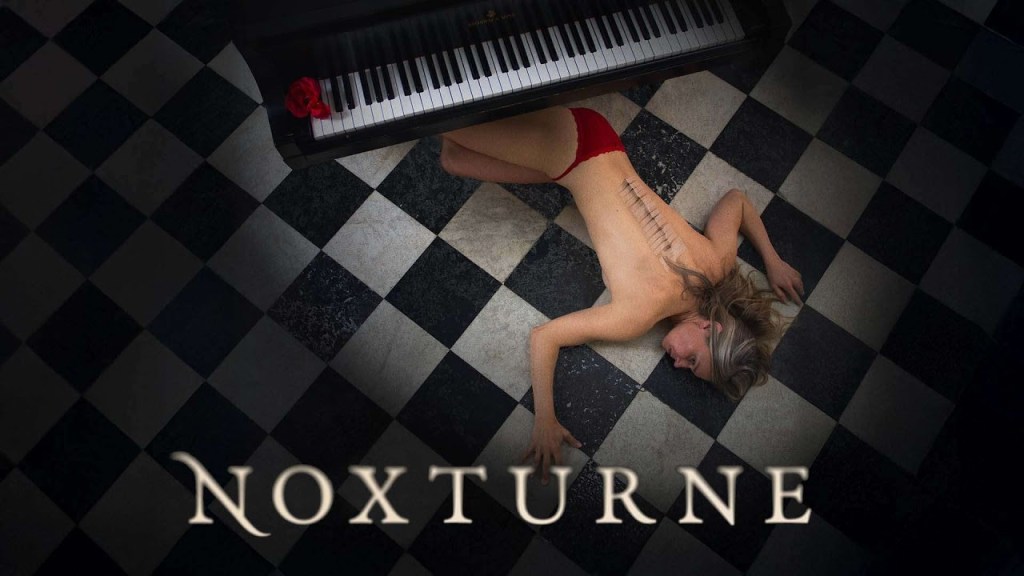
The journey of healing from a terrifying experience can be deeply traumatic. Actress Kristina Klebe’s protagonist of Mia Nox in the new psychological thriller, ‘Noxturne,’ learns that vital lesson as she contemplates how true recovery requires confronting the phantoms of the past.
The project had its World Premiere at the Big Apple Film Festival last Thursday, May 14. The feature will be introduced to international buyers at the Marché du Film during the 2026 Cannes Film Festival.
Besides starring in the project, Klebe also wrote, produced and made her feature film directorial debut on ‘Noxturne.’ She based the story on her own recovery after experiencing ea life-altering spinal injury. The filmmaker was joined on screen by an ensemble cast, including Byron Clohessy, Laila Robins, Siobhan Fallon Hogan, Robert Clohessy and Kim Director.
‘Noxturne’ follows Mia, a concert pianist who’s famous for wooing audiences with her renditions of ‘Chopin’s Nocturnes.’ She also has a brazen, new lover by her side as she dreams more than ever of reinventing herself.
Just a week away from a solo performance at Carnegie Hall though, Mia’s dream is interrupted when a freak accident causes her thoracic spine to shatter. Suddenly, she’s left unable to press the pedals and finds herself in the care of a man a decade her junior.
His motives grow suspicious as time passes. He books a coveted audition at Lincoln Center, signs with her manager and is seen dallying with another woman. Desperately waiting to regain feeling in her legs, Mia’s physical wounds begin to creep more than skin-deep as she questions whether the man she loved is slowly taking everything that once was hers.
Klebe generously took the time the day after ‘Noxturne’ premiered at the Big Apple Film Festival to talk about penning, helming, producing and starring in the project. Among other things, the filmmaker discussed how her recovery from her spinal injury influenced how she crafted the drama’s story. She also mentioned how she approached collaborating with the movie’s cinematographer, Jendra Jarnagin, and composer, Holly Amber Church, to create the intimate, visually stylized New York indie feature.
Film Factual (FF): You wrote the script for the new psychological thriller, ‘Noxturne,’ which you based on your own recovery after a life-altering spinal injury. Why did you decide to make the film, and how did you approach penning the story?
Kristina Klebe (KK): I broke my back in 2022 and was laid up for a good couple of weeks, really stuck on my back. During that time, one of my friends reminded me that Frida Kahlo made a lot of self-portraits while going through difficult ailments and periods in her life. He told me, “Why don’t you use this time to think about the story for your first feature?”
At the same time, my partner was going through a personal struggle with getting sober, which he’d be open about discussing himself. We were both going through a very difficult period, and the story almost wrote itself. I started writing it a couple months later.
The story evolved over the next six to eight months, and then we started shooting about a year later. It was a very fast process.
FF: Besides scribing the screenplay, you also made your feature film directorial debut on the project. How did you approach helming the drama after you wrote the script?
KK: I went to NYU grad school for directing and minored in directing in college. I learned on 16-millimeter film, edited it on Steenbecks and made a lot of shorts. I’ve been working toward making my first feature for so long that it felt like something was ready to burst out of me.
Of course I was nervous. But I think whenever you do something for the first time that you care deeply about, nerves come with it because you want to do well.
Still, I felt prepared. I prepared extensively with my director of photography, Jendra Jarnagin. We storyboarded together for a month before shooting. I’m a very visual person, so I created shot lists. I also shared visual references from other films to communicate how I imagined scenes being framed.
FF: Speaking about the cinematography, how did you create ‘Noxturne’s overall visual style with Jendra Jarnagin?
KK: Jendra told me it was actually my lookbook that sold her on the project because I was so specific about my vision. We had only just met a month earlier, so we were still figuring out how to collaborate together.
She’s an incredible professional who’s worked extensively in television and indie film, and I’m incredibly grateful for her expertise. She elevated the film tremendously.
FF: Besides penning and directing the movie, you also play the protagonist of Mia. The thriller also stars Teresa Avia Lim, Laila Robins, Kim Director and Siobhan Fallon Hogan. How did you cast the film?
KK: A lot of the cast members were friends or people I already knew.
Teresa Avia Lim, who played Maya, came through a recommendation from Laila Robins after they’d worked together in theater. I met Laila through the Classical Theatre of Harlem.
Kim Director and I have known each other since working together on Spike Lee’s “She Hate Me” in the early 2000s, which was actually my first feature film experience. Siobhan Fallon Hogan knew my parents.
It all came together in a very organic way and became this little New York family.
FF: Did you work with the rest of the actors before and during filming to help build your characters together?
KK: We didn’t have much rehearsal time because the production schedule was short and the budget was tight. I did rehearse with Laila Robins because she needed a German accent. I coached her by recording lines and helping her shape the delivery.
My partner Byron and I also rehearsed one of the emotional scenes near the end of the film while I was still writing it. We acted it out together months before shooting, which helped shape the scene.
FF: Besides the cinematography, ‘Noxturne’s score also helped build the tension throughout the feature. How did you work with the drama’s composer, Holly Amber Church, to create the project’s score?
KK: Holly Amber Church completely saved me. We had originally been working with another composer, but creatively it just wasn’t aligning. Holly came in and wrote the score in only two months. She was incredibly professional and collaborative.
We already had some classical music in the film, but she created all of the more magical emotional elements of the soundtrack. My friend Henry Gummer also contributed one of his songs.
FF: You have performed extensively in the Off-Broadway scene in New York City. How did your theater background influence the way you approached making the movie?
KK: I love theater so much. It teaches you how to wear many hats because everyone works together closely. Back when I was doing theater, actors would help with costumes and other production work too.
Theater also teaches you how to truly stay in the moment. Recently I’ve even been thinking it would be amazing to adapt this movie into a musical someday because it would reconnect me with my theater roots.
FF: You also served as a producer on ‘Noxturne.’ How did you balance producing, helming and starring in the thriller all at once?
KK: Producing was honestly the hardest part. If I had only been producing, it would have been manageable, but balancing producing with directing and acting was intense. I’d literally be writing checks during lunch while preparing for the next scene.
One of my biggest accomplishments as a producer was successfully getting a horse into the townhouse location with one of the country’s top animal trainers.
Producing requires managing personalities in a very different way, and sometimes difficult decisions have to be made. I don’t think I’d want to produce again, but I’d happily continue writing, directing and acting.
FF: Lisa Hendricks edited the film. How did you work together to edit the drama and shaping the final cut?
KK: Our editor, Lisa Hendricks, also edited ‘Brooklyn 45,’ which is how we first connected. We assembled a cut and continued making adjustments over the following year.
People always say films are never truly finished – you just eventually abandon them. I do feel we got the movie to a really strong place. We ended up removing several scenes that no longer felt necessary.
FF: ‘Noxturne’ had its World Premiere at the Big Apple Film Festival in New York City. What does it mean to you that the drama premiered at the festival?
KK: It was incredibly meaningful. I had friends, family and crew members there from all different parts of my life, and hearing that people connected emotionally to the movie meant everything to me.
What surprised me most was hearing audiences laugh during certain moments. It reminded me that movies really are meant to be experienced communally. Seeing people reacting together in a theater was overwhelming in the best possible way.

