
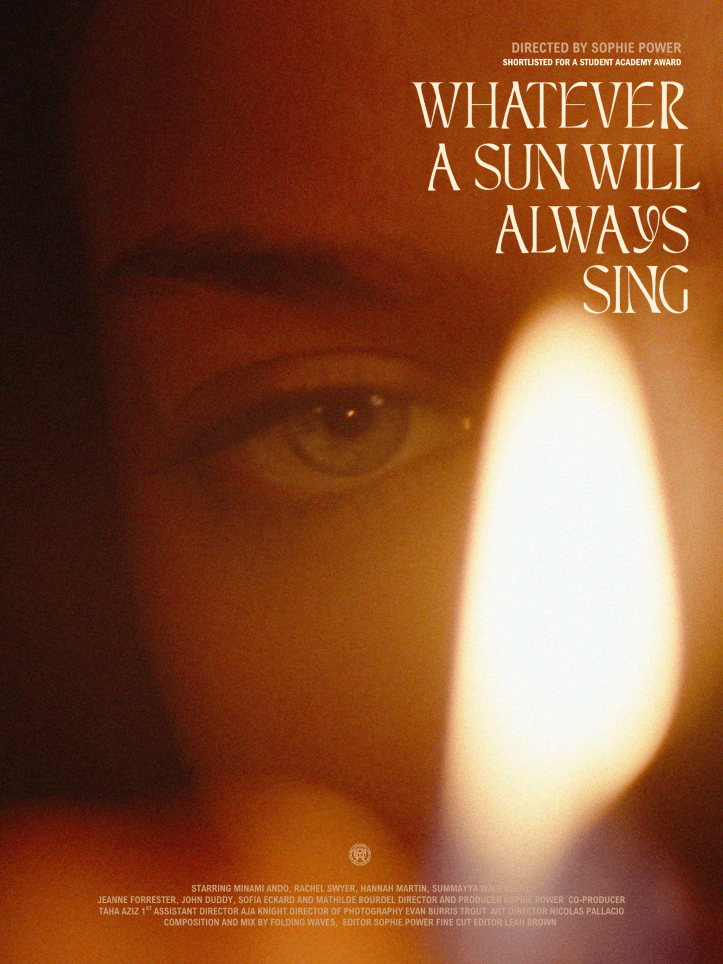
Whatever A Sun Will Always Sing
Director: Sophie Power
Cast: Minami Ando, John Duddy, Sofia Eckard, Hannah Martin, Rachel Swyer and Summayya Wagenseil
Cannes Film Festival Screening: Wednesday, May 20, 2026 in Palais F at the Palace of Festivals and Congresses of Cannes, Cannes, France
‘Whatever A Sun Will Always Sing’ is the kind of film that lingers long after it ends for its innate ability to trust the quiet force of human vulnerability. In an era when so much independent cinema feels compelled to overexplain itself, the new experimental short accomplishes something far more difficult: it creates emotional clarity through restraint.
The movie’s power comes from its confidence in authentic storytelling. It embraces allowing fragmented memories, intimate conversations and moments of stillness to carry the emotional weight that many larger productions struggle to achieve.
Sophie Power directed, produced and edited the short, which is presented in English and Japanese. She brought ‘Whatever A Sun Will Always Sing’ to screen as part of the Short Film Corner / Cinéma de Demain program during the Cannes Film Festival earlier this month.
Following four stories, ‘Whatever A Sun Will Always Sing’ follows the tenderness of young women’s journeys into adulthood. Cathartic in nature, the film’s narrative is drawn from four anonymous confessions to the question: What was the pivotal moment where you were forced to grow up? The formative moments are reimagined through actors who bring these memories to life. Each tale serves as a thread, which creates a tapestry of powerful expressions of personal truth.
From its opening moments, the movie establishes a tone that is both ethereal and deeply grounded. The cinematography from Evan Burris Trout has deservedly become one of the project’s most celebrated elements, capturing faces, bodies and spaces with remarkable tenderness.
Every frame feels intentional without becoming self-conscious. The camera often lingers just long enough to allow emotion to surface naturally, creating a visual rhythm that mirrors the uncertainty and vulnerability of growing up. Light becomes an emotional language throughout the short – sometimes warm and comforting, other times dim and ghostly – contributing to an atmosphere that’s slightly haunting yet intensely beautiful.
What makes the cinematography especially effective is how closely it works in tandem with the editing. Rather than relying on traditional narrative structure, ‘Whatever A Sun Will Always Sing’ unfolds like a collection of emotional impressions. Powers and her fellow editor, Leah R. Brown, blur memories into present moments; s silence interrupts dialogue, those pauses become as meaningful as the movie’s spoken words. The editing does not simply assemble scenes together – it shapes feeling itself.
There is a musicality to the film’s transitions, which are driven by a willingness to let images breathe while still maintaining emotional momentum. The result is a movie that feels less like watching a story unfold and more like inhabiting someone else’s emotional interiority.
‘Whatever A Sun Will Always Sing’ score also deserves immense praise for the subtle but essential role it plays in sustaining the project’s atmosphere. Experimental cinema often risks alienating audiences through abstraction, but the music here acts as an emotional bridge. Sparse, melancholic and at times almost meditative, the score gently guides viewers through moments of grief, longing and quiet resilience without dictating how they should feel. Instead of overwhelming the imagery, it complements the emotional honesty already present in the performances and dialogue. The music becomes another voice in the short – one that speaks softly but leaves a profound impact.
Yet perhaps the movie’s greatest accomplishment is how it prioritizes authentic words and storytelling. The dialogue feels startlingly natural, as though the audience has stumbled into deeply personal conversations rather than scripted scenes. This authenticity gives the film a unique intimacy. The characters speak with hesitation, uncertainty and emotional contradiction in ways that feel profoundly human.
That emotional honesty extends directly into the performances, which are among the strongest aspects of the project. The acting never feels performative in the conventional sense. Instead, the performances are raw, cathartic and completely unfiltered, allowing viewers to experience emotion in its most vulnerable form. There’s a palpable sense that the performers are not simply reciting lines but actively processing grief, love, confusion and memory in real time. This creates a rare emotional immediacy that many polished productions fail to capture.
‘Whatever A Sun Will Always Sing’s exploration of grief is especially affecting because it avoids sensationalism. Rather than presenting grief as a singular, dramatic event, the film understands it as something quieter and more persistent – something that exists in pauses, unfinished thoughts and ordinary moments.
Alongside the sadness is an equally powerful current of tenderness and resilience. The short recognizes the fragility of human connection while also celebrating the small moments of comfort and intimacy that allow people to endure.
Importantly, ‘Whatever A Sun Will Always Sing’ also succeeds as a work of minimalist cinema. It proves that emotional resonance doesn’t require elaborate production design or excessive dialogue. The movie subtlety embraces ambiguity and emotional while also amplifying voices and experiences that are too often marginalized or overlooked in mainstream storytelling. The project’s commitment to underrepresented perspectives never feels performative or politically superficial; instead, it emerges organically through the intimacy of the storytelling itself.
Ultimately, ‘Whatever A Sun Will Always Sing’ is a remarkable achievement in emotionally driven filmmaking. It demonstrates how cinema can move audiences not through excess, but through sincerity, patience and trust in authentic human expression. Through its breathtaking cinematography, evocative score, fluid editing and deeply vulnerable performances, the movie creates an experience that feels intimate, haunting, and profoundly alive. More than just an experimental short, it stands as a moving meditation on grief, love, resilience and the fragile beauty of becoming oneself.
Technical: A-
Acting: A-
Story: B+
Overall: A-

