
Listen to the full Fan Expo Philadelphia 2026 panel, ‘Behind The Scenes of Buffy: James Marsters,’ above.
For many fans, James Marsters will always be Spike – the platinum-haired vampire whose journey from gleeful villain to tortured antihero became one of the defining arcs of ‘Buffy the Vampire Slayer’ and ‘Angel.’
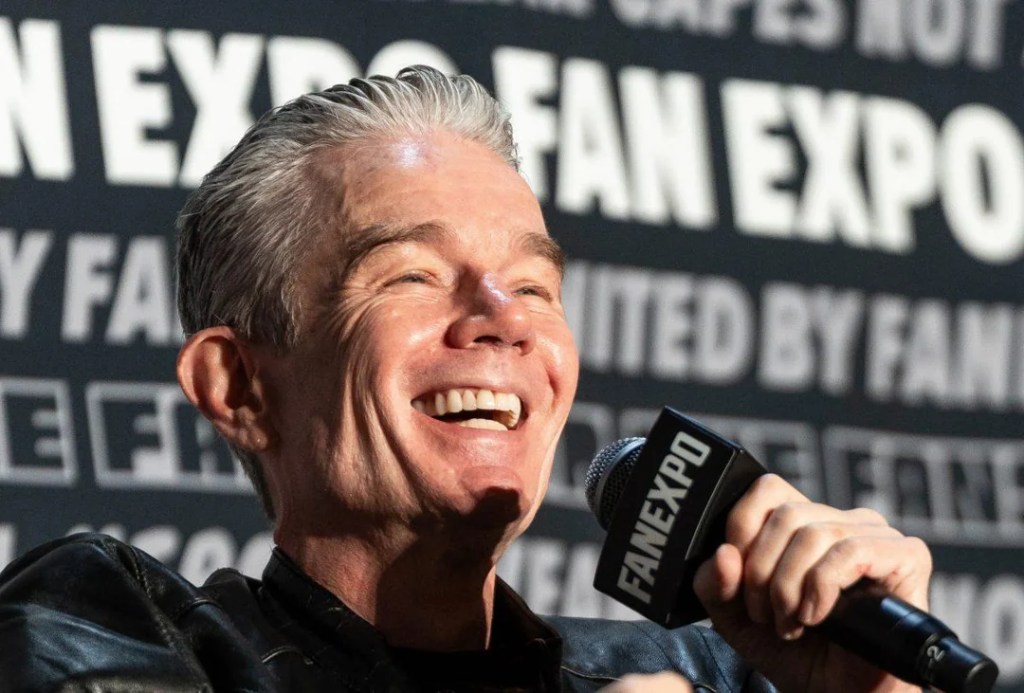
But during his recent appearance at Fan Expo Philadelphia 2026, the actor offered something deeper than nostalgia. The Saturn Awards-winning star generously appeared before a packed audience during the convention at the Pennsylvania Convention Center this past Saturday, May 30. During a panel titled ‘Behind The Scenes of Buffy: James Marsters,’ which was held on the Main Stage, he looked back on the role that changed his life
Marsters spoke about hope, perseverance, parenthood, art and the surprising ways Spike still lives within him, decades after the character first appeared on television.
The conversation quickly moved beyond favorite episodes and memorable one-liners. Instead, it became a reflection on why ‘Buffy’ continues to matter.
Asked why audiences continue returning to ‘Buffy the Vampire Slayer’ after it first premiere almost 30 years ago, in 2997, Marsters pointed to what he sees as the show’s central message. “At the end of the day, I think the theme of ‘Buffy’ is: don’t give up,” he said.
The series, he argued, resonates because it never portrays heroism as effortless. Buffy Summers struggles, fails and sometimes comes dangerously close to surrendering under the weight of her responsibilities.
“The world is messed up, and it hurts to be here sometimes,” Marsters reflected. “But don’t give up. Find something to fight for.”
That fight can take many forms. For Buffy, it was battling vampires and demons. For viewers, it might mean caring for a family member, pursuing a cause, or simply surviving difficult periods of life.
For Marsters, those moments when Buffy nearly breaks are precisely what make her inspiring. “When I watch those moments, I’m reminded of times when I almost gave up and didn’t.”
The actor drew a connection between *Buffy* and another beloved franchise from his youth: *Star Trek*.
Growing up during the Cold War in the 1960s and ‘70s, Marsters found comfort in the optimism of Gene Roddenberry’s future. If ‘Star Trek’ offered hope for humanity’s future, he suggested, ‘Buffy’ teaches audiences how to reach it.
“Star Trek sells hope,” he said. “Buffy sells perseverance. If we’re ever going to get to a ‘Star Trek’ future, we have to not give up today.”
When discussions of a potential reboot in the future surfaced years ago, he rewatched the series to see whether he could still inhabit Spike. What surprised him was how little he remembered.
The reason, he explained, was simple exhaustion.
Producing 22 episodes per season often meant working between 12 and 20 hours a day, a pace that left cast members physically depleted.
“We used to quiz each other at lunch,” he recalled. “‘What scene did we shoot this morning?’ Nobody could remember.”
Fans sometimes interpret actors’ hazy recollections as indifference, but Marsters said the opposite was true. “We cared so much and worked so hard that our memories were wiped clean.”
Spike entered ‘Buffy’ durign Season 2 as a swaggering villain intended to shake up the series. Instead, he became one of television’s most beloved characters. Marsters believes that occurred because audiences responded to one simple thing: he was having fun.
Coming from a theater background, he embraced the idea that acting should feel like play rather than labor. “I realized I had to have fun being evil,” he said.
That meant honestly exploring the appeal of Spike’s reckless freedom – the thrill of ignoring rules and consequences. Rather than judging the character, Marsters committed fully to understanding him. “I was having a blast, and I think audiences could feel that.”
His perspective on heroes and villains remains nuanced. “Being a hero is helping someone even when it costs you something,” he explained. “Being a villain is causing unnecessary suffering.”
Then, with characteristic humor, he added: “I’ve done both. So am I a hero or a villain? Depends on what time it is.”
Few Spike moments are quoted more frequently than his iconic entrance after receiving the Initiative chip: “Out for a walk… bitch.”
Fans often assume the line was improvised, but it wasn’t. Marsters was quick to credit ‘Buffy’s writers, describing them as exceptionally meticulous craftsmen. “I didn’t improvise a single word,” he said.
What made the line memorable wasn’t the wording but the emotional truth beneath it. Spike wasn’t trying to be funny – instead, he was embarrassed.
In Marsters’ interpretation, Spike was secretly in love with Buffy and humiliated by his vulnerability. “He’s basically saying, ‘You know why I’m here. Don’t make me say it.’”
That sincerity, he argued, was the secret behind the show’s comedy. “The key to the humor in ‘Buffy’ was that we never played the joke. We played the truth.”
Marsters spent years portraying Spike across both ‘Buffy’ and ‘Angel,’ a rare experience for an actor who began in theater.
The contrast between the two mediums remains striking to him. He compared theater to the creation of Tibetan sand mandalas – beautiful, painstaking works designed to disappear.
But television is different. A successful scene can live indefinitely. “So can every mistake,” he noted.
That permanence created both excitement and anxiety. So while many actors routinely watch playback footage, Marsters eventually stopped.
“It was like eating a half-baked cake,” he joked. Without music, editing, and visual effects, he found the raw footage discouraging.
To preserve the confidence necessary to keep performing, he preferred not to watch. “I needed that illusion to stay brave enough.”
The strongest connection between Marsters and Spike may now exist through music. His band, Ghost of the Robot, recently released a video for the song ‘Civilized Man,’ a project that unexpectedly became a return to the character.
The song originated years earlier while Marsters was filming in Toronto. Frustrated after witnessing someone mistreating extras on a production, he found himself wrestling with anger. “I wanted to hit him,” Marsters admitted. “I didn’t, but I wanted to.”
Instead, he returned to his hotel room and wrote a song about the struggle of remaining civilized when confronted by cruelty.
Over time, he realized the emotions fueling the song were closely tied to the emotional territory he had explored as Spike. “The anger, loneliness, and cynicism I used to create Spike all live inside me somewhere,” he revealed.
That realization inspired a creative experiment. He put on the blond hair, stepped back into Spike’s attitude and transformed the music video into what he laughingly described as “Spike playing rock guitar.”
When online commenters then suggested the video’s appearance might be AI-generated, Marsters responded by filming a quick social media video in character as Spike – proof that both the actor and the abs were entirely real.
Perhaps the most moving moment of the Fan Epo panel came when Marsters discussed what being cast as Spike meant to him personally. Before ‘Buffy,’ he spent years struggling as a working actor. He accepted poverty as part of the profession, often going without health insurance and living on minimal income.
Then he became a father, and everything changed. “The moment I saw him, I knew I had to provide for him,” he shared.
Marsters recalled telling his agents that his priorities had shifted. “I’m not here for awards. I’m here for diapers, doctors and college tuition,” he admitted.
Soon afterward, he landed the role of Spike. Though the salary was only union minimum, it represented financial stability unlike anything he had previously experienced.
He remembers a promotional photo shoot taken shortly after being cast. Fans often interpret Spike’s smile in the image as confidence or swagger.
Marsters sees something entirely different. “What you see in that picture is the smile of a father who suddenly knew his family would be okay,” he said. For the first time in years, he had health insurance. “That’s what that smile is.”
Toward the end of the panel, Marsters was asked which performers inspire him most. His answer revealed a philosophy that seems to connect every part of his career – from Spike to music to theater. “Any actor who doesn’t lie,” he stated.
For Marsters, great acting isn’t about looking cool or appearing flawless. Instead, it’s about exposing imperfection and allowing audiences to see genuine humanity. He cited Meryl Streep, Joaquin Phoenix, Robert De Niro and John Savage as artists whose work feels profoundly honest. “Acting is allowing people to stare at you and still being honest,” he said.
It’s a fitting conclusion for an actor whose most beloved character succeeded for the same reason. Spike wasn’t memorable because he was stylish, dangerous or witty – though he was all of those things. He endured because beneath the leather coat and sharp one-liners was something recognizable: pain, longing, anger, hope and the stubborn refusal to give up.” If Marsters is right, that may be the very reason ‘Buffy the Vampire Slayer’ continues to find new audiences decades later.
 Film Factual