
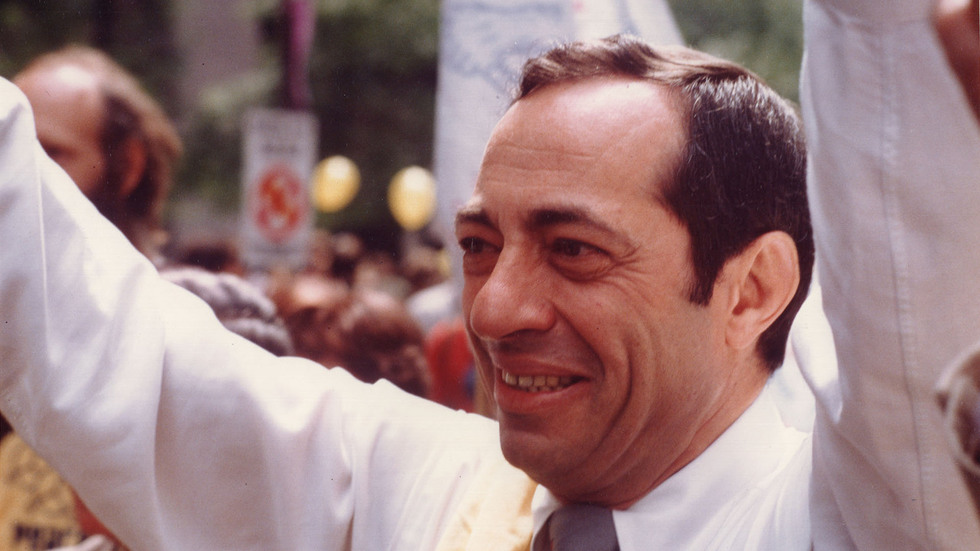
For many Americans, Mario Cuomo remains one of the defining political voices of the late 20th century – a gifted orator whose speeches championed working-class families and challenged the prevailing political currents of the Reagan era. Yet the new documentary, ‘Mario,’ aims to look beyond the public image of the former New York governor and explore the man behind the headlines.
Peter Kunhardt, George Kunhardt, and Teddy Kunhardt directed the movie. They also produced the feature through Life Stories, a division of the Kunhardt Film Foundation.
Set against the backdrop of Ronald Reagan’s America, ‘Mario’ follows the titular politician on his journey from the son of Italian immigrants to a champion for working-class families as Governor of New York. Through unseen archival footage and personal diary entries, the film reveals the complex tension between his deeply held Catholic faith and his progressive battles for abortion rights and AIDS advocacy. More than a political chronicle, the story explores the duality of a leader shaped by intellect and humility as he navigates the delicate balance between public duty and family life.
The documentary also features interviews with Cuomo’s wife Matilda and their children, including Mario, Margaret, Maria, Madeline and Chris. It also features interviews with powerhouse political players including Nancy Pelosi and Michelle Obama.
‘Mario’ is having its World Premiere in the Spotlight Documentary section of this year’s Tribeca Festival. the movie’s premiere screening is being held tonight,Thursday, June 4 at 5:00pm ET at New York City’s SVA Theatre. To help promote the documentary’s premiere at he festival, teddy and George Kunhardt generously took the time o talk about directing and producing the feature.
Film Factual (FF): Together, you directed the new documentary, ‘Mario.’ What inspired you both to helm the film?
Teddy Kunhardt (TK): In 2018, we made a film on President Obama for HBO. During that production, we were spoke with David Axelrod, the former Senior Advisor to President Obama. He pointed us to Mario’s speech as an example of what Obama drew on before his 2004 DNC speech.
Unlike our father, who is from an older generation and was very well versed in Mario, George and I were not. That was actually our first point of entry into listening to the 1984 keynote speech, and we always wanted to do a film about it.
As the country’s 250th birthday is coming up, we knew we wanted to create some programming around it. Then, by happenstance, we were approached by (public relations consultant) Ken Sunshine, who said someone should be making the Mario Cuomo film – and that it should be us. He put us in touch with (Mario’s daughter,) Maria, who watched a few of our films. She said, “If you want our archive, go for it. We’re happy to participate.”
FF: Terry, you mentioned that you both didn’t know too much about Mario before you made the movie. how did you approach researching his life during the documentary’s production?
George Kunhardt (GK): It was amazing. As Teddy said, we didn’t know much at all about Mario. Going into it, sometimes you have a baseline knowledge of a subject matter or a person you’re going to profile. With this one, not having much and having a blank slate was actually a nice, refreshing way to start a documentary.
During the research process, learning that he didn’t know English until he was eight-years-old – he only spoke only Italian – was an amazing entry point into the storytelling for us. Learning about his baseball career and how family was everything to him was amazing. There were so many facets of his personal life that we learned.
All of it stemmed from and was rooted in his diary entries, which we went through exhaustively, studying and reading them in depth. We really learned about the man behind the politician, which is always an exciting part of the process for us.
Top of Form
FF: Along with your father, Peter, you both also served as directors on ‘Mario.’ How did you work together to helm the film?
Bottom of Form
GK: Well, this is actually our 24th or 25th film that we’ve made together, the three of us. It’s not just the three of us – there’s a big team. We have a lot of collaborators, including brilliant producers, editors and people from all walks of life that we work with.
Specifically between the three of us, we divide and conquer in unique ways. Teddy and Peter are the primary interviewers. They do a lot of the frontline work – conducting interviews, shaping the storytelling and leading much of the research, which we all contribute to and balance each other out on.
I manage a lot of the staff and the day-to-day operations side of things, making sure we’re moving smoothly, keeping the creative process moving forward, and maintaining engagement throughout the project. I’m also the primary liaison with the family, making sure all the archives are in place and coordinating everyone’s schedules.
There’s a really nice balance among the three of us when it comes to running an organization. We run a nonprofit called Life Stories. Everything we produce is available free to the public – from our documentaries to our interviews and everything else we do. On top of producing films at the moment, we also have to keep the operation running smoothly. It really does require all three of us, dividing and conquering across every aspect of the work.
TK: I would also add that Peter is the linchpin. He’s the golden star that we follow and have been learning from for the last 18 years. To this day, we still work extremely closely together. We just got off a call with him. We speak every day, and we’re in the office together three days a week. It’s a very healthy, good relationship.
FF: Speaking about the interviews, how did you work together to set up the interviews for the film, and determine who you wanted to speak with to gather more information about Mario?
TK: Well, we knew immediately that we wanted the family. One of the things we’re very happy about with the film is that the public – including us – was very familiar with Chris and Andrew, but not as familiar with the women behind Mario: his wife, Matilda, and his three daughters. We were very excited to speak with all four of them and get their perspectives on their husband and father.
As far as the process goes, the interviews themselves are only about two hours long, but the preparation beforehand takes weeks, if not months. We spend hours and hours in a room going back and forth over questions: Do we want to ask this question to this person? Should we ask that question to someone else? How should we approach it?
Sometimes we even ask each other the same questions. It’s a very collaborative process.
Interestingly enough, we also bring the editor into this phase to see if we’re missing anything or if there’s something they’ll need later in the edit. So it really is a team effort.
FF: Speaking of the editing process, Aleks Gezentsvey and Raven Dahlin edited the movie. How did you work together to put the final version of the film together?
GK: The story evolved a lot. At one point, the film was three hours long, and then we started shaping it in different ways.
For us, one of the hardest things is figuring out the entry point. What’s the first thing the audience sees? We thought it was interesting to start with Reagan and the question of whether Mario would or would not run for president. We felt that was a unique way into the story.
As I mentioned, though, it wasn’t until we focused on the diaries that the film really found its shape. Otherwise, it would have been a very literal documentary – a straightforward biography told chronologically from birth to death.
But by using the diaries as the entry point and as the narrative thread, we were able to reveal the emotional side of Mario. We felt was the most unique aspect of the story. You only get that by seeing his personal reflections read by his children, by seeing the actual documents on screen and by reading what he wrote in his own words.
The editing process was grounded in that part of the storytelling: what he said and did in public versus how he felt behind the scenes and reflected on those experiences privately.
Without those diaries, it would have been a very different story. We were fortunate to have that material.
TK: I would add, too, George, that a lot of my friends, when I explain what we do and the films we’ve made, say, “Oh, you make political films.” But we do not make political films. Our films are really character studies.
We touch on some of Mario’s policies, including his work on AIDS and homelessness, but we don’t get into the minutiae of politics. We want to understand the human being behind the politician.
That’s true of the Obama film. That’s true of the John McCain film. It’s true of any film we make. We want to know who this person is, who this person was, and how they evolved from childhood to adulthood – to the end of their life, or, if they’re still living, to the present day.
When we dive into a story, we’re committing to it for a long time. We typically make a film every year to year and a half, and sometimes a project can take almost two years.
GK: The people we choose to tell stories about are often viewed through the lens of moral leadership. Whether it’s Gloria Steinem, Bryan Stevenson or Tova Friedman, who’s one of the youngest survivors of Auschwitz, we try to find people whose lives can serve as a guiding light.
We look at how they lived, how they led and what lessons can be drawn from their experiences. For us, that’s a very meaningful purpose behind the stories we choose to tell.
FF: ‘Mario’ is having its World Premiere . What does it mean to you that the movie is playing at the festival?
TK: We couldn’t be prouder that the film is premiering at Tribeca. It’s a New York story, about a New York politician, premiering at a New York festival.
We’ve had one film at Tribeca before. It was about the photographer Gordon Parks, but it played at the festival during COVID, so everything was outdoors. We didn’t really get the traditional Tribeca experience. So we’re very excited that we get to have that traditional Tribeca experience with this film. I can’t wait for the public to see it and hear Mario’s important words.

