
Exploring what happens when ordinary people are forced to choose between remaining passive in the face of injustice or risking everything to oppose it is a powerful driving force in many historical war dramas. The new short, ‘The Resistance,’ is one such film that explores the moral consequences of looking away from such oppression and persecution.
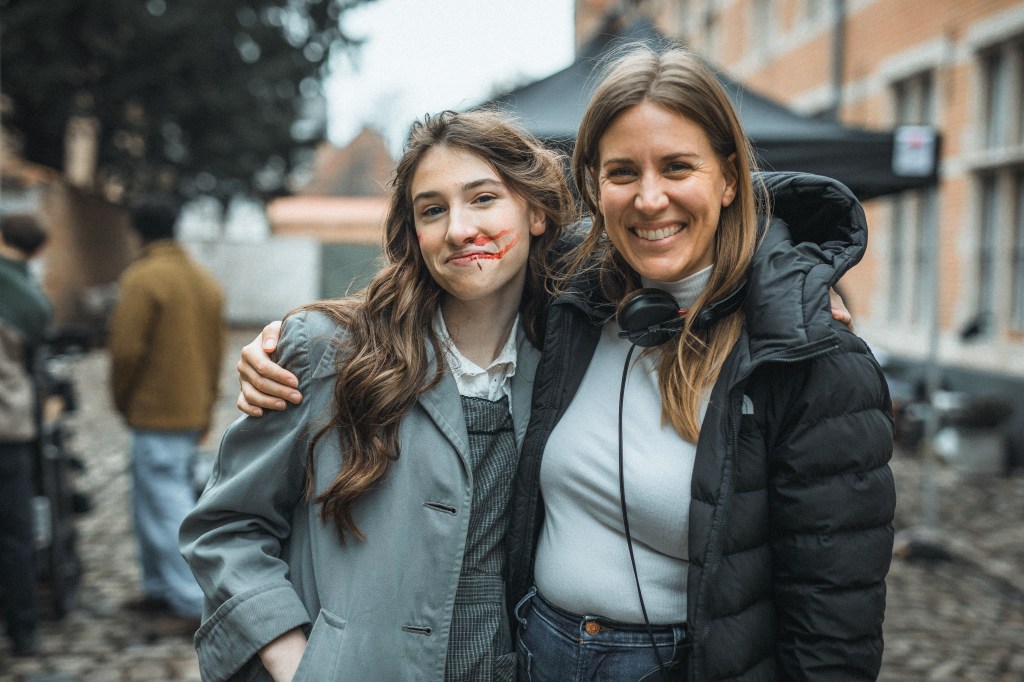
Natalie Schwan wrote and directed ‘The Resistance.’ Ella-June Henrard, Cielke Bessemans, Felix Meyer and Michel Bauwens star in the movie.
The drama was shot in Belgium with a nearly entirely Belgian cast and crew. The 14-minute short was produced by an American production company.
Set in Nazi-occupied Belgium, ‘The Resistance’ follows Eva (Henrard) as her sheltered life becomes fractures. A brutal act of violence forces her to confront the cost of willful denial. Drawn into a covert Resistance group championed by her sister Helene (Bessemans), she finds small ways to help Jewish citizens survive under tightening control.
But as the danger escalates, so does their ambition. Alongside Pierre and Gérard (Meyer and Bauwens), Eva and Helene prepare for a daring operation targeting a prisoner train bound for Auschwitz, an act that could save lives or cost them everything. As night falls, Eva must decide how far she’s willing to go in her newfound defiance.
‘The Resistance’ will have its World Premiere at this month’s Dances With Films: LA. In honor of the movie’s premiere, Schwan generously took the time recently to talk about penning, helming and producing the project during an interview over Zoom.
Film Factual (FF): You wrote the script for the new short film, ‘The Resistance.’ What was your inspiration in penning the screenplay for the drama?
Natalie Schwan (NS): We originally were pursuing funding for Holocaust-specific short films. I started brainstorming different angles I hadn’t really seen before in the genre.
I came across this incredible true story of a train heist in Belgium that I knew nothing about. I loved seeing World War II from a Belgian vantage point, which we don’t typically see in mainstream cinema. I was also drawn to portraying resistance and autonomy within the Holocaust, rather than only a long-suffering resilience narrative – though that is part of it as well. I was especially inspired by the idea of people fighting back.
FF: While you were scribing the script, how did you approach researching and gathering information to help inform the story?
NS: It’s not a very well-known story outside of Belgium. So I only found a few books and articles. But I poured over everything I could get my hands on.
I focused on the broader historical context of the period in Belgium – what the environment was like, what signage looked like and what costumes looked like. There was some material on the resistance group itself, but for this specific event there wasn’t much available.
I did as much research as possible. Once we decided to film on location in Belgium, I relied heavily on our production designer, Linse Van Gool, and local team to help fill in the gaps as an American telling a Belgian historical story.
FF: Speaking of the movie’s production design, how did you choose the locations and building the story’s visual world?
NS: We were very lucky to film on location. My producer, Jessica Olthof, and I originally planned to shoot in the United States, so we explored building historic sets. We eventually realized it would be more cost-effective to bring a small team – five of us – from the U.S. to Belgium.
We filmed in a historic town called Lier, which has largely remained unchanged since the 1920s and 1930s. It felt like stepping into a time capsule. You simply can’t build that kind of world for a short film.
Belgium also has a strong infrastructure for period filmmaking, so we had incredible access to costumes and production design resources. We even shot in a pharmacy that hasn’t been changed since the 1920s. Those kinds of locations are almost impossible to find in the States.
It was really special not only to access that slice of history, but also to film so close to where these events actually took place.
FF: Speaking of the costumes, Sarah Cogan served as the costume designer on ‘The Resistance.’ How did you work together to the looks for the characters while maintaining historical accuracy?
NS: That’s always a challenge, and something I’m very focused on as a filmmaker. There’s some creative license, but I try to stay as accurate as possible.
Our costume designer, Sarah Cogan, is brilliant. She collaborates closely with me to find patterns, colors and details that reflect each character’s inner life on a subliminal level.
For Eva, the lead, we wanted a more naive, youthful feel, so she’s in lighter colors and floral patterns. Her sister Helene, who is more of a leader, is dressed in more structured, tailored 1940s-inspired clothing.
We also used pieces from Sarah’s atelier and rented additional costumes from Paris, which gave us access to incredible period materials.
FF: Further speaking of the visuals, Connor Bodell served as the short’s director of photography. How did you work together determine how you would shoot the film and reflect the time period?
NS: Connor Bodell, our DP, was incredible. I don’t have a technical camera background, so I focus on how I wanted the shot to feel and how I wanted the audience to experience the world.
We talked a lot about creating a claustrophobic feeling in moments of tension. So we decided to have the camera slowly push in to make the audience feel slightly trapped or uneasy.
In contrast, the cityscapes were so beautiful that it was difficult to get a bad shot. We thought of the camera as a way to immerse the audience directly into that world.
FF: Besides the visuals, how did you create the drama’s score and sound design to help build the story’s tension?
NS: Our composer, Clark Rhee, is incredible, and we also had a very strong sound design team. In a period film, sound is especially important because it helps build the world beyond what you see.
I wanted a classical, emotional score – something inspired by composers like James Newton Howard, with a lot of strings and a sweeping, emotive quality.
For sound design, we were intentional about subtle background elements, like distant marching or tanks. We used those sparingly in order to suggest the larger occupation without always showing it visually.
We’ve actually released the soundtrack on Spotify, which has been exciting.
FF: Besides scribing the script, you also directed the movie. How did writing the screenplay influence the way you approached helmed the short? What was your overall directorial style like on the set?
NS: This film was different because we had very little prep time and limited rehearsal with actors outside of Zoom. We basically had to jump straight into filming, which was challenging – especially with jet lag.
I love writing what I direct because I can already visualize the shots. So by the time I get to set, I’ve lived with the material for a long time.
But no matter how much you prepare, you can’t fully predict how things will unfold on set. The collaboration is what makes it special. Everyone brought something I couldn’t have planned for, especially the Belgian crew, which made the project feel more authentic.
FF: ‘The Resistance’ stars Ella-June Henrard, Cielke Bessemans, Felix Meyers and Michel Bauwens. How did you approach casting the film?
NS: We worked with a local casting director through a production fixer company, and they brought in incredible Belgian talent. We were very fortunate with the cast.
FF: How did you build character relationships with limited rehearsal time?
NS: We did what we could in terms of rehearsal, but a lot of it came down to building personal relationships. I tried to meet with the actors one-on-one over coffee to talk through their characters and get to know them.
Those informal conversations helped establish trust and collaboration quickly. Everyone was incredibly committed, despite the logistical challenges.
FF: Besides helming the drama, you also served as a producer. How did you balance your producing and directing duties?
NS: That’s always a challenge. Once we were on set, I had to fully switch out of producing mode and stay in a creative headspace.
My producing partner, Jessica Olthof, handled a lot of the logistical pressure, which allowed me to focus on directing.
FF: Michael Wooldridge served as the editor on ‘The Resistance.’ How did you work together to put the final version of the movie together?
NS: Editing is one of my favorite parts. It often evolves into something better than I expected. A fresh set of eyes makes a huge difference.
Our editor, Michael Wooldridge, hadn’t been on set, so he brought a completely new perspective. He helped identify what was working and what wasn’t in a very honest way, which I really value.
Then you build out music, color and sound, which adds layers and depth to the final piece.
FF: ‘The Resistance’ will have its World Premiere at Dances With Films: LA on June 25. What does it mean to you to premiere the drama at the festival?
NS: It’s very exciting. You never know where a film will land, so to have a world premiere (at Dances With Films) is meaningful. I’ve heard great things about the festival, and I’m looking forward to experiencing it with the audience.
It’s easy as filmmakers to move straight to the next project, so I’m trying to take a moment to appreciate this. This is our first festival, so we’re still early in the process. Our ultimate goal is to develop it into a limited series or longer-form project and continue taking meetings to explore that direction.
‘The Resistance’ will have its World Premiere in the Fusion Shorts Block 7 at Dances With Films: LA on Thursday, June 25, 2026 at 4:00 pm PT. The screening will be held at the TCL Chinese Theater in Hollywood.
 Film Factual