
Satirical docustyle comedies often stand out for their sharp humor and character-driven storytelling. The new series, ‘It’s Getting Late with Owen Reed,’ is a noteworthy addition to the genre, as it explores the tension between public success and private struggles. The show highlights the challenges of pursuing artistic dreams while navigating workplace dynamics and personal relationships. As a result, it offers a relatable and entertaining portrait of people striving to find their place in a fast-paced creative world.
Ryan Dougall wrote and directed the project. He also served as a producer alongside David Fenstersheib and Travis Huber. The comedy stars Marissa Pistone, Jeremiah Watkins, Lance Kinsey, Luke Barnett, Alexa Blair Robertson, Hank Chen, Mark Schroeder, Branden Wilbarger, Abdul Seidu, Honey Lauren and Jared Nathan.
‘It’s Getting Late with Owen Reed’ follows Alex Teller (Pistone), a first-time showrunner trying to hold together a chaotic, low-budget digital late-night talk show. With a crew of eclectic personalities and a host seeking redemption, Alex gambles on an untested, riskier vision to save the show from cancellation.
The concept culminates in a fully improvised live episode performed before a real audience with actual guests and no script. That approach adds an unscripted layer to the series’ fictional world and blurs the line between reality and performance.
‘It’s Getting Late with Owen Reed’ will have its World Premiere at this month’s Dances With Films: LA. In honor of the show’s debut, Dougall recently took the time to discuss scribing, helming and producing the project during a Zoom interview.
Film Factual (FF): You wrote the new comedy series, ‘It’s Getting Late with Owen Reed.’ Why were you inspired to pen the story, and how did you approach creating the show?
Ryan Dougall (KD): The project originally started as an idea from my executive producer. He suggested making a late-night show for YouTube. I wasn’t convinced that a long-form late-night format would work well for YouTube audiences, so I suggested adding a scripted behind-the-scenes element to make it stand out. That’s where the idea originated, and we built it from there.
FF: Speaking about your executive producer, David Fenstersheib, you also worked with him as a producer on the project. How did you work together to pursue production on the comedy?
RD: The process was extremely collaborative, which is something I take pride in. I see myself as the person who assembled all the creative puzzle pieces. Whether behind the camera or working with the cast, collaboration was central to the project.
Many of the characters were inspired by people I’ve met throughout my career in the industry. As outrageous as some of them may seem on screen, they’re rooted in very real situations I’ve witnessed. We also spent a lot of time preparing through meetings, both on Zoom and in person, encouraging the cast to bring elements of their own lives into their characters.
Once everyone understood their roles, we were able to do a tremendous amount of improvisation on set. We ended up with about 16 terabytes of footage, which is enough material for a feature-length film. We captured what was on the page and then gave the cast room to explore and improvise. Everyone brought their best to the project, and we’re very proud of what we accomplished.
FF: Speaking about the actors, ‘It’s Getting Late with Owen Reed’ stars an ensemble cast, which is led by Marissa Pistone. How did you approach casting the series?
RD: Before hiring a casting director, we did a lot of outreach ourselves. Eventually, bringing on a casting director was invaluable because I don’t think we would have discovered some of the performers otherwise.
One of the most exciting parts was how enthusiastic many stand-up comedians were about the project. Even if they didn’t ultimately join, many were willing to read the script and engage with the material.
The casting process began around October 2023. Independent filmmaking takes time because resources are limited, so scheduling and coordination can be challenging. We combined direct outreach with the expertise of our casting director to fill the remaining roles. Along the way, there were scheduling conflicts and last-minute replacements, but that’s part of independent filmmaking.
FF: Once the actors were cast, how did you work with them to balance the humor and emotional depth of the characters?
RD: I wrote the characters based on my own comedic sensibilities, but my goal was to cast people who were funnier, smarter and more experienced in improvisation than I am. That’s why someone like Jeremiah Watkins was such a great choice for the lead role of Owen Reed.
The script served as a strong foundation, but the cast brought so much experience and creativity to their performances. They took the material and elevated it in ways I couldn’t have done alone.
FF: Speaking about the improvisation, how much did the script change once production began?
RD: Structurally, the finished project stayed very close to what we originally wrote. However, many individual scenes and lines evolved during production.
The writing process involved multiple drafts and extensive feedback from friends, family and a small writing team. Their role was less about scripting specific actions and more about helping build the world of the show. Everyone contributed ideas, and that collaborative spirit carried through production and into the final version.
FF: Besides scribing the show, you also served as the director. How did you approach directing the project?
FF: Preparation is essential. Whenever I work on a project, I try to focus my energy on writing and directing while relying on other talented people to handle additional responsibilities. In independent filmmaking, though, everyone wears multiple hats, as unexpected issues constantly arise.
We spent a lot of time preparing with the cast and our director of photography, discussing the themes and goals of the project. Many of our meetings functioned as mini rehearsals. We also held callbacks and in-person sessions with our leads, Marissa and Jeremiah, to ensure they worked well together.
That preparation paid off. By the time we started shooting, everyone understood their characters. We could begin with improvisation exercises to loosen up, then move into the scripted material. Unlike many independent productions that discover the characters during filming, we wanted that work done beforehand. Since we lacked a large budget, we had the advantage of time and used it to prepare thoroughly.
FF: Speaking about the comedy’s director of photography, Bill Palmer, how did you decide on the visual style of the project?
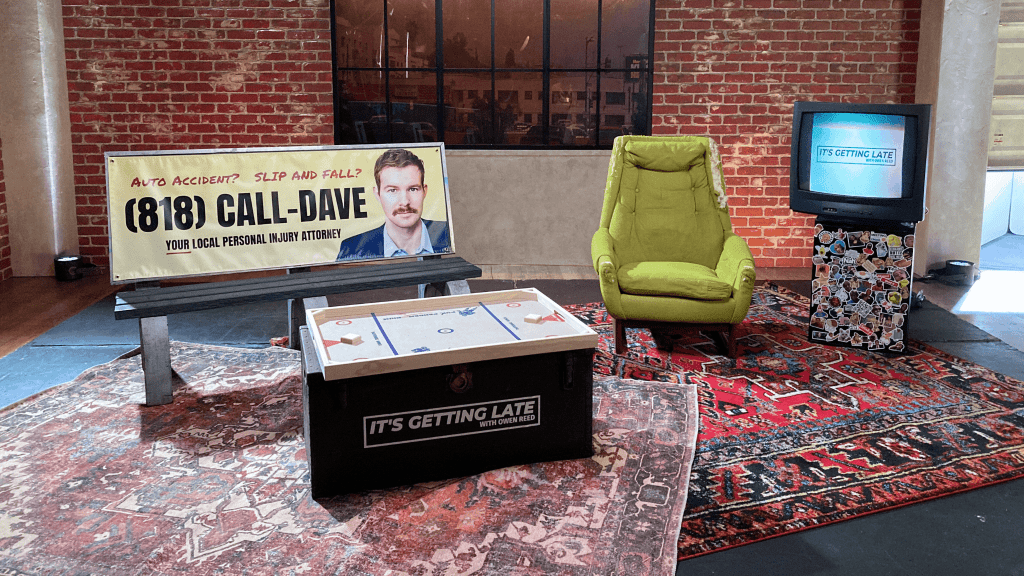
RD: We wanted a rough-around-the-edges, DIY punk-rock aesthetic. We used a lot of camera movement. We also intentionally framed shots with objects partially obstructing the view to create the feeling of being a fly on the wall.
The audience is essentially watching a documentary crew covering the behind-the-scenes chaos of the show. Our director of photography, Bill, and I had worked together for years on ‘America’s Got Talent,’ so he was already familiar with that documentary-style, reality-TV approach.
FF: How did you find the right locations and create the talk-show environment for ‘It’s Getting Late with Owen Reed?’
RD: I called in just about every favor I could from people I’d worked with on ‘America’s Got Talent.’ As a production coordinator, I’ve spent years building relationships with venues, vendors, and crew members.
After six years on the show, I finally took people up on their offers to help. We filmed the talk-show segments at Center Staging in Burbank, a live music rehearsal venue and rental facility. They gave us an incredible deal on the stage and provided support for the live audio production.
Many members of our crew were people I’d worked with before on other projects. Everyone wanted to contribute to something fun and different.
For the interior office set, we found a location in Sherman Oaks that looked like a preserved 1970s office. The outdated look was exactly what we wanted. Some of the exterior scenes were filmed at a storage facility used by one of the shows I work on. We made use of the resources available to us.
FF: Michael Hoffman Jr. served as the editor on the series. Once production wrapped, how did you approach editing and assembling the final version of the pilot?
RD: Editing was the most difficult part. We filmed throughout 2024, with the interior scenes shot during the summer and the talk-show segments filmed in December.
We also created a full-length version of the talk show that’s currently unlisted on YouTube. Festival audiences will be able to access it through a QR code as bonus content.
With 16 terabytes of footage, the challenge was deciding what to include. The original concept was a 30-minute pilot consisting of about ten minutes of scripted material, a talk-show segment in the middle and another ten minutes of scripted content to conclude the story.
However, we had so much strong footage, character development and world-building material that we decided to showcase as much of the world as possible. We wanted audiences to see the potential of the concept and all the directions it could go.
The edit went through multiple versions throughout 2025 before we finally arrived at the current cut.
FF: Speaking about festival audiences, ‘It’s Getting Late with Owen Reed’ will have its World Premiere at this month’s Dances With Films. What does it mean to you that the show is screening at the festival?
RD: It’s been an incredible experience. We’re getting the opportunity to screen our pilot on a big screen at one of the most famous theater complexes in the world, which is exciting for everyone involved.
The festival staff has been fantastic. They’re very communicative, supportive and genuinely invested in helping filmmakers succeed. Everyone involved with Dances With Films has been approachable and encouraging. It truly feels like they’re invested in our success, and I really appreciate that.
‘It’s Getting Late with Owen Reed’ will have its World Premiere in the Series Block 8 at Dances With Films: LA on Saturday, June 27, 2026 at 1:45pm PT. The screening will be held at the TCL Chinese Theater in Hollywood.

