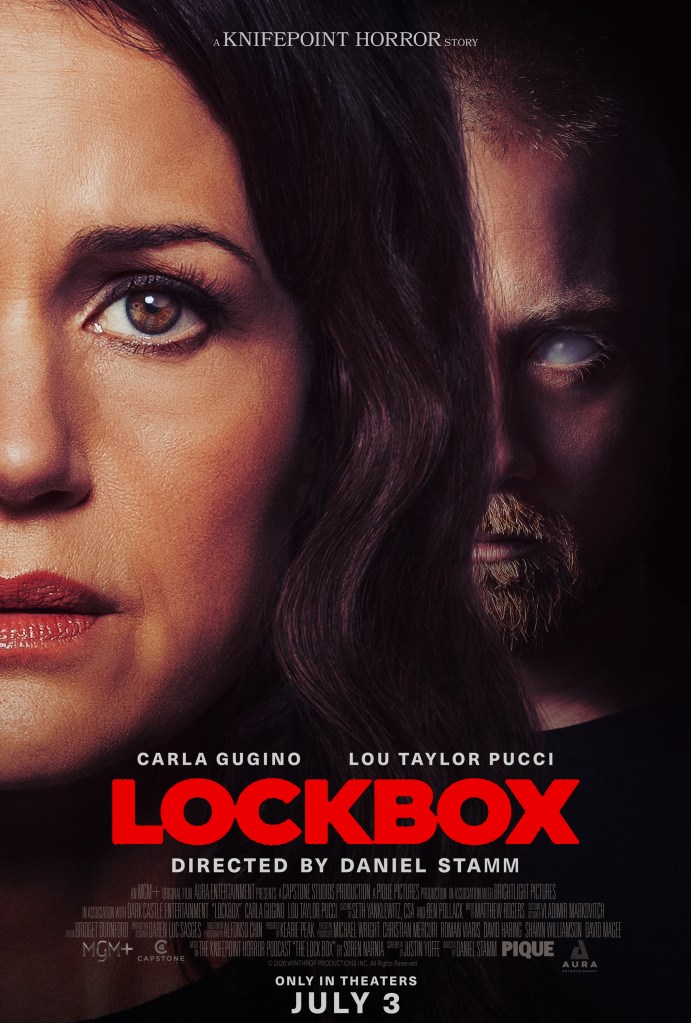
Few filmmakers balance psychological depth and supernatural terror as skillfully as director Daniel Stamm. With his latest horror feature, the possession thriller ‘Lockbox,’ he contends not only with physical scares, but with loss. He ultimately crafted a deeply personal meditation on grief that invites audiences into an intimate emotional journey before slowly revealing something far more disturbing beneath the surface.
Rather than relying on shock alone, the movie demonstrates his enduring belief that the most effective horror emerges from fully realized characters. Their fears, regrets and vulnerabilities make the thriller’s escalating dread feel inescapably human.
Aura Entertainment is releasing ‘Lockbox’ theatrically in the United States today, July 3 in a limited release. After its theatrical run, MGM+ will handle the drama’s worldwide VOD and home entertainment distribution.
‘Lockbox’ is based on the Knifepoint Horror Podcast, ‘The Lock Box,’ by Soren Narnia. The latter co-wrote the feature with Justin Yoffe, which Stamm went on to direct
The film stars several veteran actors of the horror genre. The cast is led by Carla Gugino (‘The Haunting of Hill House,’ ‘Gerald’s Game,’ ‘The Fall of the House of Usher’), Lou Taylor Pucci (‘Evil Dead,’ ‘Touch Me’) and Katharine Isabelle (‘Ginger Snaps,’ ‘Backrooms’).
‘Lockbox’ follows Ellen (Cugino), a woman who’s seeking peace after her mother’s death. As a result, she decides to retreat to a rural town and takes in her severely traumatized cousin Winthrop (Pucci). Their fragile domestic balance shatters when an erratic neighbor warns that Winthrop is dangerous. As strange phenomena escalate, Ellen must put everything on the line to defend Winthrop from a dangerous otherworldly entity determined to track him down.
Stamm generously took the time to talk about helming ‘Lockbox’ during an exclusive interview over Zoom. Among other things, the filmmaker discussed what drew him to the feature’s unpredictable script, his collaborative approach with actors and key creatives, and how careful performances, visual design and production planning helped build the thriller’s suspense and emotional impact. He also reflects on the evolution of modern horror, noting that compelling characters and relationships, and not just scares, are what make the genre resonate with audiences today.
Film Factual (FF): You directed the new supernatural thriller, ‘Lockbox,’ which was written by Soren Narnia and Justin Yoffe. What was it about the script that convinced you to take on helming the possession horror film? What was your overall directorial approach to the drama?
Daniel Stamm (DS): I received the script from my agent, and he usually writes a little cover letter with a paragraph that says what the script is about. But in this case, he didn’t write anything. He just said, “I’m not going to tell you anything about it. You have to read this.”
I’m glad that he didn’t tell me anything because the script has so many twists and turns. It’s so unusual in its structure, and even in its genre. There’s so much to be figured out that I went through this roller coaster the way the audience would, trying to uncover its mysteries.
I just loved it because you usually have the feeling you’ve seen a lot of these stories before. They come in a different costume, but the essence is often the same, so you can predict a lot of stuff. But this was one of those rare occasions where you couldn’t predict anything.
Every five pages, when I had the feeling, “Oh, this is what this movie is,” it would go, “No, it’s not. You think you’ve figured me out, but you haven’t,” and it would go in a completely different direction. There was just a complete joy in reading it, so I immediately knew I wanted to be involved with it.
FF: The movie reveals information gradually while maintaining a strong sense of suspense. How did you approach striking that balance without slowing the pacing?
DS: A lot of it was the awareness that we couldn’t make reliable decisions about it on set because it had to be so fine-tuned. The question throughout the entire film is, “What’s wrong with this guy, Winthrop?” Is he evil? Is he dangerous? Is he a victim? What is the secret that he’s hiding?
Audiences are so attuned to that. If you clearly point their attention to this mystery, then any look, any breath, any rhythm change immediately points them in one direction or another.
What Lou Taylor Pucci, our incredible actor, did was always give me different takes. Here’s the take if I’m the evil guy. Here’s the take if I’m the victim. That’s a very rare thing because usually actors like to keep their performance under enough control that it can’t be completely molded in the editing room.
Lou was totally okay with letting that happen. In the editing room, it was a joy because we had access to fine-tune the engine really acutely since we had all those different performances available.
FF: Speaking about Lou Taylor Pucci’s performance, what was the casting process like for him, as well as Carla Gugino, who played the protagonist of Ellen in ‘Lockbox?’ What qualities were you looking for in each actor, and what made you feel they would work well together on screen?
DS: For Ellen, our protagonist, we wanted someone who has a really quiet strength and who is just watchable, even if she does nothing. For a big part of the movie she’s just observing and trying to figure things out. She’s not necessarily in big action sequences at the beginning of the film.
We also wanted someone whose face you could just spend the movie with, but who also exudes intelligence and, in the end, a faith that we don’t have to signal throughout the entire movie – you just believe it.
Carla was all those things to me. She’s an incredible actress, and she also has so much experience that she has an eye for everything happening on set.
She’ll be the first one to notice if someone is wearing a necklace they weren’t wearing a week ago, or if a window is open in the background and creates a continuity issue. It was almost like having a co-director in the best way because her eyes were everywhere.
Then with Lou, we needed exactly the balance we were talking about. We needed someone you could feel protective of, someone with a childlike softness, but also someone whose physical presence feels dangerous. We wanted the audience to feel that this man could snap Ellen’s neck at any moment, so we didn’t have to constantly reestablish the threat.
We also needed someone who wasn’t afraid to dip into his own darkness because that’s where actors get their material from. Lou was excited from the beginning. He was enthusiastic about the physical transformation. It’s incredible how much he changes just by shaving or not shaving. He loved getting really buff for the movie, and I knew that excitement would carry us through.
The two of them also immediately liked each other. We did one day of rehearsals before shooting. I always want to build intimacy before filming because you can’t ask actors on the first day to pretend they’ve known each other their whole lives.
Instead of rehearsing scenes, I have them bond as people. I use index cards with questions like, “Tell each other a bad joke,” “Tell each other about a time you were ashamed,” “What’s your biggest fear?” or “Tell each other a secret that fewer than five people know.”
Then I leave them alone for two hours. Every single time they come out with a real intimacy and protectiveness toward each other that lasts through the entire shoot. It’s important that I’m not there. I don’t want to know the secrets. They should have something that’s theirs.
That worked beautifully with Lou and Carla. They loved working together, and that was important because our schedule was so short. They had to come in and nail it, and luckily, they did.
FF: Given the limited rehearsal and shooting schedule, how much room was there for the actors to contribute their own ideas or improvise, and how collaborative was that process on set?
DS: The rehearsal process was very collaborative. When you hire smart actors – and most actors are really smart – they become the specialists on their characters. As a director, you’re trying to hold the whole story in your head and know where information is revealed, but the actor is the expert on the character.
I can always turn to them and ask, “What do you think? What does the character think about this?” They’re creative partners, just like my cinematographer is my partner when it comes to light.
I once took an acting workshop with Judith Weston, who wrote Directing Actors. She said something that completely changed the way I direct. She said, “The most powerful words a director can say to actors are, ‘I don’t know.'”
That was completely counterintuitive because in film school it felt like directors had to pretend they knew everything. That’s true when you’re talking to producers or people worried about the budget or schedule, but with creative people, saying “I don’t know” brings them alive.
You’re telling them, “I don’t have it all figured out. Let’s play around and discover it together.”
They were so game. I got calls in the middle of the night with ideas for the next day. They became invested in the whole movie, not just their own roles. There were scenes we’d cut because of time, and they insisted we still shoot them – even scenes they weren’t in – because they thought the other actors were so good. It created a really wonderful spirit on set.
FF: Chad Sayn served as the film’s stunt coordinator. What was your collaboration like with him and the cast in developing the action sequences and the characters’ physicality?
DS: The action sequences are always very much up to the stunt team, which is wonderful. Early in my career, I worried because I didn’t have much experience with stunts. I thought I had to invent everything myself.
Instead, great stunt coordinators would bring in pre-shot videos with different options. Then I could say, “I like option A, but with the headbutt from option C,” and it became another collaboration.
Most of the time, their work is so polished and athletic that I actually want to tone it down. Our characters aren’t military specialists. If I hit someone, I probably wouldn’t even know how to throw the punch properly. I want to see that humanity.
If we’ve spent the whole movie building empathy, the characters can’t suddenly become superheroes. I once asked a stunt coordinator what makes a good stunt, and he said, “Everything that isn’t the stunt.” He meant the close-ups and the character moments between the action. That always stayed with me.
FF: ‘Lockbox’ has a distinct visual style. What conversations did you have with the thriller’s cinematographer, Alfonso Chin, about the look of the feature? How did those ideas shape the way you approached shooting the movie?
DS: The wonderful thing about Alonso Chin, who is a genius cinematographer, is that he’s a complete intellectual and scholar of cinematography and light.
I came in with visual references and color palette references. Usually, those references are just a starting point because once reality, scheduling, and budget take over, you never fully achieve them. But this is the first movie where I feel everything we discussed in theory actually appeared on screen.
Everybody contributed. Alonso did and the production designer did, and everyone was excited to try something new rather than falling back on habits.
Because it’s an MGM movie, we were aiming for that classic MGM look – widescreen, controlled color palettes and controlled camera movement. If we went handheld, there was an emotional reason for it.
To me, what separates a big-budget movie from a small-budget movie is often color control. Independent films often have to find their look in color correction after the fact. Bigger productions can control color on set.
We had one rule across every department: no colors unless discussed. It drove the costume designer crazy because you’re taking away one of their biggest tools, but the idea was that if I put one little green prop on a table, that alone should transform the scene into a green scene. Colors always communicate something, so it’s better to use them intentionally.
FF: Many contemporary horror films place as much emphasis on character development as they do on physical scares. How do you think the genre has changed, and what do you believe makes a horror movie resonate with audiences today?
DS: I agree – I really feel horror movies have shifted over the last few years. The old scream queen stereotype isn’t what horror is anymore.
You have amazing performances now. It’s all about characters and acting. That makes the horror much more effective because you have to make the audience care about the characters before you do horrific things to them.
Today’s horror films take the time to establish relationships, vulnerabilities and fully realized characters. Then the horror set pieces are built on top of that.
I always test a script by asking myself, If I removed every horror element, would there still be a movie I’d want to watch? Are the characters still interesting? Is the story still compelling? With ‘Lockbox,’ the answer was definitely yes.
FF: The locations and production design are integral to the drama’s mood and sense of isolation. What was your collaboration with production designer Daren Luc Sasges like, and how did the two of you develop the look of the drama?
DS: The movie falls into very different parts. The beginning feels grounded in the real world, while the third act becomes much more genre-driven.
That meant endless location scouting and convincing people to shoot in places they’d normally avoid because they were too narrow or difficult to light. By that point, though, everyone was so excited that they were willing to take on those challenges.
Our entire finale, including all the special effects, takes place in a very narrow tunnel where you can barely fit a film crew. It made everything slower and harder, but the look was worth it.
With those set pieces, what you shoot practically is only the foundation. Then you build on it with visual effects, color timing, music and everything else in post-production.
When you’re shooting, none of that exists yet, so you’re constantly telling everyone, “Trust me. We’ll get there.” You’re asking the actors to react to something that isn’t fully there yet because the atmosphere will be created later.
People often ask if it was scary on set, but it couldn’t be less scary. It’s incredibly technical, very slow and all about building layer upon layer. You’re so focused on making everything work that there’s really no time to be scared.