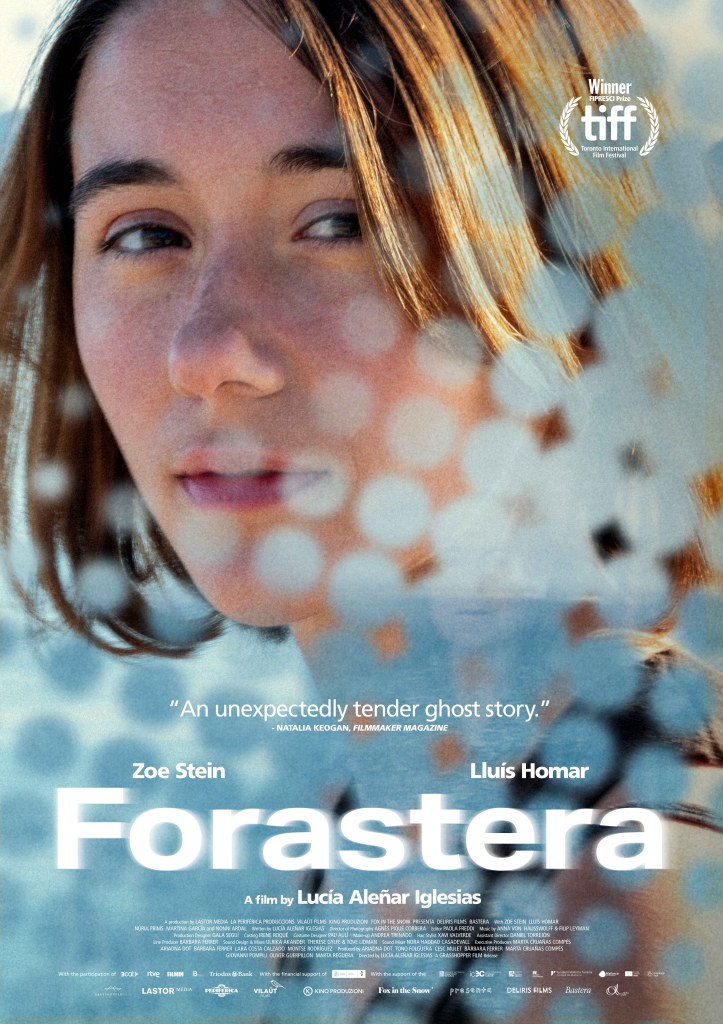
Grief, memory and identity intertwine in ‘Forastera,’ a haunting coming-of-age drama that explores how loss can blur the line between remembrance and reinvention. Through the story of a teenage girl who begins to inhabit the presence of her late grandmother, the new film examines the ways people project the departed onto those still living, searching for connection in the aftermath of death. Set against the striking yet quietly uncanny backdrop of Mallorca, the movie uses its intimate family story to explore the fragile boundaries between love, longing and self-discovery.
Lucía Aleñar Iglesias made her feature film writing and directorial debuts on ‘Forastera.’ The drama stars Zoe Stein, Lluís Homar, Núria Prims, Nonni Ardal and Martina García.
The project had its World Premiere in September in the Discovery section at the 2025 Toronto International Film Festival (TIFF), where it received the prestigious FIPRESCI Prize. Grasshopper Film then acquired the movie’s U.S. theatrical distribution rights the following month.
‘Forastera’s limited theatrical release this has included screenings in New York City, Los Angeles, Houston and Santa Fe. The feature is also opening at the Taos Center for the Arts today, July 8 in Taos, New Mexico, and at Theatre N in Wilmington, Delaware this Saturday, July 11.
Set on the Spanish island of Mallorca, ‘Forastera’ follows Kata (Stein), a teenager spending the summer with her grandparents. After the death of her grandmother, Kata begins to embody the older woman’s mannerisms and identity. As she slips deeper into the role, her family is forced to confront their own unresolved emotions, while Kata wrestles with questions of identity, belonging and the powerful ways people hold onto those they have lost.
Aleñar Iglesias generously took time on the afternoon of ‘Forastera’s second TIFF screening to discuss the drama during an exclusive Zoom interview. Amont other things, she spoke about how her fascination with the ways grief can blur identity inspired the script, as well as her collaborative approach to crafting the film’s haunting visual language. She also reflected on casting Stein and Omar, building authentic family dynamics through rehearsal with them and the excitement of premiering the movie at the Canadian-based festival.
For Aleñar Iglesias, the story began not with a plot, but with a deeply personal feeling. The scribe was fascinated by the strange ways grief can shape perception, particularly the experience of seeing someone who has died reflected in another person. As she developed the screenplay over several years, she realized that the sensation was surprisingly universal.
“I became very interested in the idea of how grief takes us to these eerie places,” the filmmaker explained. “We project our loved ones onto objects, places and even other people.”
That emotional phenomenon became the foundation of ‘Forastera.’ Rather than approaching grief through conventional drama, Aleñar Iglesias chose to explore it through the perspective of adolescence – a period already defined by transformation and experimentation with identity.
Kata’s decision to imitate her late grandmother becomes both an act of mourning and self-discovery. Through that transformation, the writer examined not only how individuals process loss, but how entire families carry grief differently.
Bringing those themes to life required an equally thoughtful visual approach. For Aleñar Iglesias, directing was an opportunity to expand the screenplay through collaboration. She worked closely with her director of photography, costume designer and production designer to create a world that feels simultaneously authentic and quietly unsettling.
The seaside village is picturesque, yet there’s an underlying sense of unease that reflects Kata’s emotional state. “We wanted the town to feel idyllic but also slightly haunted,” the helmer said. “Everything in the visual world was built to support Kata’s experience.”
Casting the film was equally deliberate. Aleñar Iglesias immediately envisioned Stein in the lead role after previously collaborating with the actress on a short film that served as a proof of concept for the feature.
Although Kata evolved significantly between the short and the finished feature, the filmmaker believed Stein possessed the emotional subtlety the character demanded.
“She’s incredibly good at holding back while still drawing the audience in,” Aleñar Iglesias revealed. “She has such a powerful understanding of her emotions.”
The role of Kata’s grandfather was entrusted to acclaimed actor Omar, someone the director had long admired. “It was a dream that he said yes,” she recalled. “He was really moved by the story.”
The ensemble was completed with the help of casting director Eva Leira, bringing together performers including Nora Navas, Marta Angelat and García.
Once production began, rehearsals emphasized physical behavior and shared family history rather than simply dialogue. Aleñar Iglesias worked closely with the actresses portraying Kata and her grandmother to develop subtle gestures, habits, and movements that would create an invisible thread connecting the two characters.
The production itself also fostered genuine closeness among the cast. Since filming took place on an island, the cast and crew spent much of their downtime together, creating a familial atmosphere that naturally informed the relationships seen onscreen.
“One of the advantages of shooting on an island is that everyone stays together,” Aleñar Iglesias said. “You end up creating your own family.”
Mallorca itself plays a central role in ‘Forastera,’ serving as far more than a scenic backdrop. The filmmaker intentionally juxtaposes the island’s breathtaking beauty with the emotional weight of grief, allowing serenity and sorrow to coexist throughout the feature.
The title carries particular significance. ‘Forastera’ translates to “foreigner,” a term Mallorcans often use to describe visitors from mainland Spain. Kata occupies that in-between space – she returns every summer to visit her grandparents, yet never fully belongs.
Aleñar Iglesias was fascinated by exploring the island through the perspective of someone who feels both intimately connected to and fundamentally separated from the place.
Kata moves between bustling tourist areas and quieter local spaces. But she remains conscious of her outsider status, much like she navigates the emotional boundaries within her own family. The island’s omnipresent coastline reinforces that emotional landscape.
“I was interested in the constant presence of the ocean,” the helmer said. “Sometimes it feels overwhelming.”
Premiering ‘Forastera’ before audiences at TIFF proved to be one of the filmmaker’s most rewarding experiences. “I’m so excited to finally watch this film with an audience,” she said. “TIFF is such an incredible platform, and I’m so grateful to have the opportunity to share our film there.”
‘Forastera’ offers a quietly powerful meditation on grief, memory,and identity. Through its richly atmospheric setting, nuanced performances, and emotionally resonant storytelling, Aleñar Iglesias has crafted a feature debut that lingers long after the credits roll, reminding audiences that the people they lose often continue to shape who they become.